Thankfully, The Killing isn’t introducing new murder suspects as we head into the final act of season three: but it isn’t quite working towards one in “Try”, spending half the episode on a manhunt and the second half remembering that there are a whole cast of characters walking around the world to check in on.
Is it entertaining? Mostly, thanks to the strong performances at the heart of the cast (Enos, Kinnaman, and Taylor-Kraus are all terrific) which overshadow some of the more cliched material hidden in the episode’s big moments.
I appreciate what writers Nic Sheff and Aaron Slavik were going for in the first half of the episode (literally: Mike’s kidnapping of her lasts a clean 23 minutes: but they don’t really find a lot of interesting things to talk about. One of the things I’ve enjoyed this season of The Killing is a closer tethering to reality: showing us a priest mistaken for a kidnapper and a murderer, who goes of the deep end because nobody will believe him and “he can’t help these keeeeeeeeds” (Cartman voice). Seriously? First of all, threatening to murder a cop is not a way to prove your innocence; secondly, there isn’t a social worker in the world who cares as much as this guy does. That’s not to say social workers don’t care, or don’t have a heart: but once they’ve been doing it as long as Mike, they’ve become desensitized to the horrors of life and the helpless system trapping many of these children. At some point, separation of home life and job life is necessary when working with the homeless, and suggesting that Mike snapped because he couldn’t handle it anymore is a very lame way to resolve the character.
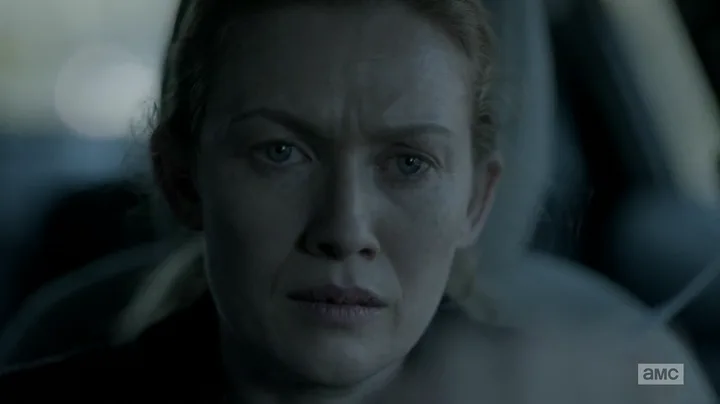
The sequences with them in the car are shot quite well, though: the close-ups of Linden’s face and the camera studying Mike’s reactions in the rear view mirror were terrific – though the latter did undermine the show’s positioning of him as a fallen angel, the man who just wanted to help and paid the price for it. A bit of a backhanded compliment, but there’s a kinetic tension to the in-car cinematography that turns the one sunny morning The Killing‘s ever had into another series of pasty, stressed faces and shadows – in terms of cinematics alone, it’s one of the best sequences the show’s ever done.
If the first half is concerned with the fall of Mike, the second half is the fall of Bullet. After lying to Holder about Lyric calling her crying about Mike hurting her, Holder pushes her around and tosses her out of the police station, angry that she’d place his partner’s life in danger over a lie. She then gets a pile of shit from Lyric, who informs her nonchalantly that she’s with Twitch and isn’t gay (in one of the show’s most honest moments; I can see the Lyric/Bullet interaction happening all over American high schools).
But again, it feels like the show takes the cliched route, undermining the strong emotional moments it has with Bullet in the second half. Even if Lyric isn’t gay, would she go back to Twitch again just to prove her point? Either the show wants to paint Lyric as a character who’s an idiot, or they’re just doing whatever is convenient to extract much-needed conflict in the homeless world (my vote’s with the latter), either of which is a poor way to approach the character.
That’s a smaller issue, though: the big problem comes in the final moments, when Bullet gives a girl heroin to get more information about the killer. It’s a fun little sequence, especially as Bullet sits in a diner alone, a conspicuous black car pulling up to the sidewalk. But when she leaves Holder the message, she neglects to give him any information: “I know who he is.” Well, who the fuck is he? It’s one of those “of course” moments I despise in dramas: of course the girl with the big answers isn’t going to leave them on the last message she leaves before she gets kidnapped (by the way…. how did the killer just happen to find her at the diner? that’s a bit convenient). They even telegraph the shit out of it: from the moment she lied to Holder, it was pretty obvious that the show was driving her directly into the heart of the beast, overtly isolating her from everyone and everything to do so.
Yes, the show has to have some mystery moving forward: but wouldn’t it have been cool if Bullet had told Holder who it was, and the episode ends with her getting kidnapped before the line cuts off? Even if it’s a name we don’t know, it would set up the last four episodes (season finale is two episodes, so there’s only three weeks left) as a frenetic chase to find him/her before Bullet and/or Kallie (if she’s not dead) dies, setting two races against the clock for Linden and Holder to fight against.
The other clock, of course, is the one on Ray’s life – a story line that is so far isolated at this point, it’s jarring when Seward’s face appears on screen after nearly 30 minutes in the episode, begging anyone who will listen to help save his life. What I don’t get is why: what finally drove him to declare his innocence, after being a prick through the legal system for years (even demanding he get hung for his own death, something he also now fears). Had this been a story arc about a guilty man whose tough facade wears down through his last days on earth, his desperate attempts to save his own life would have some more weight to them: here, it feels like it’s happening because it’s expected to, like the writers want to start getting our hopes up about Seward’s innocence by declaring it with four hours left to go, only to give us some “hard-hitting” drama in the finale when his pardon doesn’t come through, and an innocent man goes to die.
I just don’t understand the point of this Seward material: the first few episodes of the season posited that Seward’s revelations about his own crimes (or lack thereof) would explain his motivation for keeping himself in prison, and shine light into the mind and actions of the faceless serial killer out on the loose. Instead, it’s been this half-contemplative, half-shock value plot where Seward’s gone from ornery, violent inmate to crying, panic-stricken man about to die, in the period of about 11 days. There just hasn’t been enough material to justify these massive changes in heart: as long as The Killing keeps its Seward cards close to its chest, it’s hard to invest anything into the psychological torture he’s going through right now, awaiting his own death.
But as I continue to reiterate at the end of every review, this The Killing is much better than The Killing we watched through the first two seasons. With less relationship drama, mindless politics, and Linden’s kid far away from the screen where he belongs, season three can at least present us with the interesting framework of a murder story. It may not be nailing the details (which admittedly, is where the devil is in cop shows), but it’s really created a tense, driving drama with its broader strokes – and those strengths and weaknesses are front and center in ‘Try’, a wonderfully focused and driven episode with a lot of trite material holding it back from greatness.
Other thoughts/observations:
- Mike: “you think I wanted this?” well, how about you fucking change it instead of complaining that nobody will believe him!
- ok, this whole “what’s going on with Francis” thing is weird. Are they trying to tell us that Frank is the killer? I don’t know why else we need to care about his wife, son, or said wife hitting on the prison guard, but it’s all very boring and feels more pointless than what’s going on with Seward.
- “Sometimes the ones who hide, are the ones who want to be found the most.” GROAN.
- You think cops would realize Mike was helping a girl detox when she was puking and sweating all over the place? his conviction in Tempe is such a thin, unbelievable bit of back story.