Reflecting on the intense forty-two minutes that is “Six Minutes”, I’m of two minds: while I thoroughly enjoyed the character work being done by the writers and actors in the episode, there are still a lot of moments where The Killing‘s lack of nuance leads to some wooden dramatic moments.
As a whole, its a wildly effective character piece that exists in a tight 12-hour time frame – but there are plenty of pockets within the episode that distracted from the great stuff happening with Linden and Seward.
I’ve had my problems with Seward’s story line throughout the season – it never felt like an integral part of the season’s overall narrative, more of a tangential piece of story that brought Linden’s story full circle (the Seward case was the big case she had before the Rosie Larsen catastrophe) and a way for the show to install some extra moody dramatic elements. Skaarsgard’s performance has always been terrific, but much of the material required him to walk in circles: arrogant murderer turns to whimpering man looking for a way out, and around and around it went. He wanted Linden’s help; but when she or anyone tried to help him, he aggressively tried to isolate himself by alienating others. I understand the arc the show’s going for, but it never feels like an organic change in character – it’s really a bunch of arbitrary scenes who’s tone jerked around when the show needed it to. Need Seward to be a creepy murderer who attacks guards early on? Have at it. Need him to be remorseful for a scene, then a dick in the next? You got it!
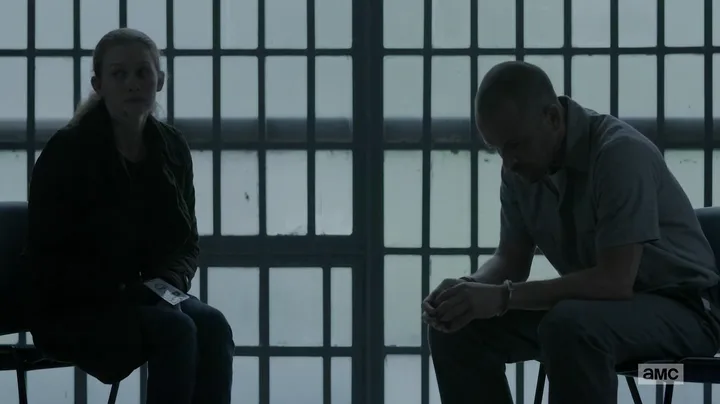
However, in the confines of “Six Minutes’ (which begins with the practice execution and ends with the real one), Seward’s character becomes a fascinating study in human behavior, taking an unexpectedly strong angle against the connotations of executing a human being. As Seward feels the constraints of time closing in around him, he grows impatient and irritable – but part of him still can’t drop the facade of a crazed murderer who thinks he is getting what he deserves. Even if he believes he deserves to die, it doesn’t make waiting for that moment any easier, especially when you were an asshole and demanded that you die in the hardest to manage, easiest to fuck up way possible.
Even when a reprieve is possibly hanging over his head, he can’t fully come clean to Linden. In his head, he’s condemned himself for being a bad father; in the end, whether he killed his wife or not matters. His comments don’t really say either way (he was their that night, and says he “went back” to get Adrian) – and the show seems to tip its hand that it’s probably not him, in order for Seward’s death to carry maximum dramatic weight for Linden’s character in the final episodes – but at least the show takes a stab at defining why he let himself be sentenced to death: he knew he was a bad person, and turned to the state to get rid of someone he was too scared to kill himself.
When it comes to that little bit of character, I’m not sure how effective The Killing really is – it’s hard for me to believe even a stone cold killer would go from wanting to be off death row to accepting it because he accepts that he’s a bad person. It’s a frustrating bit of see-sawing that harkens back to other The Killing plot lines, where characters were framed as good or evil, then both, then neither, then evil again, in order to keep the mystery going. Here, it’s supposed to give a layer to Ray’s character, this conflicted man who didn’t want to save himself – but it feels like a dramatic plot line, not a bit of gritty, conflicted-morality-realism that it appears to be going for.

Either way, it’s a great performance, and the show takes its time walking through his last twelve hours – although a lot of that is for more confusing, wishy-washy emotional characters. Holder wants to help the kid – but Holder’s drunk and berates him (then does his hair for him)! Hugh Dillon’s character is a dick to Ray all day long, and then can’t place the death hood over Ray’s face! The other guard has been a wimp all season, and here is screaming at Ray to be a man, ultimately being the last face Ray sees! It’s not just Seward: other characters are jumping across the emotional spectrum seemingly at random, depending on how dramatic a tone the scene was going for.
Now, I don’t want to dismiss this as inconsistent writing (although I think it is): in part, I think what ‘Six Minutes’ is trying to convey on a broader scale is the chaos that surrounds a man on death row. Even the people who want him to die have to actually face that, and it forces us to take a long, hard look at our consciences and what kind of people we are. It’s stressful, which explains the emotional volatility; it’s deathly quiet, because everyone’s contemplating shit; and it becomes a claustrophobic atmosphere for everyone, every second on the clock ticking louder and louder as the moment of reckoning finally draws near. And when it gets here, the writers predictably twist the knife, letting Seward hang strangling for a few minutes (all season, he’s worried that the rope and fall won’t break his neck, exacerbated when the guards keep weighing him over and over), forcing everyone to contemplate the horrible act that is executing a human being (even though nobody really executes people by hanging them anymore… but we’ll move past that). Even if you believe in the death penalty 100%, standing next to someone who is sentenced to choke to death is a hard thing to watch.
The rest of the episode is mostly throwaway: we never leave the prison, and Holder’s depression leads him to show up drunk, tell Adrian he’s wasted, then buy some more beer to throw at unmarked graves. Not the greatest way to personify his struggle with Bullet’s death – but The Killing will be The Killing sometimes, grasping at melodramatic opportunities. Personally, I would’ve rather seen Linden call Holder a few times and not be able to reach him, leaving his mental state a topic to be discusses outside this episode… it takes away from the focus on Linden and Seward during their scenes, and the back and forth between them and Seward’s son, who doesn’t get his visitation after all (it comes… six minutes after visitation time, dun dun DUNNN!), but gets to see his Dad through a window before he goes off to his death.
When it’s not with Linden and Seward, ‘Six Minutes’ isn’t doing much (remember Becker’s kid getting arrested for shooting someone?) – and when it is with them, it’s stretching out a little bit of material into an episode-length arc, which inevitably leads to some fascinating and silly moments (sometimes not always exclusive). The acting is what really carries ‘Six Minutes’ though; regardless of the spotty writing, Skaarsgard and Enos make the most of their last hour together, and it’s there where ‘Six Minutes’ delivers. In a complete vacuum, ‘Six Minutes’ is a wonderfully executed, focused hour of character drama; place it in the larger context of what’s happened to Linden and Seward all season, and it loses some of its effectiveness.
In the end, Seward’s character reflects the season as a whole, which is kind of hitting the same note over and over: people reaching out for help seconds too late, and the people they’re looking to for help getting sad after. It’s happened with Kallie, Bullet (twice), Kallie’s mom, the priest who kidnapped Linden… this season of The Killing is basically torture porn, punishing those who dare turn their backs on those we might consider lost. It’s a little too heavy and repetitive to be effective, but at least represents the change in philosophy that made this season such an improvement: the facts of the case aren’t necessarily what is important (it’s the same thing The Wire understood, though it mastered the art of being an actual cop show at the same time), it’s what these cases and events reflect about us as people, and the society we live in. Did Ray deserve to be heard one last time to save his life? Should Holder have pushed Bullet away as harshly as he did, to prove a perfectly valid point (bad CI information can lead to dead cops, even in real life)? Ultimately, The Killing seems to suggest that we should never turn our backs, no matter how long it takes to get things right, because the worst thing to be is alone. Without the case, without her son, without Holder, Linden has nothing: without it all, she’s just Ray Seward, staring at the trees and wishing it all could’ve been different.
Other thoughts/observations:
- whether or not this show comes back for a fourth season, I can safely say (regardless of what happens in the finale) that I’m glad I tuned in this season. The last three episodes in particular have shown potential I never thought the show had.
- what will we find out in next week’s two-part finale? Mills probably won’t have killed everyone, Kallie will either be found alive or dead (personally, I hope she’s never found at all) and Holder and Linden will have to come to terms with their “mistakes”. I know what you’re thinking: BUT WHAT ABOUT TWITCH AND LYRIC’S APARTMENT, DAMNIT!!!!
- the show sums up its anti-death penalty stance when Seward says his last words: “Salisbury steak is not steak; it’s ground beef” – in other words, you can dress it up and call it an fancy, expensive execution, but it’s still just a legal,pre-meditated murder of another human being by the state. (I’m not saying that The Killing is wrong or right… I’m here to talk TV, not politics).
- why does Linden stay the whole time? the show gives us an arbitrary reason (that it didn’t really need): if she leaves at any point, she can’t come back and visit him again.
- I thought Holder was into meth?
- Seward calls his wife “used goods”… not a great way to try and build empathy to the audience. He also never actually shows regret for what he did, only that he’s about to die – an interesting final note for the character.
Randy, can you explain your last point more thoroughly, about how if Linden did not have the people her employment brings into her life, her cases, and her son, then she would have and hold nothing within her life. Does that not apply to most people? I am not comprehending the exact message that you say rightfully that The Killing gives to viewers about being a loner as both Holder and Linden are. Are you suggesting that this is a tv show that is telling the viewers that individualism within being a loner and having a personality that is more likely to want to be alone rather than with other people, are you suggesting that The Killing is….almost a beating, torture porn as you say, against that loner frame of being and mind?
I do not know…As a loner myself, I would have had alarms going off from that message being projected within the tv show. But I could be turning off my brain too much to notice it also. IMO, might I suggest that….it is showing the struggles of these personality types of Linden and Holder due to their extreme and unusual lives from foster care, addiction, so on so forth. Like Holder says (I have a hugely similar persona to Linden btw) “You are always running away Linden”. I dont know. I think it is more like the examination of these specific personality types rather than an attack on strongly individualistic lifestyles.
Thoughts? Really enjoyed your excellent review BTW.
I think that The Killing’s always gone for this very The Wire-esque world where institutions are destined to fail us, and the only way we can find happiness or peace in life is to find it in each other.
Throughout her life, Linden’s relied on a number of ‘systems’: she was in the foster care system as a child, and has dealt with the judicial system and the courts as a homicide detective, divorcee, and estranged mother.
She’s a woman hardened by the failures and rejections in life, a woman who internalizes her feelings to an unhealthy point. Jimmy McNulty would drink and chase women to escape the feelings of failure and regret he felt for his job; Linden has cigarettes.
In a nutshell, what I was trying to say is that Linden and Holder both have relied on the systems around them this season to bring them peace. Linden with the Seward case and knowing the truth; and Holder with Bullet, who uses the legal system the only way she knows how to try and save Lyric.
For both of them, having faith in the socio-political systems at play and watching them fail, it draws them farther and farther away from people.In a nutshell, I don’t think Linden and Holder are two characters who are attacked for their individualism: I think what The Killing suggests is that even the strongest people can’t be alone forever, and that allowing your job to dictate your life (or provide companionship) can be the most unhealthy thing in the world.