As a series always trying to balance comedy and introspection, Scrubs often found itself exploring the intersections of human dichotomies; the lines between success and failure, the struggle between good and “evil” (both internally and externally), and the balance between perception and reality being some of the core driving forces of the series. “My Tuscaloosa Heart” is one of those reflective episodes, an early example of Scrubs pausing to look inward and take stock of its characters before heading into the next big plot development or character arc – unfortunately, it does so by examining two of the show’s most dynamic, complex characters (Cox and Kelso) alongside the static personality of young J.D., giving “My Tuscaloosa Heart” an imbalanced emotional dissonance that is compelling, but is never quite able to resolve effectively, even with an incredibly strong ending.
With J.D., “My Tuscaloosa Heart” basically puts him in the same box we saw in “My Student” – or, given that it is patient-focused, an inverse of “My Old Lady” is perhaps a better comparison point. Where in “My Old Lady” J.D. overinvested in a terminal patient emotionally, “My Tuscaloosa Heart” sees J.D. react the opposite way to a belittling, frustrating patient – and then when the patient dies (of terminal cancer, resolving J.D. of actually committing medial malpractice), J.D. spirals into an anxious place of self-doubt. Sound like a familiar arc? Even this early into the show’s lifetime, Scrubs has landed on a fairly reliable little formula to lean on: J.D. seeks the guidance of Cox and others around him, realizes he has to look inward for answers, and then gently resolves his conflict in the episode’s final minutes with a soothing, encompassing voiceover.
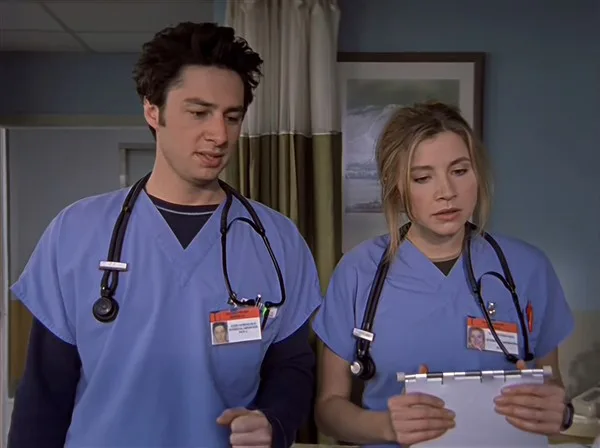
And like said spiritual predecessors, “My Tuscaloosa Heart” is mostly about failure, primarily that of J.D., whose neglect of another once again causes him a great deal of internal strife. But rather than present this through an empathetic character , J.D.’s frustration in “My Tuscaloosa Heart” is directed at a terribly rude patient, one even Carla’s willing to openly dismiss. It’s a twist that makes sense, especially as the first season continues to reflect on some of the arcs and internal conflicts its characters faced in the season’s early episodes – but it also creates a lack of tension for J.D., especially considering he really only has two brief interactions with his shitty patient before he’s suddenly passed.
While the story doesn’t have a lot to offer in terms of J.D. and his progress (or lack thereof), it serves as a nice framework for the other stories of the episode, primarily Cox undermining his relationship with Kristen, in what is an equally engaging and frustrating way to position his character before season one’s final stretch. He blows off Kristen’s romantic plans to help Carla move a dresser – arguably the most out-of-character thing he ever does in the whole series – and then has a (apparently regularly scheduled) round of angry sex with his ex-wife… which he then accidentally spills to his current girlfriend, ending their relationship almost as rapidly as it began but one episode earlier.
It’s never a terrible idea to see the grand mentor of Sacred Heart self-sabotage himself (John McGinley’s ability to embody Cox in these moments is the real and true heart of this series, if we’re being honest) – and “My Tuscaloosa Heart” is no exception, watching Cox undermine the only good, peaceful thing that’s entered his life post-divorce by falling back into old patterns. However, it almost turns him into the parody in the process, represented most viscerally by the massive yellow rain coat he wears during his exchange with J.D. about how easy it is to “treat the nice ones nice”, and giving voice to the episode’s underlying themes of growth, and how they emerge in our normal, predictable patterns and choices. More importantly, it creates this cascade of resonance, as J.D.’s story gives way to Cox, which gives way to Kelso in the final moments: but the most resonant of those stories ends up being Kelso’s, when most of the episode was spent listening to J.D.’s neurotic tendency to make everything, even the death of a terminally ill (and terminally unpleasant) patient, about himself.
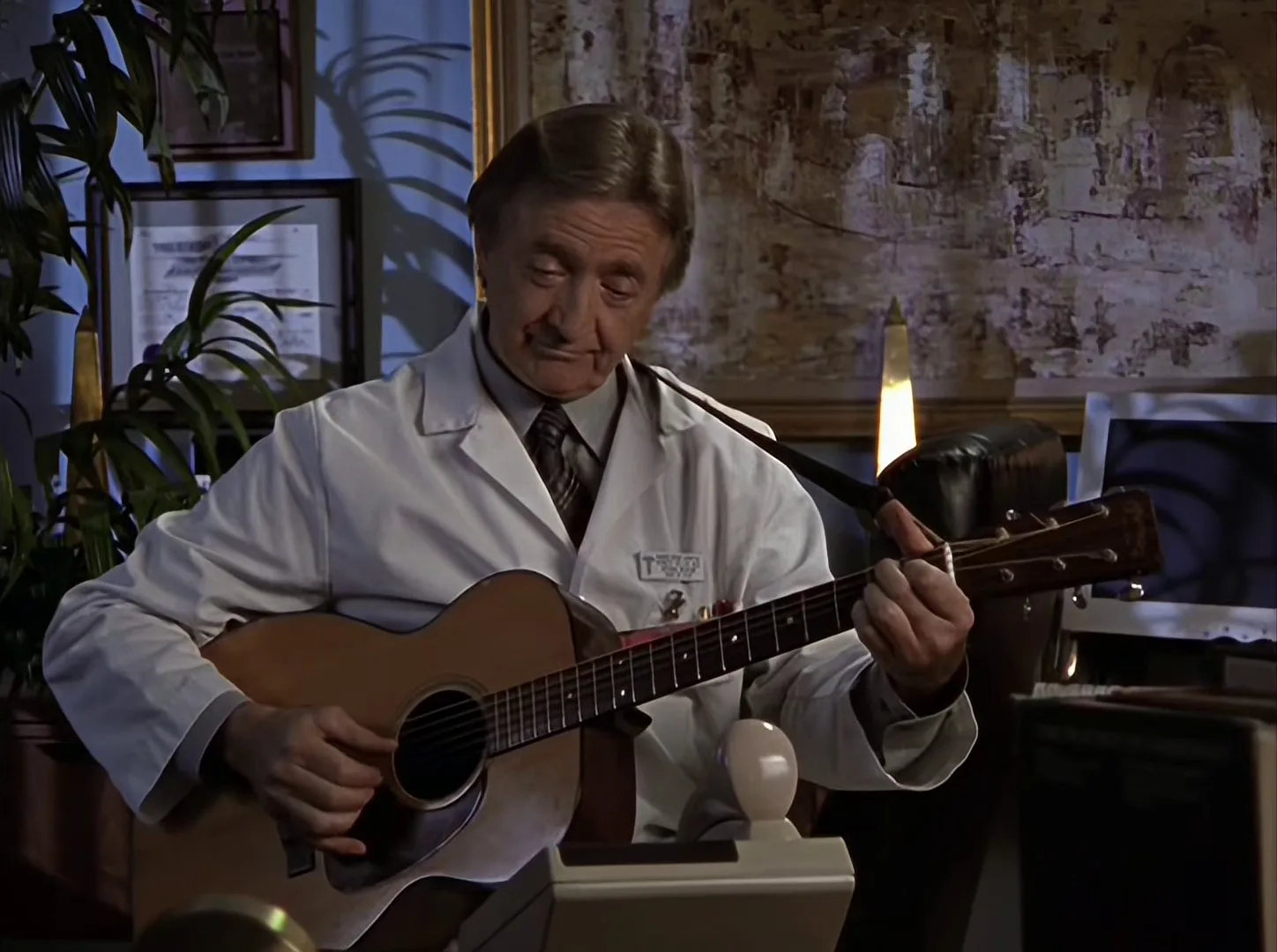
“My Tuscaloosa Heart” uses J.D. and Cox’s theatrics to eventually reveal an origin story (albeit a somewhat embellished one) for Kelso, revealing his guitar-strumming romantic side that defined his youth and pursuit of his eventual wife. Over the seasons, Kelso’s unseen wife would become the butt of a lot of jokes (ala Niles’s ex-wife Maris) – but in this episode, it both reveals Kelso’s romanticism, and acts as a tragic comedy of sorts about the ebbs and flows of a longstanding relationship and marriage. And it does so with an unexpected splash of poignancy, as Kelso plays the titular song in his office alone, pausing only to take a brief, unpleasant phone call from the “Bunny” he’s been singing about for decades, drowning out any temporary sense of peace and solace Kelso may find in his advanced years.
It also serves as an effective reminder that one thing Kelso has over J.D. and Cox is his ability to compartmentalize his life; this of course would begin to fragment in later seasons of the show, but how “Tuscaloosa Heart” conveys this subtle difference between its three focal characters helps bring unity to an episode otherwise fragmented in various areas of Sacred Heart, and gives “My Tuscaloosa Heart” a bit of a smoother landing than expected, even though Cox’s story still feels a little miscalibrated (and J.D.’s feels a bit unnecessary and small, even when it tries to lean into the existential underpinnings of his story).
While it’s always fun to watch Scrubs explore Cox and Jordan’s toxic co-dependence, how it comes about in “My Tuscaloosa Heart” is a bit abrupt and frustrating – even if that’s what was intended, in retrospect, it doesn’t quite work. And theoretically, if you pair a poor Dr. Cox story with an intentionally repetitive J.D. story, you’d appear to have the recipe for a disappointing episode – however, the Turk/Elliot plot (a most unlikely redeemer) that gives way to Kelso’s secret little love story swoops in to save the day, (mostly) redeeming “My Tuscaloosa Heart” with a simple folk melody, and a wonderful closing scene with Ken Jenkins strumming the guitar and singing about his love – who then calls him and screams at him for forgetting something at the store, as Scrubs-ian an ending as one could’ve hoped for.
Other thoughts/observations:
- Hey, number two!
- Kelso, turning his life story into that of an iconic mid-century rock star: “Then in 1977, I died on the toilet. Or did I?”
- Elliot’s pinky swear didn’t even last a second.
- Kelso’s “Thank you very much” is also iconic.
- “Are you and Daddy playing wheelbarrow?” No wonder why J.D. has so many sexual hang-ups.
- “You can kiss my man-sized ass.” “Will you hold me after?”
- Todd High Five Count: still stuck at 11 (with a season total of 13).
- Up next: Parents descend upon Sacred Heart in “My Old Man”.