
(Note to readers: episode by episode reviews of House of Cards will appear every day through the next week and half, with final thoughts on the season to follow. To keep up to date on when new reviews publish, follow me on Twitter, Tumblr, or good old Facebook).
It makes sense that House of Cards is a show about ambition – it embodies the spirit of Netflix in 2013, attempting to shift the paradigm of broadcast television with no less than five new series to debut in 2013 (including the long-awaited return of our beloved Arrested Development). But with a $100 million dollar budget and a shit load of hype surrounding it, the long-awaited American adaptation of the BBC political thriller.
Directed by David Fincher and written by playwright Beau Willimon, “Chapter 1” is a whirlwind introduction to this parallel universe of 2013 America, introducing a slew of characters and plot lines to play out over the next 12 episodes. There’s no avoiding its density – the sheer amount of names referenced in the first episode took up multiple columns in my notes. And although its not as consistently sharp as one might hope, there’s a lot of intriguing elements spread about, which hopefully will blossom throughout the season.
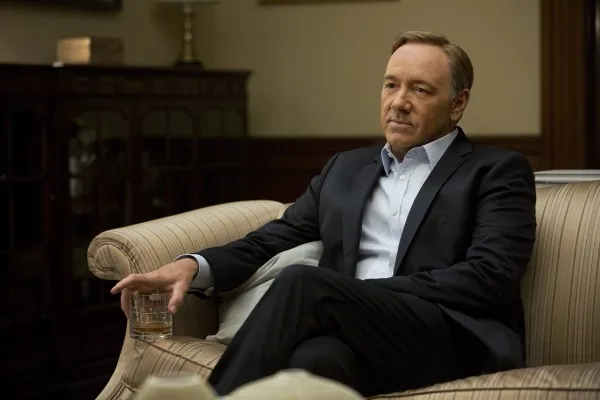
In a nutshell, House of Cards is about Washington’s ruthless politicians, particularly a grand plan being executed by a jaded Majority Whip Frank Underwood (Kevin Spacey) after his promises of being named Secretary of State by the new President Garrett Walker (Michael Gill) go unfulfilled. Spacey’s clearly on cloud nine with the role, boasting a slighty obnoxious Southern accent, and some stage-ready overwrought monologues like are Sorkin-esque, with a touch of Fincher surrealist flavor. At times, they can be enjoyable in the way watching great actors chew on dialogue can be – but most of the time, it feels like stylistic hand-holding I don’t think the audience needs (and no, I don’t care that it’s a holdover from the British version… two different shows, people).
That surrealist layer is when Francis breaks the fourth wall: the oddest moments of the pilot are when Spacey turns toward the camera to wax poetic about ambition, power, or vengence – or in other cases, to simply explain things that normally can be inferred through normal dialogue and/or good camera work (something Fincher can do in his sleep). It’s definitely a jarring stylistic choice – but considering the writer’s familiarity with the stage, it evokes the tone of a modern take on Greek theater, and definitely gives the pilot a distinct (if slightly snarky) personality.
There’s a lot of exposition throw around to fill out the rest of the cast, but the obvious relationship to watch throughout the first season is that between Frank and Zoe Barnes (Kate Mara), a Washington reporter who becomes an important tool in Frank’s attempts to implode his party from the inside. She’s an archetype character – career-minded female trying to advance herself professionally – but the nature of her agreement with Frank raises some questions about her internal morality I hope we’ll see explored more through the season.
The rest of the characters are mostly of the fill-in-the-blank variety: the show really embraces its narrative early on, only giving rough sketches of the important players in this political game of thrones: most notable among these (for their performances) are Claire (Robin Wright), Frank’s wife, and Peter Russo (Corey Stoll) an addict-riddled Congressman living under Frank’s thumb. I say their performances are what’s notable for a reason: the script doesn’t really fill in Claire past observant and quietly catty, and Peter mostly bumbles around, a slave to his dick and the bottle.
This is the only real issue with “Chapter 1”: the performances are only able to hide the somewhat stock characters and plot set-ups to a certain degree. It becomes noticable in scenes like Frank and Claire’s first conversation about him being passed over for Secretary of State: it feels more like two actors talking at each other (and by way of proxy, the audience) rather than talking to each other about the feelings they’re experiencing, and no matter how great the performances are, it leaves things feeling a little bare-boned and undeveloped in the first hour.
But this is a show designed for the long haul – we’ll see how these characters blossom and develop themselves over the next 12 episodes. There are some things bubbling under the surface I’m looking forward to seeing throughout the season: none more than the death of an ideology a deconstruction of what happens to people when everything they’ve believed in leaves them short-changed and without an umbrella in the middle of a torrential downpour. Hopefully House of Cards digs into this further: if it’s just a privileged white guy’s self-corrupted, pride-drenched plan to take the power he thinks he deserves, it won’t be worth all the hype.
Other thoughts/observations:
- Frank asking the audience “Can you smell that?” is annoying. You’re talking into a fucking camera, you think any of us can smell?
- it appears the show’s narrative is being told in a 100-day window… either that, or they just really, really wanted us to remember that number.
- “tough as a $2 steak” is the kind of chewy dialogue actors love, and TV watchers can’t stand.
- Frank’s been in government 30 years, but can’t believe it when he finds out he was sold a bunch of empty promises. Did he forget what country this was?