
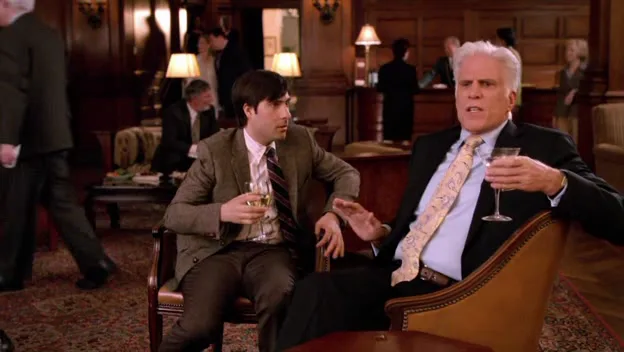
For an unheralded show in its third episode, Bored to Death makes a daring script choice with ‘The Case of the Missing Screenplay’; that is, there really isn’t a ‘case’ to be had in this episode. The screenplay goes missing on account of Jonathan, and for 95% of the episode, the show’s premise of a struggling writer/detective is put on hold, for this little comedic piece full of irony, laughs and fantastic character moments. And although its a departure from the concept of the first two episode, ‘Missing Screenplay’ sets up what will prove to be a number of important seasonal story arcs.
Chief among these is the rivalry between George and GQ’s editor, Richard (in a great guest spot for Oliver Platt), something which will continue to develop over the next five episodes. Here, it’s established in the first scene that not only does Richard work for a more prestigious men’s magazines, but he’s married to George’s ‘favorite’ ex-wife, Priscilla. Obviously, this sends George into contained fits of rage, and gives us a little more insight into why he’s got such a cynical view of the world. (When Jonathan asks “Do I want to change my life?” George replies, “Most people do.”)
Undeterred, George tries to hump away his memories of Priscilla with Miriam, a woman he meets while with Jonathan at an NY Film Society event. Jonathan is there to meet filmmaker Jim Jarmusch (playing himself), who wants Ames to take a look at this newest film, and offer some revisions. Of course, he leaves the script in a therapist’s office after finding out the girl he left the party with is only 16 (and daughter of said therapist). It’s not a professional case from his craigslist ad, but this situation provides Jonathan and George and opportunity to team up for the first time, on something besides comic books drawings and coffee shops.
George sees the therapist as a double whammy: Leah will finally break their sex-less streak if he goes to see a therapist, and Jonathan’s going to pay for it so he can get his script back. What he doesn’t realize is that he’s walking into a minefield of the most direct, cliched-spewing psycho therapist monster in Brooklyn, scarring him so badly he can’t even cash in on the post-therapy sex he earned (“It’s totally recessed.”). It’s bad enough he’s the woman in his own relationship, but even when he jumps through the right hoops to get laid, things don’t work out as planned.
In the end, Jonathan gets his script back, but it’s too late: Jarmusch gets Charlie Kaufman to handle the revisions. The episode ends with Jarmusch riding his bike around Jonathan in circles, while he stands there, contemplating his next move. It’s a perfect parallel to where Jonathan is emotionally: he sees the success, glory, and escape from memories of Suzanne orbiting around him, but he can’t just can’t keep his eyes on it enough to grasp it.
Besides introducing larger plot points like George’s rivalry, or Ray’s desire to donate his sperm to two lesbian fans of his comic book, ‘The Case of the Missing Screenplay’ is a meandering set of vignettes that continue to explore the ideas of identity and true happiness. It’s also a great showcase for the writers, weaving and integrating all of the characters in the episode so smoothly, vastly different situations like Ray’s emotional problems and Jonathan’s professional issues weave into each other, to hilarious results.
There are still a few problem notes: Leah’s still a whiny character, but to this point we’ve really only had three scenes with her, two of which were in this episode. Leah and Ray’s relationship at this point is focused mainly around sexual frustration, and definitely feels a bit one-noted at times. But this is a minor complaint for a fantastic episode that manages to take a step back from its premise and still maintain the same tone and humor while introducing a number of the season’s plot arcs.
Other thoughts/observations:
- favorite visual of the episode: Ray is so emasculated in his own house, he can’t even the pants in the family, instead forced to parade around like a trouser-less child. Great use of wardrobe there.
- doesn’t Jonathan’s jacket looks like a Sam Malone special from the Cheers days? Intentional homage, or just the cyclical nature of style?
- best line of the episode goes once again to George, when discussing Jonathan’s almost-sodomy: “Polanski was a lot worse.”
- why is Bored to Death Brooklyn so freaking white? For an on-location show, the white-washed race of the cast and extras is a bit disturbing so far.