
Whether we want to admit it or not, we expect the same from life as we do from storytelling. Moments of profundity, love, discovery, wonder… and of course, closure. Maybe not the kind of closure that makes us comfortable, but deep down, I think what we all hope for is that the end of consciousness – at least as we know it – is that is comes with a kind of peace. Seeking out that peace, in life and in narrative, can lead to so many different places; some exciting, some boring, and some underwhelming, but all of them worth experiencing.
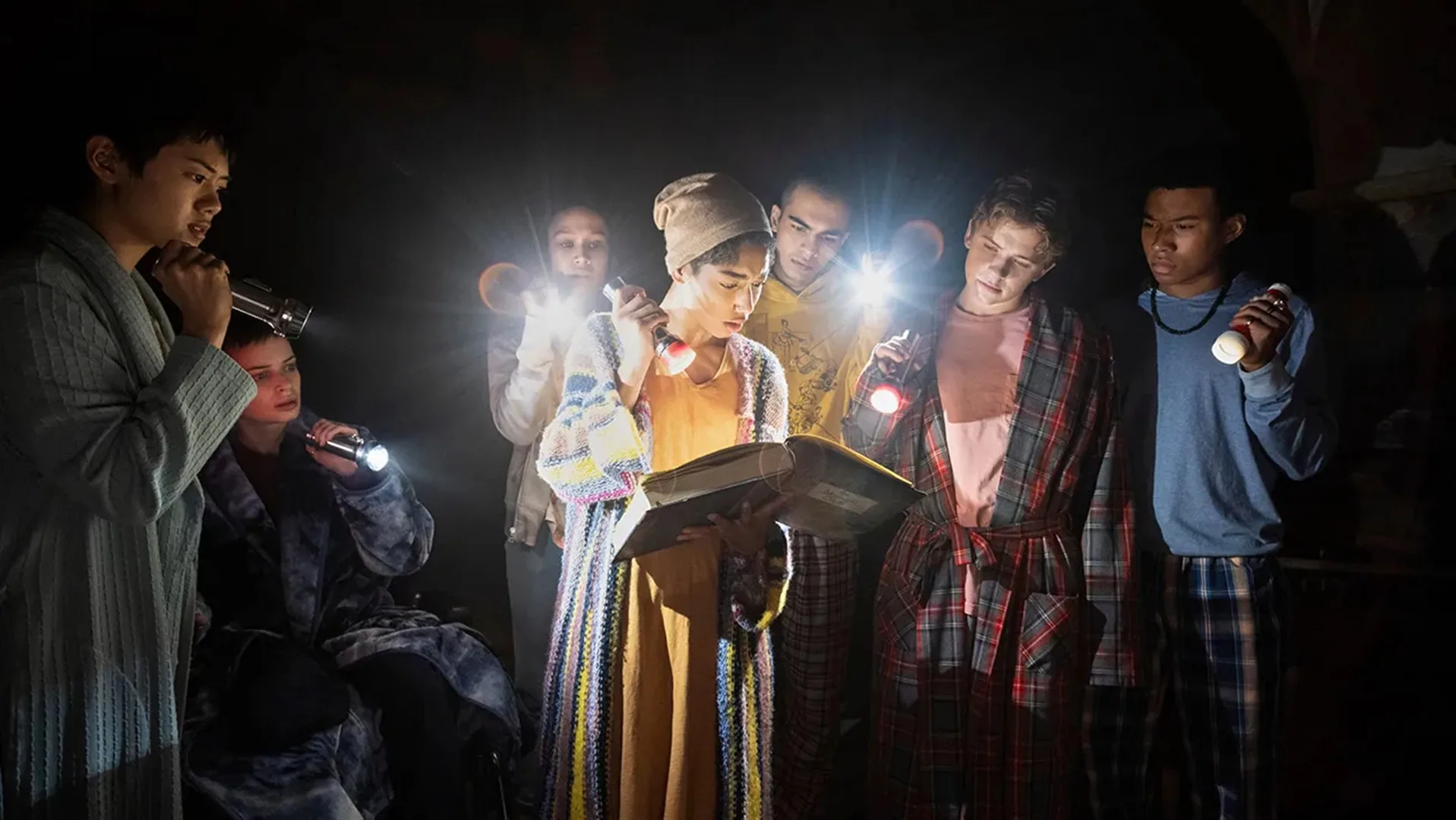
The Midnight Club, Mike Flanagan’s fourth Netflix adventure (co-adapting Christopher Pike’s novel with Leah Fong), is ten hours of television earnestly trying to capture those tenants of existence, told through the tale of eight terminally ill teens staying at a home full of mysteries, memories, and things going bump in the night. More so than his previous offerings, The Midnight Club is an inherently difficult watch; though it eases viewers into the experience via a catchy 90’s soundtrack and a very familiar, intentional opening hour, The Midnight Club is slower and even more subtly contemplative in its reflections on life, which will probably turn off some fans of The Haunting of Hill House and Midnight Mass.
But as the ten episodes begin to take hold, anchored by the nightly gatherings of the titular club and the ever-familiar set of jump scares and creepy vibes, The Midnight Club slowly transforms into something more exciting – a more effective, memorable version of The Haunting of Bly Manor (to be a bit reductive). An even more apt description of sorts would be calling this Flanagan’s version of Tales From the Loop; through an overarching narrative with the familiar elements we expect (spooky shit happening at an evocative location), The Midnight Club looks inward, at the stories we tell and why we tell them, both to others and to ourselves.
Perhaps the most important facet of Flanagan’s storytelling in The Midnight Club is how it approaches resolution through the mechanics of its stories-within-a-story feature. At each meeting, a member of the titular club – eight dying teenagers, introduced through the lens of our quasi-protagonist Ilonka – tells a “ghost”; a story they’ve made up, thin analogies of their brief life experience filtered through the pop culture they know and love. These stories they tell, which range from traditional horror, to detective noir and 1980’s era science fiction, present themselves as simplistic homages; despite their predictability (all of them mini-adaptations of other Pike books, by the way), how Flanagan utilizes them as devices to explore character and emotion, brings a depth of storytelling to its story of sad teens and religious pondering. It makes for a powerful, connective experience about love, pain, and the freedom of imagination, a rumination on the certainty of change, and the chaos of trying to connect with others (maybe even sometimes from the ‘other’ side).
It would be easy to dismiss The Midnight Club as distracted or underwhelming; its dramatic swings are much shorter and pointed than in previous Flanagan series. Even the various mini-film homages can feel a bit dry at times; then again, as stories designed to be conceived and told by teenagers all destined to drop dead in the very near future, the simplicity of narrative and stark emotional choices give shape to something different. Flanagan is reflecting on the nature of telling stories, in the personal experience of creating art – even if we’re adapting The Terminator, for example, the decisions we make offer so much rich material in helping understand each other as human beings.
But mostly, The Midnight Club is about the unifying experience of death – the one thing in our life that is certain, but something we can never quantify or comprehend. So how do we reconcile it? Continuing the theological curiosities explicit in so much of Flanagan’s work (and historically, so much of the horror genre), it quietly builds to some of the most frightening material he’s made to date, and possibly his most challenging to watch: thus is the nature of trying to interpret the impossible, and grasp at enlightenment against the fading of the light – hardly a concise, comfortable realm for a limited television series to try and exist. But through the underlying warmth and curiosity it has for both its character and subject, The Midnight Club delivers a thoughtful, emotional story about the most difficult moments of self-definition in life, and how we try to find clarity in them. Never absorbed by its tragedies, but always driven by fear of the unknown, The Midnight Club is a remarkable balancing act of tone and form, only occasionally frustrating in its willingness to move too quickly through a scene, or linger on its more traditional genre trappings too often, like the audience’s safety net.
Like people, stories are sound and light, combinations of elements and ideas that crystallize for brief whispers in time. We can guess at their conception, but we can never understand their end – some stories last for a generation, some legends perpetuate throughout human history for thousands of years (and some streaming series are erased from existence to be forgotten forever, but we’ll talk about HBO Max another day). In the playground of stories, we can understand a little bit more of who we were, what we believe, and what we want. The Midnight Club is a devastating, imperfect examination of how we accomplish this, how we build community even as we face the inevitable, something this grizzled old TV critic wishes more series aspired to explore.