
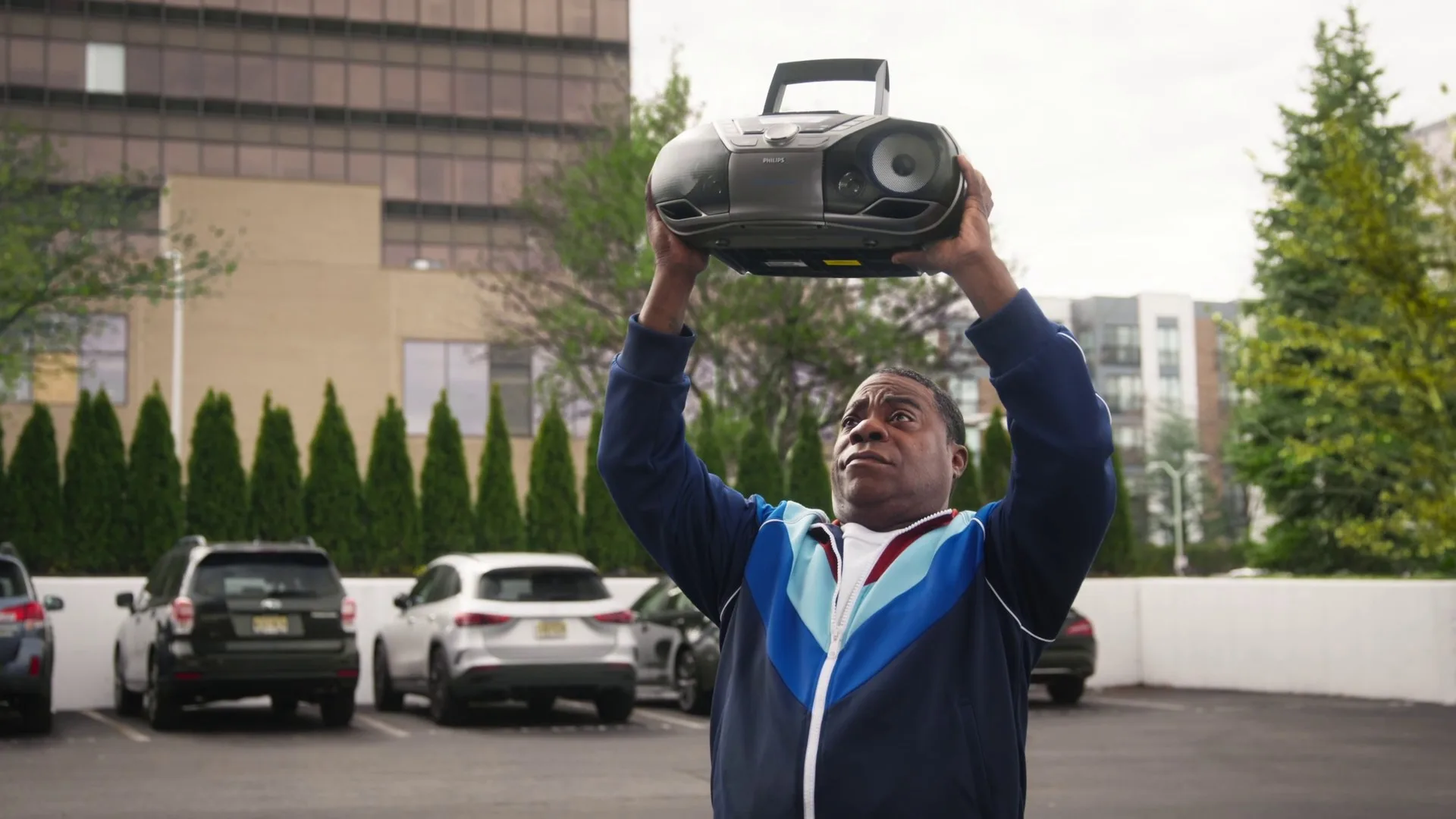
The Fall and Rise of Reggie Dinkins is a sitcom that seems like it was built in the lab for TV viewers like myself; created by 30 Rock stalwarts Robert Carlock and Sam Means (who executive produce alongside Tina Fey and Tracy Morgan), starring eternal millennial favorites Morgan and Daniel Radcliffe, and featuring a premise both prescient and timeless (disgraced retired athlete tries to redeem their reputation), on perhaps the greatest network for sitcoms of the past 40 years, NBC. And its first two episodes, “Pilot” and “Nittany Means Big” have humor and charm in abundance, making it an easy world and narrative to slide right into – but if the series is to succeed in the long-term, it’s going to have to recalibrate the balance of silliness and profundity a bit, as the clash between the show’s comedic delivery and its cornier emotional ploys, as currently constructed, are more dissonant than symbiotic.
Jordan stars as the titular Reggie Dinkins, a 21st century version of Pete Rose, disgraced from the game of football after accidentally admitting to huge amounts of sports betting during a call-in segment to Not SportsCenter. Twenty years later, he lives in a large house with his slightly aloof son Carmelo (All-American‘s Jalyn Hall, who is not given much to do in the first two episodes), his former teammate Rusty (Bobby Moynihahn) his ex-wife and business manager Monica (the always-welcome Erika Alexander) – and his new fiancée, Brina. The show begins when, in his misguided attempts to rebuild his character so he can try and fenagle his way into the Football Hall of Fame (in anticipation of this, he keeps an empty shadowbox above his living room mantle), Reggie hires disgraced filmmaker Arthur Tobin to direct a documentary about his life.

It doesn’t take long for “Pilot” to find its rhythms; anyone familiar with the creators’ oeuvre will recognize the show’s breakneck comedic pace – which, for those who haven’t done a recent rewatch of 30 Rock lately (or like me, openly avoid rewatching the incredibly overrated Unbreakable Kimmy Schmidt), will feel like a slightly suffocating, incredibly welcome breath of fresh air. The pace is relentless, full of one-liners and occasional cutaways – which, combined with the show’s mockumentary presentation (watching the filming of a documentary, of course), makes for a rather frenetically-paced story of personal redemption, a dissonant approach to tone and story that almost works to cover up some of the flaws in the show’s emotional core.
The performances and stories of the opening two episodes are great; the slow reveal of Arthur’s professional plight in “Pilot” give the first episode’s third act a really strong hook for the series, and “Nittany Means Big” smartly centers itself on an early check of Reggie’s outsized personality, and the ego that drove him to be defined by his failures, rather than his successes – throw in a handful of incredibly funny cutaway jokes, and it seems The Fall and Rise of Reggie Dinkins is an easy layup for a great new comedy series.
But there are elements of The Fall and Rise of Reggie Dinkins that aren’t quite as calibrated as they feel – specifically the mockumentary interview element, which feels like an unnecessary leftover from the era of The Office and Parks of Recreation that really isn’t needed here. When both episodes pause for these moments, be it Arthur’s interpretation of interviews as jazz, or Monica’s discussion of “air quotes”, it feels a bit inefficient and disjointed – a feeling that only intensifies when the script tries to push away from sardonic ironies and hilarious punchlines, into a more saccarchine family comedy where everybody announces their feelings and intentions (oddly enough, a bit in “Pilot” about Reggie delivering a faux emotional performance becomes almost metatextual in the clumsy final minutes of “Nittany Means Big”).
(I’m also not a fan of Monihayn’s character, a presence that feels like a leftover from the era of sloppy adult male roommates from the mid-2010s, which infected everything from Best Friends Forever and Broad City).

However, there’s a working formula here that just needs a bit of refining to truly shine. “Pilot”, surprisingly enough, is the better of the two episodes, more consistently able to surprise and effectively emote its way through a whole lot of exposition and establishing moments – “Nittany Means Big” is a decent follow up, but retreads over itself thematically just enough to become a bit flat and unremarkable by its end. There’s certainly something here, from the unique family dynamic between Reggie and his two women, and the uphill battles to self-redemption that are clearly the basis of Reggie and Arthur’s characters (and connection to each other); those tenants are strong in these first two episodes, even if they are mostly accessed through strong moments of humor, without a whole lot of pathos drawn in.
The Fall and Rise of Reggie Dinkins is definitely a sitcom to keep an eye on, if it can survive the strange scheduling of its ten-episode first season (following up the strong pilot episode with “Nittany Means Big” some 36 days later is not entirely encouraging), and force its characters into something other than a vaguely uncomfortable, easily recoverable emotional place (for a series about a disgraced NFL player, the stunning lack of financial and health concerns the Dinkins clan has make this a slightly less prescient series about modern sport). But with its comedic elements firing on all cylinders, and a talented cast of actors who are clearly game to push these stories forward, there’s an incredible amount of potential in the buzzword-salad that is the premise of The Fall and Rise of Reggie Dinkins.
Grade: B

Share this:

Discover more from Processed Media
Subscribe to get the latest posts sent to your email.