
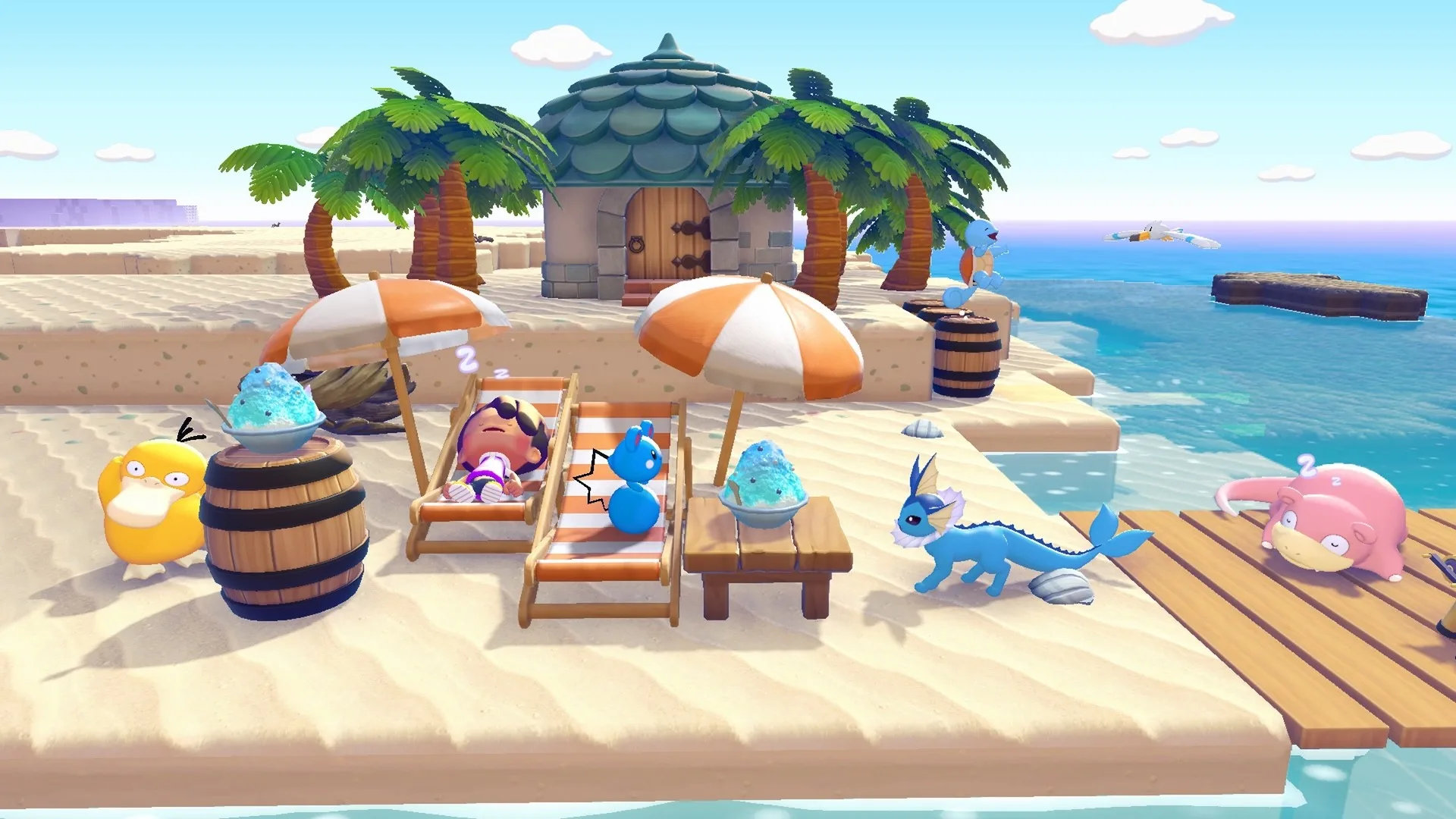
It’s been a rough few years for Pokémon, with games like Pokémon Scarlet & Violet suffering from the technical limitations of the OG Switch, copycat sequels like New Pokémon Snap failing to capture a new audience – and the spinoff games all but vanishing, save for the occasional Mystery Dungeon remake or Legends: A-Z, the latter of which contained some of the best battling, and worst world design, ever seen in the series’ storied three-decade lifespan. March saw the release of two new Pokémon games; a digital re-release of the FireRed and LeafGreen remakes of the original Red & Green – and Pokémon Pokopia, a game that initially appears to be a Minecraft ripoff, but slowly reveals itself to be the arguably most thoughtful, addictive spinoff game the series has ever seen (and the first true Switch 2 exclusive-Pokémon game, to boot).
Pokémon Pokopia begins with players waking up as a Ditto, a Pokémon with the ability to morph into anyone (think like Mystique, just friendlier, a purple blob, and not portrayed by Rebecca Romijn or Jennifer Lawrence). After taking a few steps forward, Ditto is greeted by a confused Tangrowth who refers to themselves as a Professor – and both are confused by the absence of their respected Pokémon trainer from their immediate surroundings.
After assuming the general appearance of Ditto’s Pokémon trainer, players exit the cave and immediately are introduced to the game’s basic systems, wherein the traditional battles and Pokéball throwing of the traditional mainline games are traded out for mining materials, terraforming landscapes through brute force – and building habitats, the three activities that form the core gameplay loop of Pokopia, an enticing mix of Minecraft, Viva Pinata! and Dragon Quest Builders (no surprise on the latter, given Pokopia was developed by the DQB team) that I’m still finding new wrinkles and moments of joy over 80 hours in.

The loop is simple: build different habits using combinations of items and locations, which then entice different types of Pokémon to come and take up a home. Want to befriend a Hitmonchan? Build a bench next to a punching bag, and a few minutes later the lanky boxer will be putting in reps on the bag, sleeping on the bench, and asking the player for various improvements to their newfound home (like adding decorations, providing food, or sharing other gathered resources). Find materials, craft items, build homes, watch Pokémon arrive, repeat – at its core, there’s nothing earthshatteringly fresh about Pokopia’s gameplay, which leans into the ever-popular genre of “cozy game”, led by the likes of Stardew Valley and Terraria, as it slowly eases players into the tranquil worlds of Pokopia’s multiple biomes (all of which contain their own secret nods to the history of the series, from the sighting of an infamous ship, to a map that contains a hidden underground Pokémon museum).
It doesn’t initially feel laidback and relaxed, though: from the moment it begins, the freedom Pokopia gives players to shape and change the world around them can be a bit overwhelming. It only takes a few minutes of punching blocks and cutting trees before one is playing chicken with their inventory, and as more and more Pokémon arrive, making requests and asking players to engage with them: it makes Pokopia an incredibly busy game, and one that can easily daunt a player with no experience managing inventories, or someone trying to wrap their head around the game’s incredibly deep, extensive environmental systems, which include running water, electricity, agriculture – and even basic automated systems, turning gamers into engineers, city planners, and professional inventory organizers, all at the same time.
Pokopia does a better job of most games easing players into its mechanical depth; players can move along at their own pace, especially early on, without ever feeling the pressure of passing time (unlike Stardew, there’s no strict hourly cycle to follow). Some things, like completing buildings to finish main story missions or unlock new abilities, explicitly won’t happen right away: most houses and structures take a full 24 hours to finish (unless you cheat by manipulating the Switch’s internal clock, of course), and Pokémon with critical tasks to complete to advance the story are never in a particular rush to do anything, forcing players to take a break from productivity and explore its intricate, fascinating world of minerals, landscapes, minerals, and abandoned structures.

Perhaps the most unique aspect of Pokémon Pokopia is, in fact, the game’s written dialogue: being a Ditto, players are able to interact and speak with every one of the 300+ Pokémon in Pokémon Pokopia, the first time in the series (mainline or side) where Pokémon have their own voice in the world, bringing the inherent optimism of (most) creatures and their symbiotic relationship with humans to the forefront, in ways that are not only cute, but revelatory – and over time, begin to open the doors to the narrative of Pokopia, the large majority of which plays out before Ditto wakes up next to Professor Tangrowth in the game’s tutorial.
Through dozens of conversations while meeting Pokémon and completing objectives, one thing becomes clear: Pokémon miss their trainers, and all seem to think that fulfilling their natural purpose and rebuilding the community of fellow pocket monsters is the most logical way to get their beloved humans to return home. What players eventually learn, through various scattered tablets that contain letters, journals, books, and diaries from the humans of Pokopia, is that after decades of trying to develop new processes and technologies to counter the effects of climate change, humans could no longer keep up with the cascade of natural disasters and system collapses that were affecting every aspect of life on Earth – and left.
That context creates quite an interesting friction at the core of Pokopia, which is basically about making Pokémon happy (a list that includes a Pikachu who lost their electricity powers trying to keep the lights on, a Snorlax that’s covered in moss after sleeping for decades, and a Trubbish that really, really likes to eat garbage) by completing menial tasks, foraging for materials, and decorating cute little houses… all of which is being done for the creatures who’ve left our iconic, adorable friends to fend for themselves on a broken, dying planet. While the story of Pokopia never becomes an explicit or particularly front-facing, left in the background for players to discover as they make their way through the game’s main missions and multiple biomes, that sadness, that tinge of underlying despair, immediately establish Pokopia as one of the most somber, thoughtful games in the series.

Thankfully, Pokopia isn’t overly heavy-handed with these ideas – and is constantly distracting the player with new habitats to discover and build, new long-term projects to work on, and the never-ending freedom to build and reform the world in their own vision (especially after unlocking some of the abilities gated behind late-game activities, which make terraforming incredibly easy and fun). And no matter how depressing its story can feel, the Pokémon themselves are forever beacons of optimism and progress; no matter how much the world around them reshapes and changes, they remain hopeful for the world to get better, for happiness to find them where they are – and most importantly, that one day things will be rebuilt enough for their dear trainers to come home.
Pokémon has always kind of been a game about environmentalism, the relationship between humans and Pokémon always working to serve a greater good that benefits all of the world (perhaps distilled most finely in this game with the legendary Pokémon that appear at the end of each map’s final main mission). Pokémon Pokopia is a world where even that bond failed to save the natural world from species-endangering disaster; it may not be an explicitly political statement, but it’s the closest Pokémon has come to pleading with its audience to consider the fleeting beauty of the world around it – and more importantly, our place in it, alongside the many other creatures that call this spinning rock now. Pokopia may not have an answer on how to prevent climate change, but what it does suggest – that in the end, connection to each other is the only chance we have – is a simple, resonant idea that makes Pokémon Pokopia the most unexpectedly poignant game to release (at least so far) in 2026.
Grade: A-
Share this:

Discover more from Processed Media
Subscribe to get the latest posts sent to your email.