
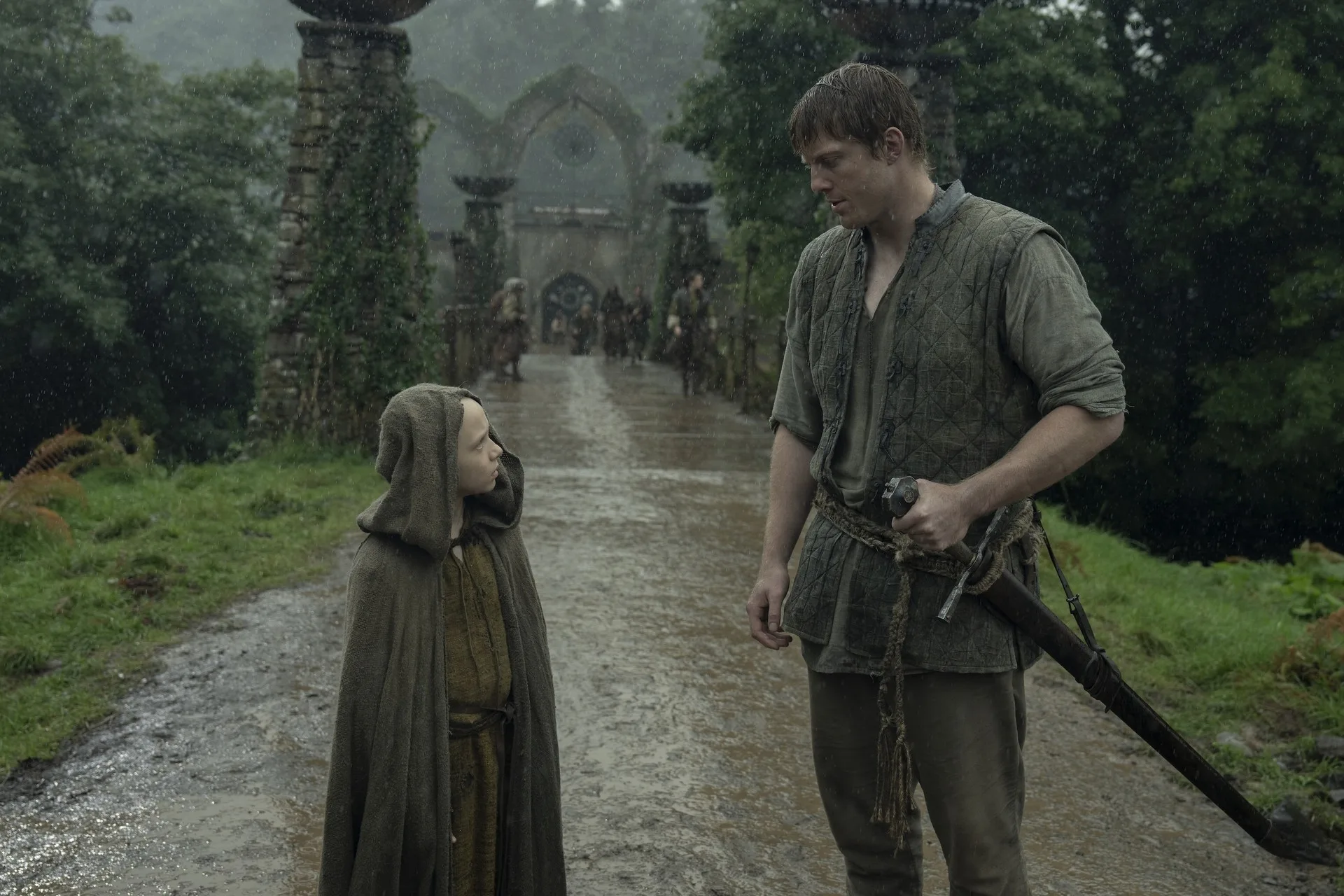
With only six episodes in its first season, it was only a matter of time before A Knight of the Seven Kingdoms put its central mystery to bed, revealing that Egg is, of course, Aegon Targaryen (specifically Aegon V, or “Aegon the Unlikely”, well-respected future rule of Westeros – and brother to both impugnant Aerion and Aegon (future maester of the Night’s Watch and mentor to one Jon Snow). How it does so – as the climactic reveal capping off another fantastic episode about power, fortune, and identity – is a bit unexpected, as A Knight of the Seven Kingdoms continues to surprise and delight with its strong core performances and impeccable aesthetics, all led by strong thematic foundation reaching towards the deeper themes and ideas lying within the Dunk and Egg series.
“The Squire” opens on the future King working with Dunk’s horse, training it alongside himself to prepare for Dunk’s impending entry into the lists. Amidst the fog and early sunlight, the young (and still unknown, having shaved his head to remove his Targaryen blonde locks) squire does the work of the common man, even managing to avoid getting into trouble when he comes in contact with the suspicious, one-eyed Robin Rhysling (also known as one of the most unhinged knights in all the seven kingdoms). But one doesn’t feel like Egg is cosplaying the life of a commoner as he prepares horse and self alike for Dunk’s shortsighted plan to conjure knighthood out of thin air; the escape and freedom Egg feels, especially when there’s no potential pressure to have to out himself and his stature in society, is a palpable one, and is a strong opening scene to establish exactly why Egg’s decided to live this life – and in particular, attach his proverbial cart to Dunk and his own journey of self-discovery.

From there, “The Squire” settles into the familiar rhythms of any story in Westeros, where dickhead Targaryens inflict their violent will on the people, drunk Baratheons sing songs about women with specific sets of skills (specifically, a disabled woman capable of legendary prostate massages), contrasting reminders of the power of both name and “acts of dogged spirits” that drive the stories and histories – and even more specifically, the class systems of Westeros, as Dunk continues to learn that the game of life is one rigged in favor of the rich and powerful in every facet of life.
Even the so-called games noble knights play are privy to the politics of the realm, with Dunk learning that the very conception of the games are imbalanced (noble houses and royals get to pick their first opponents), and that outcomes can not only be decided by fair play, but by asshole nobles exacting their power on the proletariat by breaking rules – in his first fight, Aerion puts his joust through the neck of his opponent’s horse, leading to the horse crushing the knight when it collapsed. And even though nobody likes having them around (Dunk’s new friend Raymun notes “the best thing [a Targaryen] can do is finish on their wife’s tits”), there’s nothing anyone can do but tolerate them – that is, until Aerion takes offense at one of the local puppet shows, and decides to break Tanselle’s finger as punishment, since “the dragon ought never lose” (not surprising behavior coming from the guy known to history as “The Prince Who Thought He Was a Dragon”).
Their mere presence even comes with a significant cost, one they clearly don’t consider; as Dunk learns, hosting the tournament has put Ashford into considerable debt, to the point he’s willing to make his son lose, if only to cover the bills incurred when hosting a tournament that the rich Targaryens are attending – and all the extracurricular demands that came along with it, as they trample over the competitive rules and commit violence on the people beneath them.

Like most of Westeros storytelling, the presence of Targaryens being shitty (and paranoid) drives a lot of the external drama; thankfully, A Knight of the Seven Kingdoms uses their presence more as an accentuation of a much smaller, more emotionally satisfying story of a boy and a man trying to make a name for themselves in the world together. Once again, “The Squire” absolutely shines as a buddy comedy, from a wonderful little scene of Dunk teaching Egg how to sew, to the two sharing a massive breakfast sandwiches – and later, taking in the games together (where we hear Egg yell “Kill him!” in encouragement to Ser Hardyng, before Aerion cheats his way to a horrifying victory); though the Odd Couple-isms of their pairing are incredibly simple, how the series has drawn on their growing friendship as something defining, and even slowly changing, them both is one of 2026’s early surprises, a franchise-reinvigorating depiction of an unlikely friendship filtered through some of the most prescient observations of class and power dynamics offered in the extensive, incredibly detailed and complex history of Westeros.
There is a chance of this series doing what both other Game of Thrones stories have done, focusing on the dramatic elements of the Targaryen narrative a little too heavily to drive its characters and themes; however, Egg’s reveal is smartly positioned in a moment of crisis, after Dunk beats the shit out of Aerion and faces a violent curb-stomping as retribution. Throughout these first three episodes, we’ve watched Egg pine over the simple life he knows he’ll never be able to have; his appreciation and reverence for the makeshift town set up for Ashford’s tourney is palpable, giving voice to both Egg’s desperation to divorce himself from his own lineage – and more importantly, Egg’s inner drive to define himself as anything other than a powerful royal. As Aegon V, he would be known for his willingness to ignore the noble families and his council to develop policies to help the commoners of the realm; this very first act of rebellion is the first brick in the foundation of who Aegon would eventually become – of course, that humility would eventually give way to the usual Targaryen tragedies (as he learns from a fortune teller, he’s going to be king, die terribly, and leave his enemies happy), but for now, it provides a potent backstory for one of the more relevant leaders in the history of the Seven Kingdoms.
With its little pockets of humor and character, combined with its ability to use its small-scale setting to offer much larger reflections on the nature of humans and power, “The Squire” is easily the highlight of the first half of A Knight of the Seven Kingdom‘s freshman season, a careful, meticulous study of character delivered with an impeccably delightful light touch, against the familiar backdrop of corruption, happenstance, and survival that defines so much of the stories in the Seven Kingdoms. And with Egg unmasking himself to quell the chaos at the end of the episode, “The Squire” also marks a turning point for the first season, as the catalyzing event that brings so many of these ideas and people crashing together, like one of the jousts him and Dunk so joyously watched but a few hours earlier.
Grade: A-
Other thoughts/observations:
- Of the three scatological jokes opening each episode, the horse shitting as Egg shouts out commands is easily my favorite.
- “When it’s madness bid, it’s madness delivered.” Though Newton’s laws of motion haven’t made their way to Westeros, they certainly exist in spirit.
- Dunk’s nervous vomiting as a backdrop to Egg singing is a great bit.
- Another sign of the weak and wealthy; it’s well-known Steffon, Raymun’s cousin, will pick an injured knight for his first opponent.

Share this:

Discover more from Processed Media
Subscribe to get the latest posts sent to your email.