
Clarity and profundity often come from the most unexpected of places; I mean, who would’ve thought HBO’s six-episode adaptation of a 90-page novella, set in what’s become one of the most maligned, meme-d fantasy universes in the history of Western literature, would be one of the most endearing, heartfelt series of the year? Though the questions Duncan the Tall asks himself and the gods are much more prescient and existential than the ability to market a niche spinoff of a maligned cultural juggernaut, both A Knight of the Seven Kingdoms and its lumbering, lovable protagonist reach their philosophic conclusions the same way in “The Morrow”: by examining the contents of their respective hearts, through an incredibly well-paced, emotionally rich season finale.
Set the morning after Dunk’s fateful trial and Baelor’s sudden death as Ashford and its visitors pack up and limp gingerly off in their own respective directions, “The Morrow” similarly presents Dunk at a crossroads – both with himself and the gods of the realm. He’s lucky to be alive (hell, the local maester thinks he’s on death’s door already, a notion Lyonel thoroughly ignores), but feels nothing but guilt for surviving (as he tells Maekar during their first conversation, “how can a foot be worth a prince’s life?”), even after Lyonel appears to offer up some comedic Baratheon takes on the Targaryens and their legacy in Westeros. Though Lynoel’s mostly there to gloat of their victory and offer Dunk a job at Storm’s End (“there’s a war coming,” he warns Dunk), his point of view sends Dunk into an existential spiral for most of the rest of the episode, as he contends with suddenly being perceived by the public around him, and tries to reconcile within himself the questions of legacy and identity that have followed him, in the form of Arlen’s metaphorical ghost, for the entirety of the season’s brief-but-perfect six episodes.

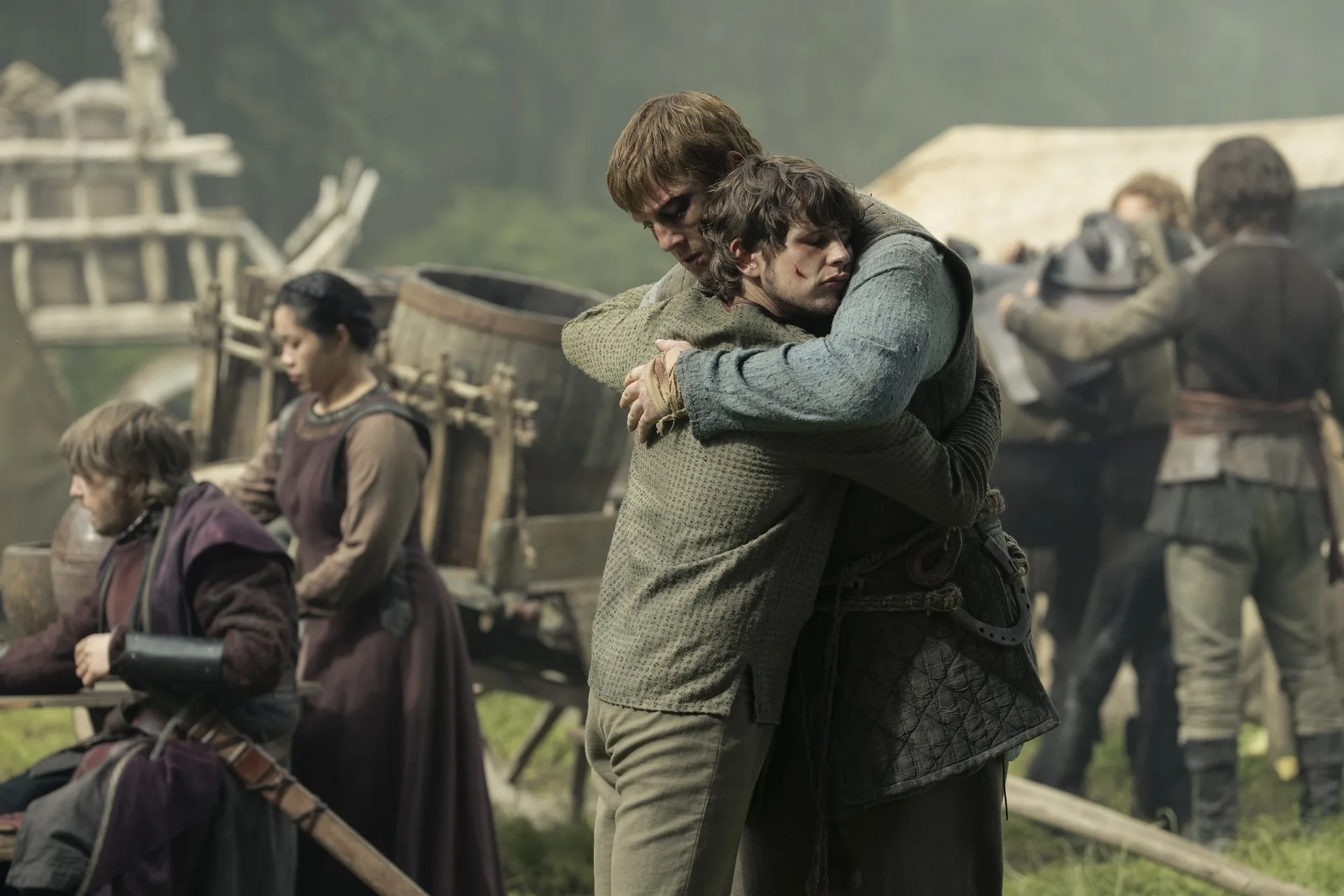
To achieve this, “The Morrow” almost plays like a greatest hits of season one’s themes, as Dunk speaks with Lynoel, Maekar, and Daenor, and enjoys an incredibly long hug with best friend and resident lovable idiot Raymun. Through it, the dystopian nature of all longstanding Westerosian houses brings Duncan pause, as Maekar Targaryen desperately seeks an heir to the throne that isn’t toxic and spiritually corrupted, Raymun contends with his shit-eating family that he’s suddenly found himself in a dominating position over (not to mention a fiancée that is definitely pregnant with someone else’s kid), all of which feel like brief reprises of the show’s explorations of family, class, and power – “The Morrow” shifts away a bit from some of the class theory from previous episodes, but this is more a nature of the season finale being a polished character study than anything it might be missing explicitly.
Ultimately, the feeling Duncan can’t shake is that his work isn’t done in Ashford just yet – and as his deceased, endlessly charming mentor reminds him, “a true knight always finishes his story.” With survival finally behind him, Dunk is able to slowly start to process what happened to him, and start to consider what a life beyond that might be – though he stops short of committing to bring Egg with him, quickly realizing after talking with Maekar (and at least one of his sons that he didn’t beat to a pulp) that leaving Egg to be raised and trained in Summerhall would only lead to more suffering of the realm on the behalf of the Targaryens; and if he was able to get the prince of the realm to not only fight on his side, but die for Dunk to continue, that it might just be a worthwhile fight to try and guide one of the potential (if incredibly unlucky, at the moment) future leaders of that realm – though he’s only willing to do it on his own terms, away from the noise and corruption of spirit Dunk’s spent his whole life either running from, or being subjected to the will of (as we saw in last week’s harrowing flashback).

The final lesson Dunk takes from Arlan is that while it’s good to have a house and a sigil, a knight’s true value comes from their conviction of spirit; though Arlan was a whoring drunk, he rode a path of honesty – and most importantly, saved the life of a child experiencing the worst injustices of the world on a daily basis. Arlan of Pennytree became a man of honor because he adhered to his code, the same way Baelor did – or at least, purported to (Lyonel makes a fair point when he tells him that Baelor fighting Kingsguard who weren’t fighting back against him wasn’t exactly a benevolent pursuit is so goddamn good here). Not all codes are created equal, of course: Raymun’s trying to change that after his cousin’s failed attempt to bring their house to glory, and Maekar spends this entire episode considering that his own code has led his bloodline astray (considering Egg, his youngest, to be the last chance he has at his own spiritual salvation, it makes it all the more ironic when he tries to pawn off Aegon to Dunk, for seemingly practical reasons). What Dunk recognizes, however, is that maybe it’s a lot simpler than that: maybe being a great knight is just about being a good person, about rejecting the tenants of the world as they are handed to you – and even though you might just be another cog in a much larger, more malevolent machine, your impact on the world can potentially be a great one, with the right luck (or the worst luck, however you want to frame it).
“The Morrow” does not take a particularly complicated path to this final thesis; after opening on the morning after the Trial of Seven, “The Morrow” walks a pretty straightforward path to its finale moments, where Dunk – with Egg in tow and his third horse, Sweetfoot, making its way back to Tarth alongside Raymun and his family. But what it does with that path is phenomenal; as a piece asking the question of “what is a legend?” and how to find purpose within oneself, A Knight of the Seven Kingdoms is firmly entrenched as one of the most thoughtful, pleasantly emotional experiences of 2026, a series that not only brings harmony to its theories on class and identity, but of personal discovery, of grief and healing – and, of course, of staying true to oneself no matter what shit pile life might throw your way.

“The Morrow” closes on one of the most elegantly beautiful parting shots in recent memory; after Egg appears to squire for Dunk mere moments before he leaves town (which we later learn is a lie; Maekar never agreed to let Egg experience hard life on he road with Dunk), the two slowly ride off into the unknown, with the ghost of Arlan riding the memory of Sweetfoot, watching over Dunk and Egg briefly until veering off into his own direction into the field, finally able to rest and get back to work now that he’s fulfilled his job of raising Dunk into a respectable young man.
As they ride off into the fields beyond Ashford (a moment set to the eponymous “Sixteen Tons” song from 1955), A Knight of the Seven Nine Kingdoms completes its well-earned victory lap of a final episode, setting up a fascinating set of questions for season two to answer (like what Maekar does when he learns Egg is gone, and what Dunk does when he discovers this lie) while sending itself off to hiatus with a fantastic, assured finale – and a particularly touching final image. A truly impeccable ending to a surprisingly consistent, thematically rich little spinoff series.
Grade: A
Other thoughts/observations:
- “An itchy asshole is beyond your abilities, my friend.”
- Jazz opening and the “Sixteen Tons” ending? Game of Thrones this is not, and it continues to be all the better for it.
- “Plenty of sons have died in their father’s armor. How many fathers have died in their sons?”
- Egg insists there are nine kingdoms, not seven – it’s a good joke, and the final title card is a pretty nice little final joke.
- Oh, poor Raymun, who is about to be a husband… and a father to someone else’s child. That man does not understand what a pregnancy is, and boy, is he in for an awakening we unfortunately won’t get to see!
- Dunk’s a nice dude, but he will push the issue: “You swung the mace, m’lord”) Dunk says when it is clear Maekar is trying to dodge responsibility a bit.
- well, that’s a wrap on A Knight of the Seven Kingdom‘s first season! Season two is already in production, so I will be back whenever season two arrives. Thanks for reading!

Share this:

Discover more from Processed Media
Subscribe to get the latest posts sent to your email.