
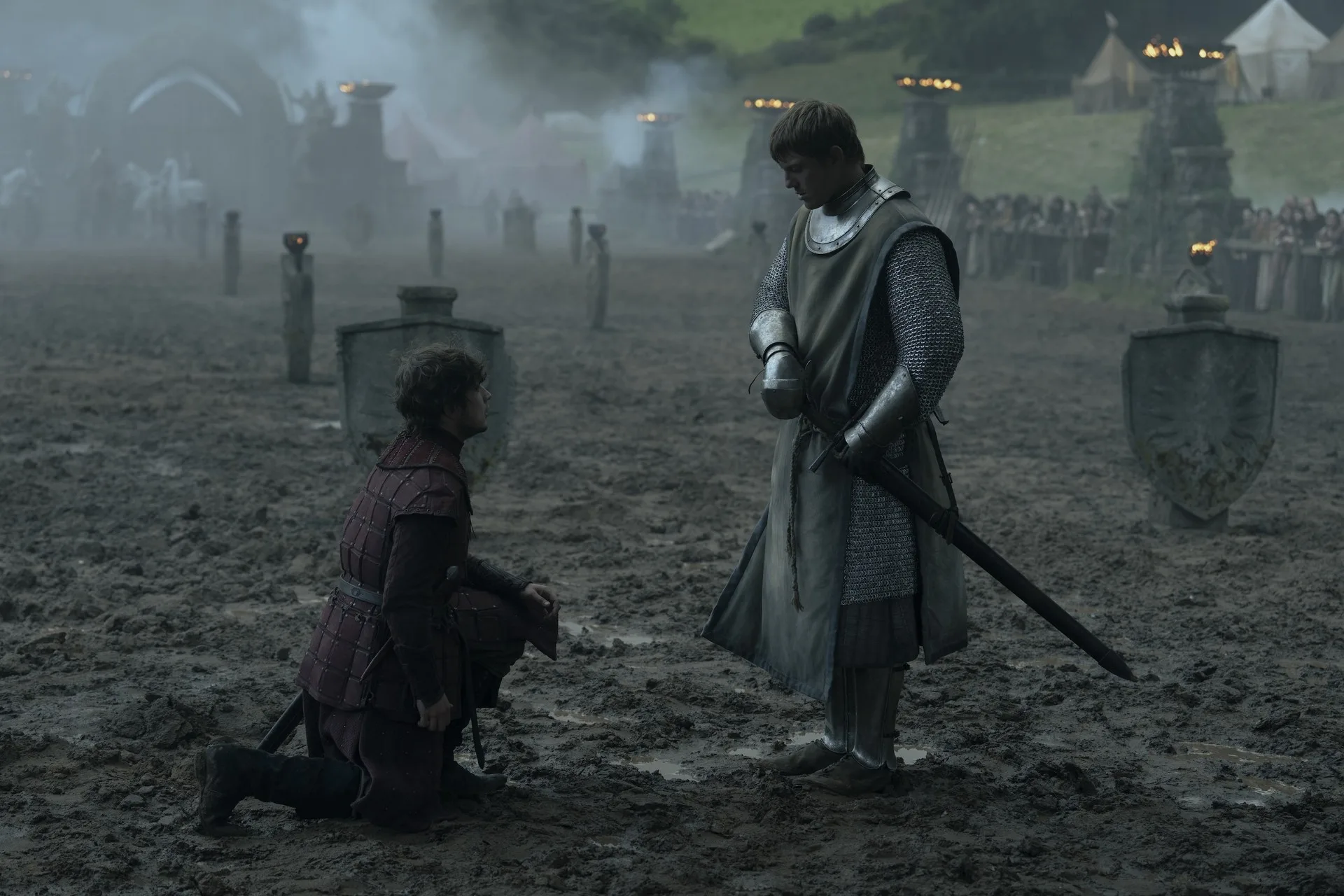
Leave it to the Targaryens to make it all about themselves, right? Though it would be easy to dismiss “Seven”, A Knight of the Seven Kingdoms‘s phenomenal fourth episode, as yet another example of a Game of Thrones story derailed by Targaryen navel gazing; after all, it begins and ends with different members of the notoriously insane royal family (first Egg, then Baelor) rejecting the premises of their families in pursuit of something more tangibly noble. But underneath that familiar surface lies an incredible beating heart, something the series has uncannily built in just a trio of episodes: as Dunk reels from the latest shit pile handed to him by Aerion Targaryen and tries to form a team, A Knight of the Seven Kingdom‘s many elements snap into place, delivering one of the most heartfelt half hours in fictional Westerosian literature.
After admonishing Egg for lying about who he was to Dunk (who opens “Seven” in a dark holding cell, as rain pours down around them), Dunk lets slip that it was “just a bit of bad luck we found each other””. “Seven” then proceeds to point out just how many people have had their own bad luck in the days since everyone descended upon Ashford for what’s quickly become a fateful tournament of class warfare, as Dunk scrambles to assemble a team – one willing to potentially die for someone else’s cause at the hands of the Kingsguard. But instead of focusing an episode on arguments, redundant testimonials, or a by-the-numbers gathering of the not-so-all-star team, “Seven” builds itself around Dunk’s journey of understanding himself through others, of learning that his worth in the world and his newfound community come not from his name or (secretly fake) title, but from the spirit of his actions and words.

A lot of this comes in the form of Dunk simply pleading for common sense (“Would you not do the same?” he asks the Targaryens when telling them of seeing Aerion break Tanselle’s finger) – which, at first, seems to fall on the deaf ears of arcane rules decided by the royal families. First, Baelor notes the fate of the last man to strike someone from the royal family – and then after trying to claim a trial by combat, Aerion first refuses, then busts out an incredibly arcane rule, forcing Dunk to find a half-dozen strangers to fight alongside a Targaryen prince and six trained, well-armored swordsmen (be they relatives or Kingsguard doesn’t matter). After Dunk leaves their tent, understandably defeated that he’d never find a squad to help him fight, he tells Raymun and his father “maybe the gods figure this is what I deserve. For not knowing my place”, a strong reminder of how just how helpless it can feel to live in a world of haves and have nots; specifically, those who have a family and support system, and those who don’t, left to be subject to the whims and wishes of the powerful, brazenly arrogant and infamous Westerosian family.
But just when it seems Dunk is going to hit his lowest point, relief, and even hope, begins to seep in from the most unexpected places, beginning with the apologetic Daeron, who apologizes to Dunk and tells him he’ll basically lay down and play dead as soon as the trial of seven begins, in order to hopefully help shift the advantage to Dunk and his still-unassembled ragtag team of supporters. It’s a strong little moment, but one immediately eclipsed by Dunk receiving the shield Tanselle made for him, a moment that becomes emotional as he sees the dusk behind the elm tree, the fallen stars in the background.

While Dunk tears up, thinking his shield means nothing but death and despair, Pate reminds him: “the elm’s alive man”, hope and protection alike proffered in the form of a simple wood shield (with a little bit of metal supporting its frame, thanks to the incredibly affordable Pate). And when Dunk shows up at the foggy dawn for his requested trial by combat, he’s met by the Fossoways, the constantly thrill-seeking Lyonel Baratheon, and Humfrey Hardyng (the latter of which whom claims Aerion owes them a debt, and they’re fighting to “collect it”). It’s not a full team of seven, but he’s almost there – that is, until the powerful tip the scales in their favor once again, purchasing Raymun’s opportunistic cousin Steffon, and reminding the audience of the family’s unofficial slogan (“A Taste of Glory”, for those whose brains aren’t rotted with useless Westerosian history) – though in Raymun, that manifests in him rejecting his father’s sellsword-like qualities, pledging himself to Dunk by asking to be knighted in the moments leading up to the battle.
Although Lyonel eventually steps in while Dunk makes his plea to the audience, him contemplating knighting Raymun is a hilarious image, one that’s much more subtle in its humor than the big fart joke we get after Dunk finishes his speech to the audience. Here stands a young man, outmanned in a fight he didn’t ask for, believing in a code that he’s already betrayed (remember – Dunk’s not actually a knight) while preparing to make another false knight in the process – if there isn’t a better image of two men in the wrong place at the right time, it’s this one, a moment that marries the goofy charms of A Knight of the Seven Kingdoms with the deeper internal character conflicts that makes Game of Thrones such a compelling saga when it is at its best.

Of course, “Seven”, like all Westeros stories, finds a way to make itself about the Targaryens; in this instance, when Baelor shows up to fight on the side of Dunk, reminding Maeker that underneath all the pomp and circumstance, underneath the accusations and rules and interpretations, is a man fighting for his life by adhering to the rules of the realm, of being a knight who protected an innocent women from the whims and desires of the powerful and reckless. It ends “Seven” on an incredible high note, the dueling reveals of Fossoway and Targaryen switching sides at the 11th hour, setting up a fascinating battle between the entitled royals (and their hired swords), against an embodiment of the spirit of the realm itself, a group of unknown, invariably broken men finding their voice and strength amidst the volume and power of the most powerful, mysterious, completely insane house in Westeros.
“Seven” is a remarkable little piece of work; although it’s only had three episodes to establish its characters and narrative, the focused, patient storytelling of A Knight of the Seven Kingdoms has created a micro-universe of compelling characters, against incredibly strong thematic backdrops of identity and class, all of which come crashing together in the episode’s rainy, dark, dreary, utterly beautiful second half. Already one of the biggest surprises of the new year, A Knight of the Seven Kingdoms‘ has delivered the first great episode of 2026 with “Seven”, setting the stage for what should be a magnificently magnanimous penultimate episode.
Grade: A

Share this:

Discover more from Processed Media
Subscribe to get the latest posts sent to your email.