
A television show can only contrive profundity for so long; no matter how many characters, plots, and ideas a series tries to incorporate, one with a hollow thematic foundation is eventually going to collapse like a house of cards – it’s the reason why so many LOST clones failed back in the early 2010s, a classic, almost industry-wide example of missing the forest for the trees. Daredevil: Born Again‘s second season has slowly but surely started to occupy a similar space, feigning back towards the Netflix series preceding it by incorporating characters and concepts from seasons past – but occupying the present in a much lesser, broader fashion, favoring noisy plot histrionics and a half-dozen, half-baked plot ideas over consistent, engaging material focused on serving character and story in a logical way. “The Hateful Darkness”, Born Again‘s penultimate sophomore effort, is the culmination of this imitative approach: though the shortest episode of the season, “The Hateful Darkness” packs in the most plot it possibly can, stretching its plausibility to the absolute limit as the coincidences and idiotic decisions of our Hell’s Kitchen mainstays pile up – and eventually cascade over, leading to a head-scratching third act that does nothing to set up an exciting season finale, and in fact, works against itself with the most questionable creative decision Daredevil‘s made since killing off Foggy Nelson back in “Heaven’s Half Hour”.
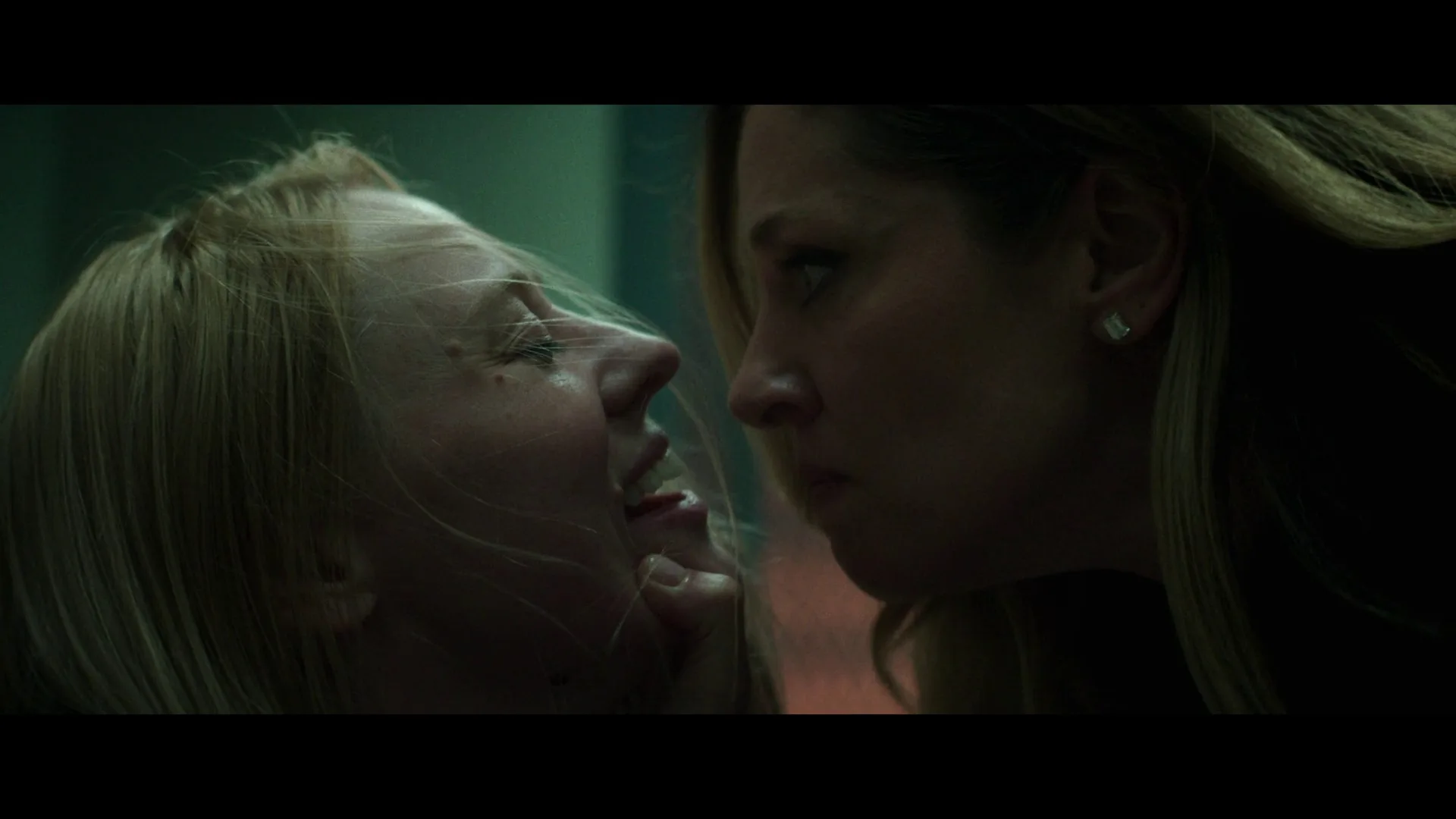
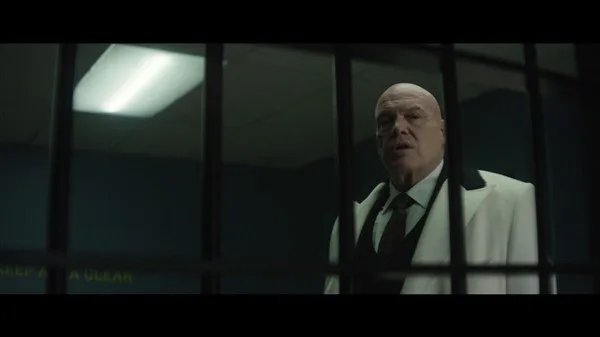
“The Hateful Darkness” opens as the sun rises on a new day in New York, following the AVTF-accelerated riot outside city steps, where Powell murdered Saunders and coincidentally ran directly into Karen Page. Her arrest and booking gives way to a brief visit from Fisk – where it feels like Vincent D’Onofrio has let go of the proverbial leash of his performance, with a sad, angered Fisk that borders on cartoonish (his “HAH” laugh at her is perhaps the most comic book-y moment his character’s had since the days of Michael Clarke Duncan wearing oversized suits in the role). Fisk coming to gloat in front of Karen really makes no sense, logistically; though it does start to revitalize the smartass, annoying version of Karen that defined her in the show’s original run, perhaps the one redeeming element this episode (and this season) has offered her character (allowing her to be something other than the woman Matt kisses on helps here).
From there, “The Hateful Darkness” quickly lets go of any sense of reality or coherence it has been clinging onto; anyone hoping the faceless inhabitants of New York would have any presence after being beat down by the police all night have another thought coming (remember those BB reports on the street? I don’t miss them, but boy, they’d actually make sense to see here to understand the supposed changing public perception of Fisk!), as “The Hateful Darkness” immediately moves into Karen Page’s case in Fisk’s kangaroo court. And what’s really the point of these scenes, except to re-establish that New York exists in some vacuum outside the rest of America in the MCU, as the prosecutor grins villainously and Kristen tries on a toned-down Arthur Kirkland impression, deciding that now is the time to ask the trio of judges “what is a vigilante?” with a wink-wink knowing that her words would be televised (though I swear, if another character says “hearts and minds”, I’m going to self-immolate).
Do we want to take any time to see how Kristen continues to process this, or how the public views this latest court case? Nope, we ain’t got time for that: instead, “The Hateful Darkness” gives us a scene where the governor, alone in her mansion, announces that it’s time for Fisk’s reign of power to end – a sentiment that the mysterious Charles agrees with, while discussing with Jessica Jones plot points that have nothing to do with this show altogether (why is Luke Cage doing merc work overseas? I guess this is something we’re supposed to care about for season three, where we already know the rest of The Defenders will be making cameos?). Even here, we can’t spend any time trying to dig into the nature of Charles or the goals of Jessica Jones; no, instead we get smarmy dialogue about power levels, plots happening elsewhere – and oddly enough, a moment where Jessica almost cries when Luke’s name is first mentioned?
Jessica’s presence in Born Again has been disappointing and weird, nerfing her character’s powers and presence for the sake of… what exactly? “The Hateful Darkness”, again having only 40 minutes to bang through a bunch of plot, doesn’t even stop to consider the ramifications; nope, instead we are whisked off to a scene where Daredevil LETS BULLSEYE LOOSE (under the vague guise of “you should do something good, but I really don’t care where you go”… huh?) and then makes a dramatic appearance in court, bringing Matt Murdock back from the proverbial dead – even though that’s a plot point nobody has mentioned since the season premiere, but is somehow treated as a major, shifting revelation the moment he walks into court. His affect on the actual court case is naught – which makes it feel like a lot of dramatic camera work in service of an incredibly dull, disinterested story.
What’s wild is none of those scenes or developments are even nearly the worst part of the episode: that is reserved for Daniel Blake, whose two-season long arc turns out to be nothing but a bullet point inside the arc of BB Ulrich, when he decides to save her life and sacrifice himself to Buck instead (a plot point Dino Scardapane and team have already said was changed in the editing room, which speaks to why the whole episode feels like it is building to an entirely different moment). In the end, Daniel Blake’s entire character was just a cock tease, a Diet Coke version of Agent Nadeem from Daredevil‘s third season – and one who gets summarily dispatched by Fisk’s lieutenant as Nadeem did, murdered when Daniel’s final pleas to Buck’s humanity fall on deaf ears (“what are you going to do when you’re the guy on the floor?” he asks Buck; feel like he could’ve framed this ideological debate a bit better, no?). In the end, Daniel was merely a nod towards a plot, a character who ultimately only served as a thematic underpinning for an entirely different character, one whose presence and place within the Born Again world has been precarious and underexplored from the start.
At this point, BB is an important character only because of her last name, and because Daniel died for her: outside of that, Born Again has really done nothing to make her an interesting or dynamic character (in fact, her entire arc was that she was friends with someone who was using her to shape public perception), so killing off Daniel to serve her character seems like a real short-sighted decision, even if it makes sense for Buck’s character to do exactly what he did (though again – Buck not killing Daniel in that moment creates an entirely new dynamic for the character, that might give him more than one dimension… we can’t have that!). Unfortunately, Daniel’s decision to save BB is not grounded in anything tangible; we can assume he was attracted to her, but why sacrifice his life for her? She’d done nothing to protect him or his reputation – and on top of that, he was openly dismissive and uncaring about how Fisk was abusing New Yorkers and perfectly willing to continue working to serve his agenda, aspects that were never given any sort of internal conflict for Born Again to explore through him. With his sudden, cheap death, these bits will never turn into powerful, motivating bits of narrative or character to make him a more memorable, and empathetically tragic, figure – which ultimately begs the question of why he was even included in the first place, a character whose utility was never actually utilized by the series, merely alluded to and danced around until being unceremoniously disposed of here.
His death is unfortunately appropriate for Born Again‘s second season, however, which has been a long string of plot points heading to abundantly familiar places. “The Hateful Darkness” and its many mechanical plot developments really just sets us up for yet another familiar season finale, one that appears to once again be refusing to break the cycle between Daredevil and Kingpin (and Bullseye, honestly) – both with their relationship to each other, but also in how they affect and inspire others in their wake. Jessica gets to be the more sanitized fill-in for Frank Castle, Daniel goes the way of Nadeem, Heather becomes a bad guy (more on her in the notes below), and Fisk manages to escape the collapse of his kingdom yet again… what else does Born Again‘s season finale have to offer, but a few supposed plot twists (like Powell’s partner, who seems obvious is going to turn on him), next to a conflation of familiar, redundant, still-unexplored resolutions?
Ultimately, “The Hateful Darkness” reinforces the metatextual lessons of “The Grand Design”; without Foggy, without Matt Murdock, and without a tangible beating heart, there’s nothing to smooth over the show’s many, many rough edges. With its philosophic and religious bents, Daredevil could at least feign towards something deeper as he fought The Hand and Fisk’s spreading corruption; without those, Daredevil: Born Again is really just a lot of unsatisfying dramatic noise, unable to tether itself to anything grounded or material, its approach to story and emotion a soulless pursuit of trying to recreate something that may not have been perfect or revelatory, but rarely ever rang false or hollow. “The Hateful Darkness” is all of those hallowed-out parts, a corpse of what was re-assembled into something slighter and lesser, one oddly without the sense of purpose and vision that drives its titular hero.
Other thoughts/observations:
- There’s an interesting character somewhere in Heather Glenn, but the most interesting, exploratory parts are happening offscreen, in between scenes. Her lack of fear with Fisk and the missing earring is great, as is the shot of Muse watching her as she castigates Karen Page; unfortunately, her arc is more allusion than action, defined only by the external actions of “violence now makes her horny” and “she has flashbacks”. Why is she completely willing to write blank psychiatrist checks for Fisk and his kangaroo court? Hard to be invested in a character who is presumably losing her mind when every action of hers is considered logical and is only referenced in cheeky, half-assed asides by other characters (though I am looking forward to Karen smacking the shit out of her).
- Speaking of Karen, she is the lone bright spot this episode. Who would’ve thought that letting her out of the literal closet she’s been hiding in, might allow her to interact with some cast members and bring some energy to the proceedings?!
- The AVTF just rolls up and starts shooting at Matt, Karen, and Cherry. Are we sure public perception is strong enough for this right now?
- How quickly Vanessa’s been forgotten as anything but a gleam behind Fisk’s eyes is…. incredibly telling for how the show’s kind of always approached her character.
- What is more interesting: Buck as a character who compromised his own horrific persona to build a friendship, or someone who is willing to kill the only person who has shown him humanity? Either way, how the final scene plays out between them is disappointing.
- Hey there’s Cherry!
- The way Jessica’s voice hitches at the very mention of Luke is the kind of shit her Netflix character would’ve never, ever done. Doesn’t help Krysten Ritter kind of looks like she’s thinking “this is really all I’m here for?” every time she’s on screen.
- “Part of me wants to kill you, and part of me needs to forgive you.” Matt Murdock, in the exact same position he was 15 hours of television earlier.
- Matt rushing to say a prayer while he bleeds out in the church is another solid metaphor for Born Again: a series literally killing itself to rush to the unnecessary end of a subplot.