Outside of the phenomenal baseball film Eephus, it’s been a pretty rough year for sports films in 2025, from the indulgent, disappointing Him, to the middling Christy or the incredibly unfunny comedy Happy Gilmore 2 – but with two sport-focused Safdie brothers projects (albeit individually, following their recent creative split) releasing during the holiday season, there seemed hope for the genre to end the year on a high note. And what a pair of divergent projects they turned out to be; while Benny’s The Rock-starring Mark Kerr biopic is a middling, formulaic sports biopic, Josh’s Marty Supreme is one of the best films of 2025, a powerhouse statement of aesthetics and performance that set the stage for a remarkable character study of masculine ambition and capitalistic pursuits of greatness, like an absurdist, modern mix of Rocky, Whiplash, The Sporting Life – and, at times, Josh and Benny’s last cinematic collaboration, the phenomenal Uncut Gems (another terrific, unorthodox sport film).
Marty Supreme follows 23 year-old Jewish shoe salesman and professional table tennis player, Marty Mauser, as he tries to bend the world to his will to achieve his self-professed vision of greatness. But like any great sport film, Marty Supreme is really more about observing a man on the precipice of change – just not the one its protagonists think they are on, of course. Marty, a young Jewish-American trying to stake his claim in 1950s New York, is pathologically persistent; of woman (including a washed-up actress whom he becomes infatuated with early in the film, played by Gwyneth Paltrow), of wealth – and most importantly, of greatness, of which Marty sees table tennis as a stepping stone to a higher mountain, rather than a peak to which he can call his very own.

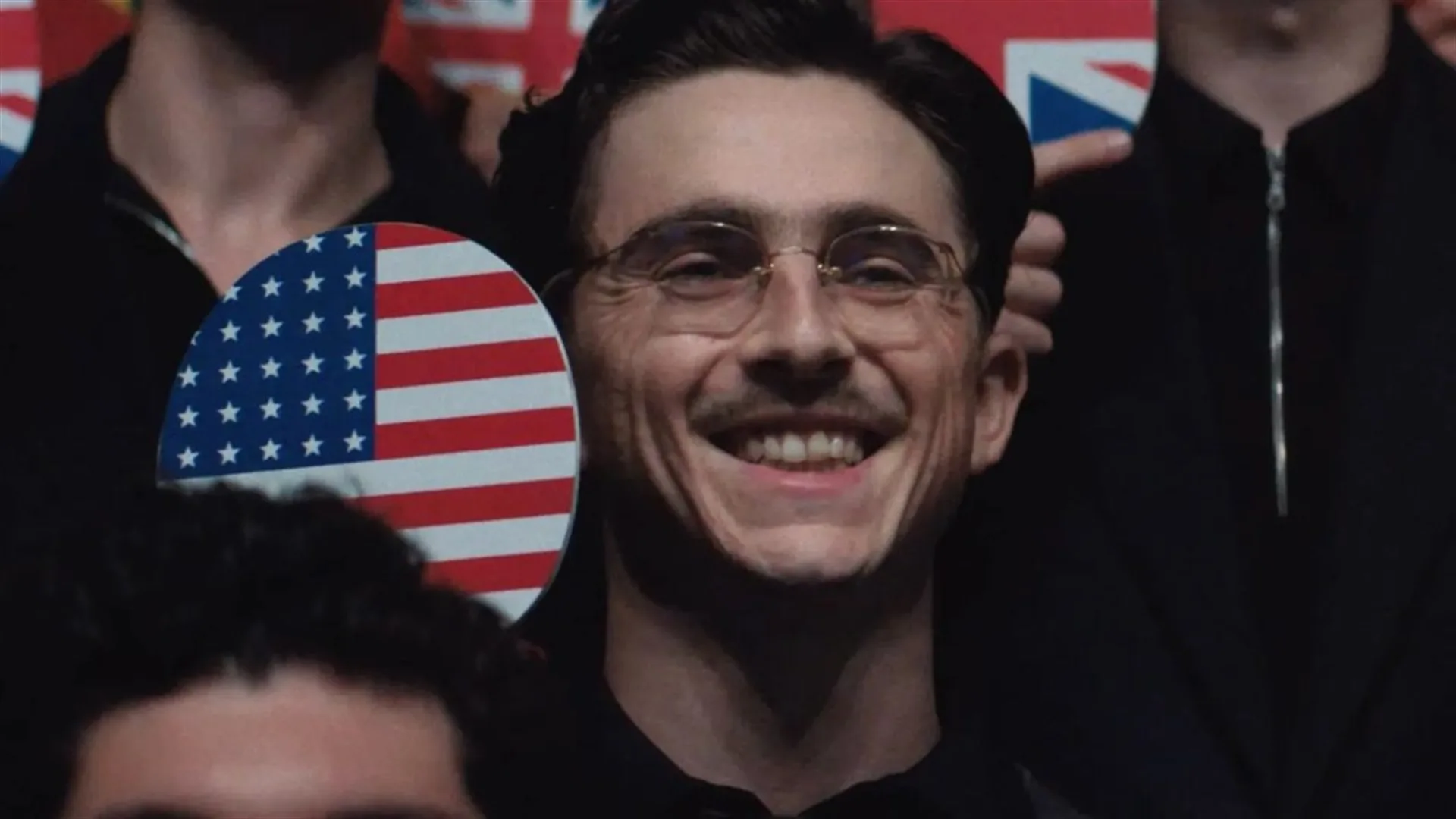
Marty’s presence is all intoxicating, electrifyingly annoying id; and Chalamet, whom the role was clearly written for (and slightly about), disappears into the role with all the aplomb of a young Pacino or Redford. The mustached Marty Mauser is not just self-righteous in his pursuit of relevance; he is downright religious about it, at one point in the film chopping off a piece of a pyramid in Cairo to bring back to his mother as proof of his own pious self-designation (“we built that!”, he reminds her). Marty drowns himself in self-effacing details and suits that are two sizes too large for him, in an incredibly overt, effective nod to the presence he feels he brings to the world, both ping-pong and writ large; that outsized personality is not only reflected in the costuming, but in the incredibly big, bold performance from Chalamet, who literally bares his ass and gets spanked at one point for the opportunity to pursue his dreams.
Marty Supreme, of course, is a film of many performances; Chalamet’s at the center, obviously, but a bevy of terrific guest stars – including Abel Ferrera as a shady individual, an almost-unrecognizable Penn Gillette as a paranoid farmer, and even frickin’ Kevin O’Leary (yes, the Shark Tank guy currently jacking up prices on high-end sports cards), whose tongue-in-cheek performance as a business man (and husband to the woman Marty occasionally sleeps with) is an unexpected highlight of the film. But Chalamet is the film’s center, a performance that channels De Niro, Pacino, and Redford alike in its willingness to examine the mix of ambition and masculinity driving their protagonists to such extreme pursuits of greatness, and the wicked ways in which their failures only push them farther to their undefined, often immeasurable goals.
At times, like any Safdie film, Marty Supreme‘s aesthetics exist on the edge of absurd indulgence, full of big performances, breakneck pacing, and a manic push and pull between silliness and profundity that often feels like it’s teetering on the edge of oblivion. I mean, there are entire side plots about lost dogs and orange ping-pong balls that often exist merely as tone pieces amidst Marty’s desperate pursuit of lasting relevance; in lesser, more wandering films, these side stories could easily drag down a film whose running time (at a whopping, if pleasantly unsuspecting, 150 minutes) can occasionally feel at odds with its thematic and emotional brevity.

But for the most part, save for a second-act departure that works mostly because it feeds off the chemistry between Chalamet and (of all scene partners) Tyler, the Creator, Marty Supreme‘s lengthy running time and aggressive pursuit of its themes work in delivering a generational film about the pursuit of exceptionalism – and whether realized or not, the accomplishments, no matter how great, often pale in comparison to the price one was willing to pay, or sacrifice they were willing to extract from themselves in order to pursue that greatness. And unlike previous Safdie films, Marty Supreme takes this idea to the next logical step, in a terrific final sequence that pushes Marty into a new, unfamiliar, and extremely uncomfortable place, one that recontextualizes its protagonist’s entire worldview with one final shift in perspective – one that suggests, unlike many of his previous films, that those solipsistic extremes are capable of greatness and horror, but also, in their most beautiful moments, growth and inner peace.
Marty Supreme is a film that tries to be many things, but all in an incredibly focused pursuit of a singular character’s vision of what they think the world is; seeing that observed and challenged across the film’s nearly two-and-a-half hour running time is a remarkable, stylistic delight of incredibly strong performances, impeccable production choices (Jack Fisk’s period design is astonishingly good, in particular), and kinetic storytelling – not only one of the best movies of the year, but among the best sports films of the 21st century.