(Editor’s note: Seasons 1 and 2 were reviewed under an earlier editorial standard and format. They’ll be revisited in the Second Look Remastered series, running January – June 2027. Subscribe to Processed Media (it’s free!) so you don’t miss the updates.)
Need I introduce Friends? I’d be hard pressed to find a person over the age of eight who hasn’t passed along an episode of the show at some point in their lives – especially considering it’s still in heavy syndication on networks like TBS and Nickelodeon. But I’ve always found Friends a fascinating case of a show that managed to stay on TV for over 200 episodes, while never really ever becoming a great show – and in fact, being surprisingly mediocre for most of it. There aren’t any seasons that begin to approach the brilliance of Cheers‘s first season or Seinfeld at its best, but somehow, it’s a show that remains in the collective minds of almost any TV viewer reading above an elementary-grade level.
Going back and watching the Friends pilot from the fall of 1994 is an interesting experience, even for myself, someone’s who watched through the entire series at least a half-dozen times in my life. One of the more difficult tasks of ensemble comedies – especially multi-camera shows filmed in front of live audiences – is to find the right balance of personalities among a large cast. Most struggle doing it with two to four, and Friends took on the daunting task of featuring six main cast members, with a concerted effort to keep all six of them involved in story lines an equal amount.
Needless to say, this makes chemistry in the pilot very important, and that’s where Friends nails it in the first half-hour in ways the majority of comedy pilots don’t even sniff at. That camaraderie is one of the things that would define the show throughout its series, and in the pilot, it gives this version of New York a familiar and lived-in kind of feel. Part of this comes from the great weaving of mythology into the various plots – one of many strong parts of the show the writers would eventually beat over the head until it was a bloody mess – which gives every member of the Central Perk Six established relationships to lean on, making it feel a lot less overt introductions to characters and their personalities, which makes the entire episode feel less strained than most shows (especially in this day and age, where two bad episodes can lead to cancellation).
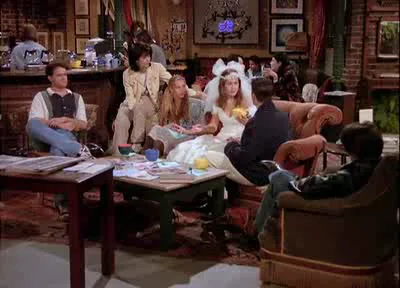
But that’s not to say ‘The Pilot’ is without a definitive event – in fact, Rachel walking into the coffee shop is where the series really begins its narration. As we all know, Friends‘s big series arc is the relationship of Rachel and Ross. In my opinion, the show wasted all of our times with the last seven seasons of ‘will they, won’t they’ by giving away the ending in the first scene. Ross says all he wants is to be married again, and just like that, Rachel walks in the door. The timing and the composition of the shot makes one thing quite clear: the writers want these two to end up together.
Unfortunately, it makes their relationship the crux of the show, and considering they’re only a couple in 27 of the series 236 episodes, there’s a lot of time wasted in later seasons with wedding vows, numerous horrible season finales, and the single worst line in the show’s history: “we were on a break”… which really is just a waste of the viewer’s time, when the entire arc of their love story is definitively established in the first ten minutes of the show.
I’ll stop before I get on a tangent. Getting back to the characters, Ross is arguably the most fully-rounded character on the pilot, a man whose dealing with some of the biggest blows a young adult can take to their self-confidence. His wife’s left him to move in with her lesbian lover, and the biggest, most unfulfilled crush of his life is now best friends again with his sister, hardly the situation a vulnerable , slightly nerdy paleontologist wants to be in. By far and away, he’s the most nuanced character in the pilot, even though he still fits smoothly into the archetype of ‘nice guy with a broken heart.’
The rest of the cast doesn’t bode so well. Joey’s a very thinly written Italian city boy who loves pussy and sports, and Chandler isn’t much but a sarcastic, insecure mouthpiece for jokes. The women are given a bit more depth – Rachel’s phone conversation with her father about not being a shoe displays a little more intelligence than expected from the typical rich, dumb girl, but Phoebe is just floaty and hippy-ish, and really nothing but a launching pad for random humor. Thankfully, Monica’s plot reveals her to be much less of an emotional roller coaster than most mid-20s single women were portrayed in the early 1990s when it came to sexual relationships. It also established Monica as the most level-headed character of the group, something the writers would begin to quickly unravel throughout the first season.
It’s funny to think now how much NBC was uncomfortable with her plot, going so far as to hand out questionnaires to test audiences to see if they thought Monica was slutty. In the original script (which had the awful title of Insomnia Cafe) she didn’t really ever care about Paul, and that small concession was made to the script, which I don’t think really affected the story line at all; I just find the dated reaction to her behavior to be hilarious, considering the landscape of females in network sitcoms today.
In reality, the first episode of Friends doesn’t do much but present itself as a Seinfeld knock-off with less intelligence, something a lot of reviewers caught onto during its premiere, and rightfully so: a few of Friends‘s earlier scripts were clearly inspired by Seinfeld scripts and story ideas (having found many writers for the first season by sifting through Seinfeld spec scripts, this is not that surprising). But like I said, the pilot’s strong points is the cast’s chemistry and the way it establishes their interpersonal relationships, not in presenting super original or witty comedic premises with some kind of high-concept design. It’s exactly what its title suggests – people hanging out – and at that, ‘The Pilot’ does a pretty damn good job of it.
Other thoughts/observations:
- every week except the premiere and the finale, we’ll be covering two episodes at a time. Just a lot to talk about in the pilot.
- Joey wears so much leather in the pilot, it’s not even funny.
- another sign Friends was supposed to be the successor to the Cheers throne: the first four episodes are all directed by long-time Cheers director James Burrows.
- there are some terrible haircuts in the pilot. Monica, Chandler, and Joey all benefit from a fresh cut before the filming of the second episode.
- the first sign the creators of Friends can’t keep their continuity straight: Ross’s parents already know Carol is a lesbian (Monica tells us this with a joke about the phone conversation), but the second episode revolves around Ross trying to tell his parents about Carol. Yes, and the fact that Rachel knew Chandler, although this was more of a sign of the show’s laziness and self-obsession in later seasons, than a lack of continuity here. Oh, and Barry’s last name in this episode is Finkle, not Farber as it is throughout the rest of the series.
- David Schwimmer received a lot of positive attention for his acting in this first season, but in the pilot, he’s way too physical and practiced, showing way too much of his stage training than his comedic chops. The difference between his body movements and the exaggerated mannerisms of Matthew Perry’s Chandler are subtle, but very noticable. It’s a trend that will carry on throughout the series.
- If there’s one line that sticks with me from the pilot after 18 years, it’s “I think I just grabbed a spoon.”
- Up next: Ross’s life changes in “The One with the Sonogram at the End”.
Your reviews are very good, great use of words and concepts. Only gripe is a woke undertone/bias is very evident throughout them all, specially with using (or implying) the term “misogyny” oh so very lightly. You are quick to call the promiscuity in the male characters (“Joey likes pussy”) and water it down in case of the female characters (“I find it dated and hilarious that NBC was worried about Monica’s coming across as slutty”).