
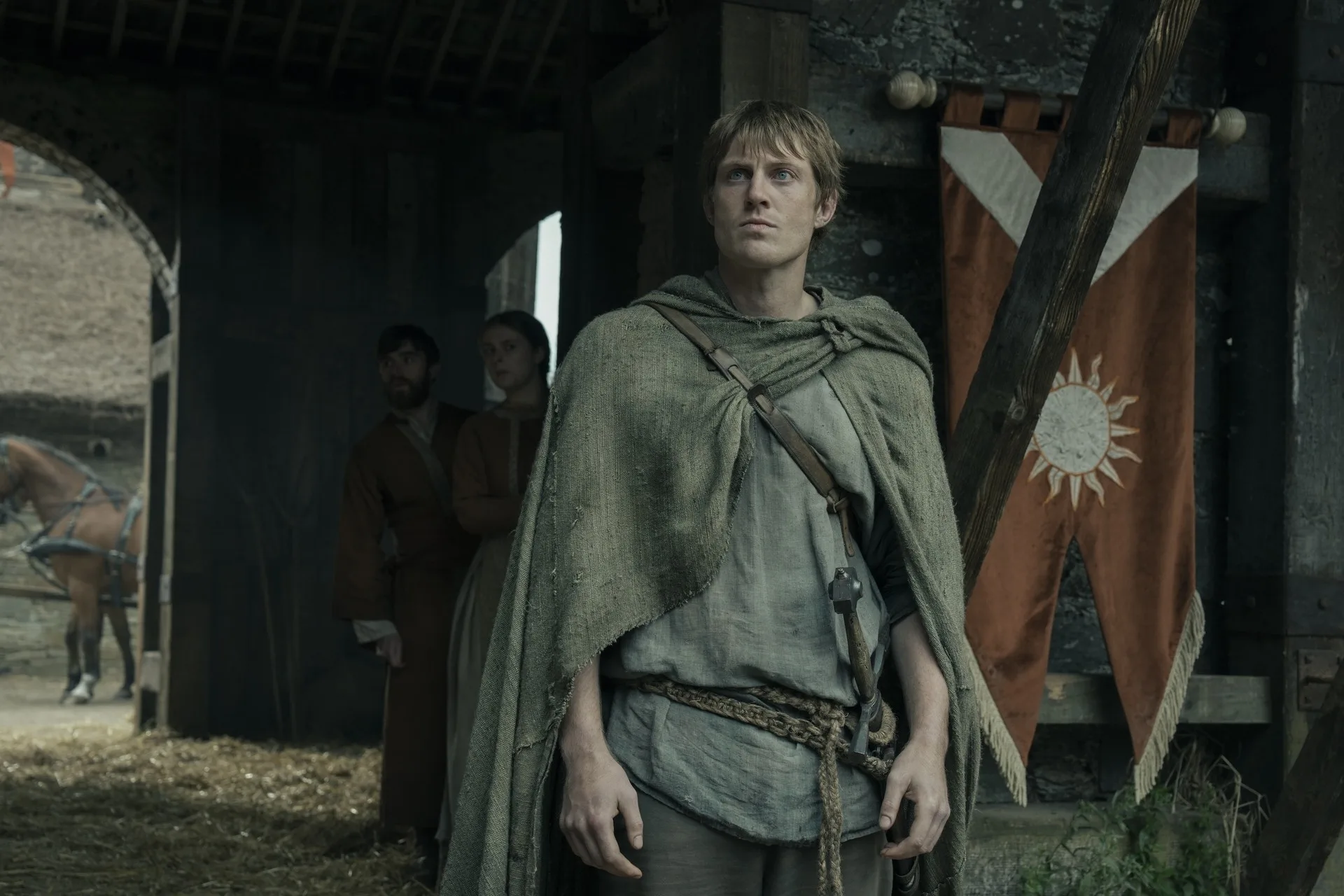
Life of a hedge knight is hard – and for one with a bad work ethic, a drinking problem, and an enormous dick that always got him into trouble like Ser Arlan of Pennytree, it’s not exactly a story that lends itself to any kind of exciting, or memorable, legacy (except the myths and legends of his adventurous cock, of course). More importantly, it’s not a story that anyone who employed him ever remembers; as Duncan the Tall learns over and over again in “Hard Salt Beef”, A Knight of the Seven Kingdom‘s terrific second episode, the rich don’t give a shit about the plebs of the Seven Kingdoms, those who serve them and enrich their lives – it’s not a very subtle metaphor, but an undeniably effective one, as Dunk learns the meaning of legacy, and more importantly, who is allowed to have one in Westeros.
After opening on a touching little montage of Dunk narrating his experiences with the simple nuances of Ser Arlan’s life as a knight, “Hard Salt Beef” picks up right where “The Hedge Knight” ended, with Dunk trying to ride the coattails of Arlan’s legacy into a spot in the infamous lists (under the illegitimate claim that he was knighted before Arlan’s death, lest we forget). And what he’s met with, whether its with House Floren, Tyrell, or even his initial interactions with House Targaryen as they arrive in Ashford, is apathy; nobody remembers the man who raised Dunk and taught him everything he knew, leaving Dunk desperate to find anyone willing to vouch for him to be put on the lists (even the Kingsguard are weary of Dunk’s claims to be a legitimate knight).

Things are looking real grim for Dunk, until he follows a servant down a long hallway and finds himself eavesdropping on Baelor (who, at this point in time, was Hand to the King) and his bitchy older brother Maekar, as they talk about the latter’s pair of missing children, Daeron and Aegon (brother to eventual master of the Night’s Watch, Aemon, of course). For a brief moment, A Knight of the Seven Kingdoms gets a bit bogged down in its own history, as it is won’t to do – but when Dunk comes in and triggers Baelor’s memory of a decent, uncelebrated knight who took him four lances to defeat in a tourney (held by the Baratheons, of course), “Hard Salt Beef” only allows its indulgence to be temporary, as Baelor ensures Dunk’s participation in the upcoming tournament.
But once he’s officially on the lists, Dunk has another major revelation: he’s a knight without an identity, one who can’t live on the borrowed, oft-forgotten legacy of the man who raised him. And as Dunk (with Egg tagging along, knowing an awful lot about the Targaryen lineage) tries to find an artist for his sigil and somewhere to get armor for his upcoming fights, he realizes he’s set up for a game that isn’t designed for him to win, especially with a Targaryen in the tournament, their resources and equipment far beyond anything Dunk would even be capable of considering, had Arlan saved every single penny he’d ever made (and not spent it all on whoring and drinking, of course). Just to get a small set of armor, Dunk ends up having to sell one of his three horses, already compromising a bit of the legacy Arlan left behind in order to even have an opportunity to compete against those with more experience and more wealth, whose entire prospects for their future don’t lie on their ability to overcome insane odds and hopefully, maybe just catch the attention of a prominent house to make a better life for himself.
Though much of this weight of legacy and intent hit Dunk as he watches the tourney begin (with a Targaryen and Tully competing, no less), it’s in the scenes before that this tension between the classes of Westeros are acutely felt – especially when he has to sell the horse Arlan rode his entire life, a piece of the legacy he feels so compelled to continue. As he tells Egg, Arlan wasn’t a great man, a man lauded with trophies or adoration – but he was a relentless one, someone who raised Dunk to be a person of honor, whose soul wasn’t always defined by the contents of his wallet (or the next person willing to fill out). And as the only family Arlan had left (with no lands, no children, and a nephew who died as his squire), Dunk feels the weight of Arlan’s entire life, of a man who “fought a hundred wars but was enemy to none” only to be completely forgotten by the world and people he served, nothing but an expendable, faceless commodity that exists only to pad the lives and legacies of those more fortunate than him.

Those cruel realities are occasionally explored in A Game of Thrones – but it’s necessary to revisit it here, as A Knight of the Seven Kingdoms tries to distinguish its storytelling from its central opus, which is nothing but a tale of how a bunch of wealthy people ran amok and fucked everything up for everyone (I’m paraphrasing… but it ain’t wrong). Through Dunk, A Knight of the Seven Kingdoms accesses a different part of Westeros culture – and through a protagonist like Dunk, a softer, much lighter version of storytelling, one that’s already serving the show well in establishing its tone (although if we continue to have shots of genitals and/or defecating in the opening scene, it’ll certainly start to a feel a bit formulaic), whether it’s Dunk fumbling through his first interaction with Tanselle, or talking to Egg about his outlandish dreams of becoming a hedge knight who works for the richest, most prominent house in Westeros.
If there’s a drawback to “Hard Salt Beef”, it’s in the other half of the show’s central pairing; beyond being established as an eloquent child with a very obvious secret, Egg’s presence in these first two episodes is a bit shapeless (sic), relying more on filling in Egg’s character in his reactions to Dunk and the world around him, in what’s a clear case of a series afraid to say anything about a character until they can say everything about a character (to which I say… why do we have to play so coy about this? Isn’t it obvious – and wouldn’t the storytelling be more satisfying if his identity was a little more consciously explored, even if it’s only with the audience having explicit knowledge of who he really is?
Regardless, “Hard Salt Beef” is an incredibly encouraging – and occasionally, even touching – second episode, one that reiterates much of what is established in the first episode, but through an interesting contrast in class and identity that I hope continues to be a thematic core of this first season. One thing is for sure; from its setting, to its costuming, and the clearly-restrained budget of the big, climactic jousting sequence, A Knight of the Seven Kingdoms is embracing its smaller scale and budget – and is all the better for it, delivering exactly the kind of irreverent-yet-still-resonant storytelling that could be just the endearing salve still-bitter fans of the original series need to dip back into the rich, insanely layered and still-intriguing history of Westeros HBO clearly intends to continue exploring (even if the author himself is struggling to).
Other thoughts/observations:
- The real moment the class commentary kicks in is when Dunk realizes that the legend of Donnell, the crab fisher who became a champion, is complete horseshit, Donnell being the son of a crab fishing magnate who owns half the industry in Westeros. Nepo babies!
- If there’s one big nitpick to this episode, it’s in some of the editing; the busier sequences get, the more A Knight of the Seven Kingdoms relies on some odd cutting techniques that are distracting (and often, ineffective).
- Yet another great example of economic status in Westeros: Lyonel recruits Dunk and Egg to participate in a rope pull, then leaves halfway through the match to get a drink before returning to win. The impact of his presence? Minimal – but he sure gets to do whatever he wants the whole time and celebrate after, regardless of his contribution.
- I agree – biting the head off a raw fish to kick off the tourney gives some weird vibes.
- Dunk deciding to make his sigil a sunset with an elm tree is an adorable tribute to his not-father.