
(this review originally published in UpPortland Magazine)
The context surrounding Martin Scorsese’s 25th film is almost as interesting as the film itself: its $159 million budget, its casting of Joe Pesci (in his first major film role in nearly two decades), the on-screen reunion of Al Pacino and Robert DeNiro, and the expensive de-aging technology employed to allow The Irishman‘s story to span four decades of time. All things considered, it seemed like a safe (if rather expensive) bet for Netflix, a conflation of cinematic icons and buzzwords, in what almost feels like a film designed by the streaming giant’s algorithm.
And yet, The Irishman is arguably the best film of 2019, a mediation on legacy, family, and existence that comfortably sits among the greatest films of Scorsese’s career.
Based on the biographical novel I Heard You Paint Houses, The Irishman is, in a way, Scorsese’s love letter to his own career, a defining gangster epic that pulls absolutely no punches during its 209-minute run time. But it is much less self-righteous and indulgent than that idea suggests; more a somber reflection than an outright celebration, The Irishman meanders its way through the story of Jimmy Hoffa and the labor unions of the mid-20th century, a slow burn reaching towards the existential questions deeply ingrained in his career’s work.
Framed as a series of conversations aging mobster Frank Sheeran (Robert DeNiro) has in his retirement home, The Irishman is a devastating reflection on one man’s recollection of life experiences – and more specifically, the arduous spiritual journey one experiences as they reflect on the accumulation of time, trying to find meaning in the short time we spend conscious of the world, and people, around us.
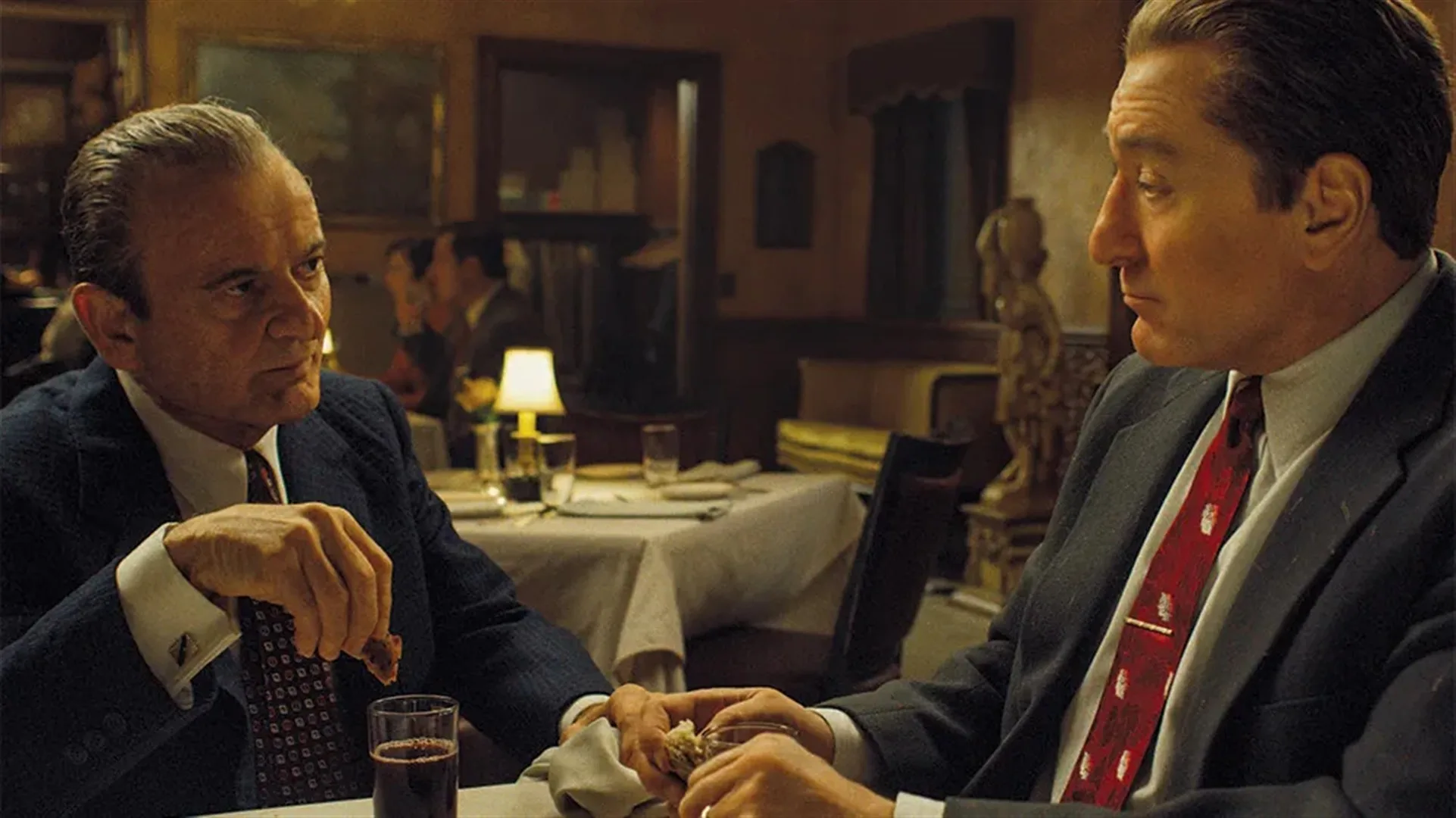
On the surface, it makes for a pretty typical Scorsese epic: accentuated by bursts of violence, The Irishman spends its time deeply concerned with the fragile egos of its protagonists, led by Sheeran, the infamous labor king Jimmy Hoffa (Al Pacino), and Pennsylvania mobster Russell Bufalino (Joe Pesci). Filled with the usual conversations about respect, purpose, and Cathoic guilt one expects from the director of Goodfellas, Mean Streets, and Silence, The Irishman‘s use of flashbacks re-contextualizes much of the familiar thematic work, using the weight of time as an emotional anchor for the familiar pastiche of historical moments and lived experience the film’s many scenes are composed of.
It accomplishes this task through its running time: there’s a reason The Irishman is Scorsese’s longest film (clocking in a monstrous 209 minutes), and it is not out of indulgence: the film’s running time is indicative of its protagonist’s journey through his own memories, an accumulation of moments and ideas that explodes into devastating emotional resonance during the film’s final 40 minutes. Scorsese forces the audience to meander through time with Sheeran, the temporal weight of his life’s arc and The Irishman‘s running time symbiotically deepening the thematic depth of its existential ruminations.
As challenging as it is curious, The Irishman‘s slowly begins building to its emotional climax through the film’s brutally brief moments of violence; many ancillary characters are introduced with the film announcing their later death, and what on-screen deaths occur, happen with such extreme immediacy and brevity, they begin to tease out the deeper ethos of the film. The Irishman isn’t about a big betrayal, a meaningful reveal, or dramatic, surprising twists: it strives to be exactly the opposite, a long, winding road to inevitability, a life accentuated by Scorsese’s usual ruminations on toxic masculinity, family, and legacy.
It culminates in one of the most shockingly somber endings to a Scorsese film one could imagine, further cementing its place as one of the director’s most melancholic, hauntingly reflective works. None of it would work, of course, without the trifecta of stars at its center: part of The Irishman‘s genius is how it brings its three iconic stars together, and compels them to deliver their best work in decades.
DeNiro and Pacino alone are worth the price of admission; the real revelation, though, is Pesci, who returns to film with a performance that captures the very soul of The Irishman in a careful, majestically nuanced performance. As Russell Bufalino, Joe Pesci delivers one of the decade’s defining performances, a man whose presence alone captures the film’s moving ponderences about time, legacy, and the actions that define a man’s life. Rumor has it they had to ask Pesci over 50 times to take the role; his performance justifies that persistence, a transcendent performance that serves both its role as the emotional and thematic heart of the film, and a defining component of The Irishman‘s meta-textual curiosities.
Though the blockbuster team-up of 2019 will probably be remembered as Avengers: Endgame (an equally-lengthy movie, similarly concerned with the idea of legacy and history), The Irishman is the truly definitive blockbuster of the year, a combination of familiar elements and ideas that blossoms into a a comprehensively breathtaking cinematic experience.