
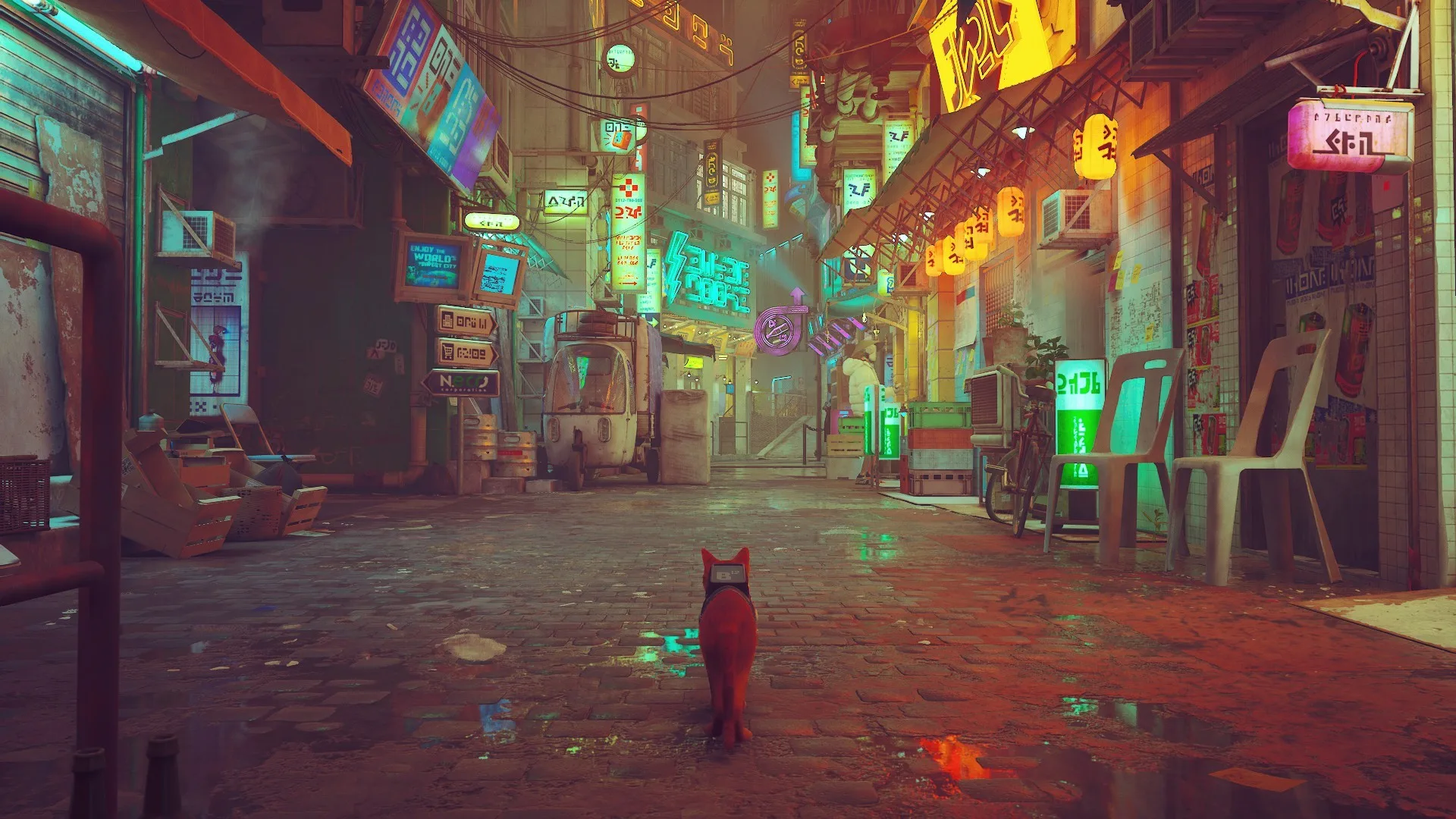
Animals have always held a special place in video games, much as they do in life, to the point there is a (pretty fantastic) Twitter account solely dedicated to denoting whether the dogs in a game are pettable. However, outside of quirky bits like “press X to pet”, or anthropomorphized 90’s protagonists of games like Sonic, Gex, and Banjo-Kazooie, video games have struggled to build out full-fledged experiences around animals as we know them. There’s no Grand Theft Auto equivalent where you run the streets as a wild dog, or a mainstream business management sim where you play the hive mind of a queen bee – which is strange, considering how much time we find ourselves contemplating the lived experiences of the animals we share the world with.
Even with the technological leaps of the 2010’s, these games were still few and far inbetween; games like Playstation 3 game Tokyo Jungle and the indie platformer Cat-lateral Damage edged closer to these more realistic experiences, but were still limited by the trappings of limited game budgets and imperfect game engines to express the experiences players are really looking for. And as games move towards a homogenous mix of open-world loot games, the niche of developers trying to find artistic expressions of animal experiences grew smaller and smaller.
The 2015 Kickstarter project Home Free looked to be a step in the right direction; built as a procedural open-world adventure game, players would live the life of a dog, interacting with humans and other animals while running around an expressionist version of a modern urban city. But in June 2022, the creator announced the project had suffered from scope creep and essentially been canceled, leaving a big hole in project supporters waiting over a half-decade to finally have such an experience.
All of that context is important, considering the reaction around Stray when it was initially announced at Playstation’s June 2020 Future of Gaming event. Quite frankly, everyone lost their collective minds at the possibilities of what the trailer presented, which was an orange cat, lost in a post-apocalyptic city run by robots and devoid of human life. With a few meows and tail twitches, the exciting promise of Stray was clear – and became even more exciting when it was announced it would release in July 2022 for $15 on Steam, and free for users of Playstation Plus Premium (the new subscription tier that is definitely not worth paying for – a discussion for a different column, perhaps).
It’s telling that I’ve spent half this column talking about the context around Stray rather than Stray itself – which is fitting, given that Stray is nothing but another moment of slight disappointment for anyone like myself still holding out hope for that experience (I just want to play cat Yakuza, is that so hard to understand??!!!). Stray, despite what its trailers suggested, is closer to a point-and-click adventure from the late 1990’s than it is to the semi-open world experience everyone anticipated.
It’s not a bad game, but it’s certainly one of extremely limited scope and ambition; each chapter of the game’s story takes place in very limited spaces, only traversable by prompts (‘press X to climb on this specific part of a railing’, for example) and repeated bits of character flavor – your cat can knock over paint cans, can scratch specific sections of carpet, and interact with very basic elements of the constructed game world.
It certainly begins strong, with a harrowing intro doubling down on the fear and loneliness accompanying a young animal separated from his furry family. But quickly, Stray becomes less a game of exploration and a cat’s experience, and more about its story – which, without giving things away, involves science experiments gone awry, a talking robot, and a whole lot of very basic puzzle-solving and platforming, none of which coalesce into a meaningful experience of embodying a cat.
Quite frankly, the game’s adherence to a narrative is its downfall; Stray’s initial promise of embracing the chaos and possibility of a young cat running wild through an ownerless city (absent of cars and moving vehicles, which I feel is an important prerequisite here). That journey of identity and discovery is contained to its world and apocalyptic mystery; by the time it gets to the end of its four-hour experience, playing as a cat almost seems counter to the experience of the game, which is as brief and underwhelming as it sounds.
There’s nobody in the world who wants to love Stray more than I; and as a bit of curiosity with some great environment design and animal animation, Stray succeeds as a cheap entry point for gamers yearning for a feline gaming experience of some depth. But the potential of what Stray’s premise provides belies the experience that’s been built; that dissonance, unfortunately, exposes the game’s mechanical and narrative simplicity, a cumulative experience that is definitively less than the summation of its various parts. Maybe one day we’ll have the Half-Life or Saints Row 3 equivalent of a cat game – in that sense, Stray’s limited, disparate parts are but a taste of the nascent genre’s potential and where it hopefully can go in the coming years.