
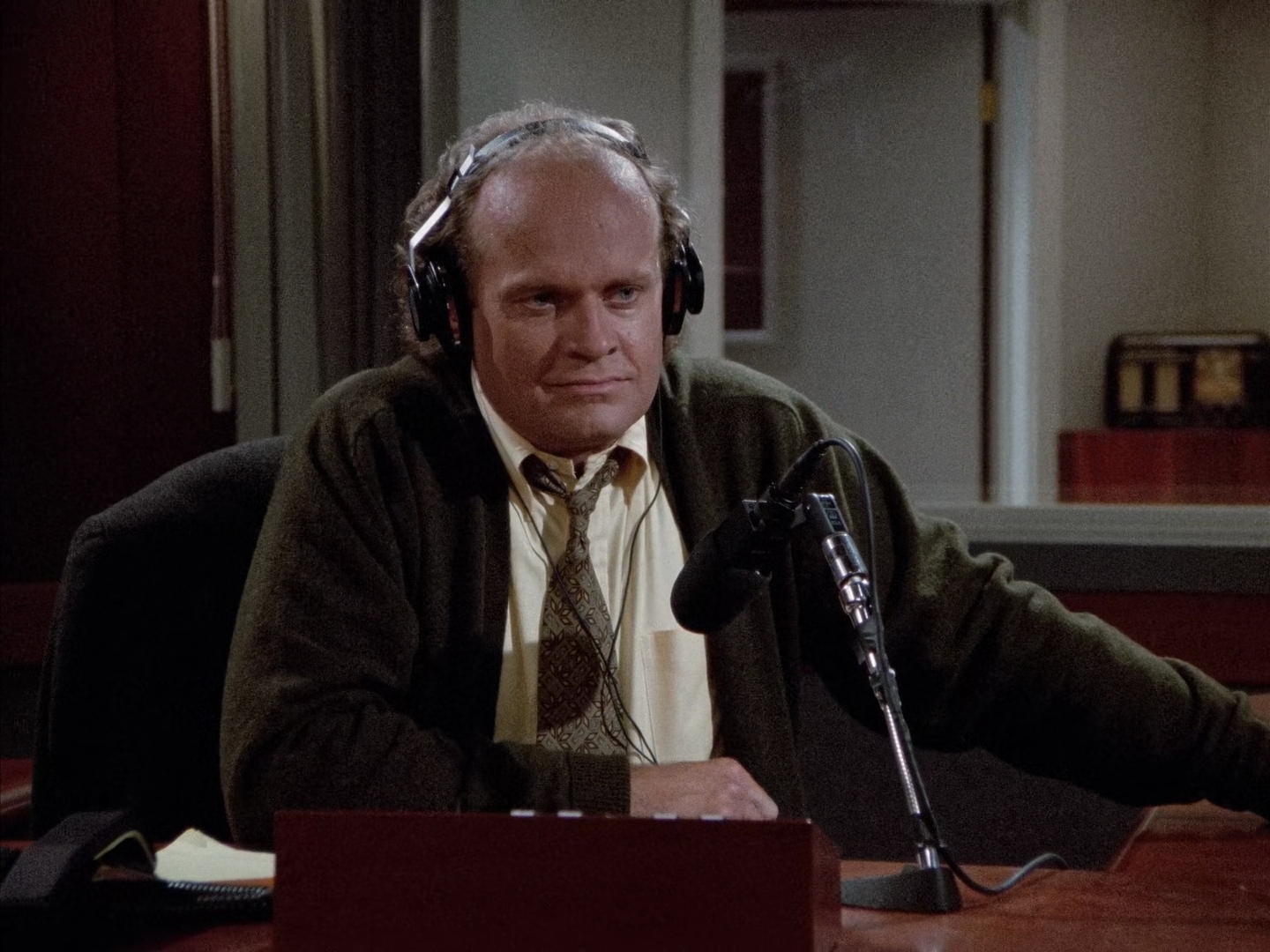

Episode 14 — "Can't Buy Me Love"
"Can't Buy Me Love" is an episode of odd pairings, featuring Frasier and a vengeful teenage girl (the child of a woman who bought Frasier at a bachelor auction hosted by his father), and Daphne and Bulldog - which is as odd and pointless as you'd expect it to be. Unfunny and thoroughly forgettable, "Can't Buy Me Love" makes the error of keeping Frasier's potential romantic partner (one of the few he has in season one) offscreen for the entire episode, forcing Frasier into stilted dialogue with a teenager he just can't seem to understand. It also forces the audience to sit through a four-minute scene of Bulldog and Daphne in a cab outside of a Sonics game - which is something nobody should have to sit through.

Episode 13 — "Guess Who's Coming to Breakfast"
It's not often, at least in early seasons, a Frasier episode focused on Marty and Frasier is disappointing - "Guess Who's Coming to Breakfast", however, proved the show's core dynamic wasn't completely infallible. Though a fun reminder of Marty's far superior dating skills, watching Frasier talk about his father's sex life on his radio show offers diminishing returns, especially when it happens multiple times in the same episode. Also, this is the episode where Roz goes on a date with radio station nerd Noel Chomsky, in season one's strangest, most regrettable subplot.

Episode 18 — "And the Whimper Is..."
Roz Doyle, despite her earned status as one of the iconic sitcom women of the 1990's, doesn't get a whole lot to do in Frasier's first season. She's around for a few sex jokes and throwaway bits each episode, but not much else - that is, except for "And the Whimper Is...", an episode which misappropriates many of character traits into a particularly ugly version of the character. Though this is somewhat by intent - the plot revolves around Frasier and Roz trying to schmooze their way into a local broadcasting award - it just doesn't work, leading to one of the season's most weightless, disappointing entries.

Episode 20 — "Fortysomething"
Part of Frasier's charm is its ability to explore the existentialism of middle age; reflecting on mortality, the loss of youth, time lost to mistakes, etc. Often, that manifests in quirky, interesting stories about Frasier's anxiety propelling him to comedic places; in "Fortysomething", it just leads to him to awkwardly try and date a 22 year old department store employee, a plot mostly designed to consider whether Frasier will consider sleeping with someone approximately half his age. It's as good an idea as it sounds.

Episode 17 — "A Mid-Winter Night's Dream"
If i were to rank season one episodes on aesthetics alone, "A Mid-Winter Night's Dream" would far and away be the winner; how the episode lights and films the interiors of Niles's home during a winter storm is captivating, and adds an incredible amount of visual texture to an otherwise pedestrian episode. As the first episode really starting to dig its nails into Niles's marriage and his attraction to Daphne, one would hope to see some sparks in the show's suddenly baroque, Victorian-era setting. Unfortunately, those sparks just aren't there - which, considering what a focal point their dynamic would become in later seasons, makes for a pretty underwhelming introduction here, despite a few solid physical gags.

Episode 7 — "Call Me Irresponsible"
Frasier's first romantic interest of the series presents an interesting dilemma for the tortured psychiatrist, when he tries to date the ex-girlfriend of a recent caller to his radio show. The episode's script just doesn't give Frasier, or his interest Katherine, any room to grow beyond the premise - and that just results in a hacky, repetitive episode, one that fully undersells how desperate Frasier Crane would get when he gets horny - a plot point the series would use to much greater effect at different points in this season, and throughout the series.

Episode 6 — "The Crucible"
"The Crucible" is one of the more by-the-book episodes of Frasier's first season, and the debut of a creative crutch the series would lean on many, many times throughout its 11-season run; Frasier, whether accidentally or purposefully, walks himself into a social faux pas and spends the episode awkwardly recovering from it. In this case, it's being swindled into buying a piece of fake art, the likes of which Frasier thinks will allow him to waltz into Seattle's upper echelon. It's not a complete loss, though: this is the episode where Niles commits a felony in a moment to try and feel something, after all.

Episode 10 — "Oops!"
Frasier would flirt with being a workplace comedy at various times throughout its run, to varying degrees of success. Its first foray into the format, however, is quite a mixed bag; after rumors start flying about a KACL host being fired, Frasier takes it upon himself to get everyone worked up into a panic, leading to Bulldog Briscoe throwing a tantrum and getting himself fired. It's not a great episode, though - save for one good Frasier/Bulldog scene, "Oops!" is a bit underwhelming, never able to turn Dan Butler's energetic performance as Bulldog into anything kinetic for the story, and lacking in any other kind of story to give the episode a pulse.

Episode 23 — "Frasier Crane's Day Off"
Stuck between the superior "Author, Author" and "My Coffee With Niles", Frasier's penultimate season one episode finds itself in a strange place - and for better or worse, leans into it. While sick with a virus, Frasier becomes incredibly paranoid when Niles successfully fills in for him as a radio host, throwing him into a feverish sweat - and, importantly, letting Frasier slightly dip its toes into surrealist comedy. Of course, "Frasier Crane's Day Off" doesn't quite commit to the bit, willing to rest on the laurels of Grammar's slapstick performance rather than make it something truly experimental and different, one of few real missed opportunities of the first season.

Episode 15 — "You Can't Tell a Crook by His Cover"
At first, "You Can't Tell a Crook by His Cover" feels like a major letdown; the episode's first half doesn't take full advantage of its premise, where Frasier tries to figure out which one of Marty's friends is a former felon. It's not terrible, but it's instantly forgettable - especially as the episode shifts its attention to Daphne's ability to hustle a pool table, bringing unexpected dimension to a character that was mostly relegated to ditzy jokes and British stereotypes. Her foray into the dirty underbelly of Seattle's dive par pool scene is a highlight for character and performer, the rare instance in Frasier's freshman offering Jane Leeves is allowed to explore the enigma that is Daphne Moon.

Episode 9 — "Selling Out"
One of Frasier's strengths over the years are its recurring side characters; and though she's hardly ever seen in episodes with any real meaningful material, Frasier's agent Bebe Glazer remains one of my favorite of Frasier's rogue's gallery of personalities. After hiring Bebe to manage his professional affairs, Frasier quickly falls victim to hypocrisy, throwing his ethics aside to hawk an embarrassing collection of products. While he eventually recovers his sense of morality, Bebe's mesmerizing effect on Frasier, and its protagonist, would last throughout the series, her random appearances always a comedic highlight of the series. It's certainly given a proper genesis in "Selling Out", even if the story around her character's introduction is a bit flimsy.

Episode 4 — "I Hate Frasier Crane"
"Radio host gets into a pissing contest with a local newspaper columnist" is a decidedly late-20th century plotline; and for Frasier, comes after an impressive trio of episodes to start the series. Though "I Hate Frasier Crane" focuses too much on its external conflict to hit the highs of its first three episodes, it ends on an incredibly strong note, when Marty saves Frasier from a self-imposed test of masculinity (one he should've never felt compelled to experience in the first place, which Marty regrets). It's a subtle sign of Marty's growing willingness to open up to his sons and begin to heal their intergenerational rift, and an important building block for the young comedy.

Episode 21 — "Travels with Martin"
Some of the best entries in Frasier's first season come when the series abandons its established formula; with "Travels with Martin", it comes in the form of a road trip to Mount Rushmore. Set almost entirely in a rented Winnebago, "Travels with Martin" and its simple story benefits from its unusual setting - especially when the group ends up in Canada, and things appear to be devolving into the kind of slapstick fare the middle portion of season one is riddled with. But once the border dramatics are behind it, "Travels with Martin" hones down on a terrific Marty/Frasier scene, as the two drive through the night and contend with their perpetual conflicts, a wonderfully disguised bit of pathos hiding in the episode's final minutes.

Episode 22 — "Author, Author"
"Author, Author" is the first of many "Frasier and Niles work together" episodes, and it remains one of my favorites, the two absolutely losing their minds trying to craft the first sentence of a psychology book they've decided to co-write (as a result of Niles failing to meet deadlines for his own book). As one might expect, this is a half hour mostly consisting of Niles and Frasier trading personal and professional barbs with each other; unsurprisingly, this works. The episode's ending, where Marty makes up a story to get the two to stop fighting, is a personal favorite, a wonderful little reminder that sometimes, we're all willing to compromise our morality a bit for some much-needed peace and quiet.

Episode 19 — "Give Him the Chair!"
In the middle of Frasier's second act skid is "Give Him the Chair!", the rare season one episode that manages to effectively mix its heaviest elements of slapstick and emotional pathos. After Frasier replaces his father's chair with an extremely (extremely) effective massage chair, he gets into a big fight with Marty about their shared home, and how Frasier's dire case of protagonist syndrome robbed Marty of the most comfortable, meaningful item in Frasier's home - his broken down lounge chair.
For an episode whose entire third act is set at a high school stage play practice, "Give Him the Chair!" manages to pack a lot of meaningful material just under the surface of Frasier's dramatic scramble to recover Marty's decrepit lounger. It also features the season's best trio of incidental characters, in the form of a furniture salesman, the building's repair man, and a disgruntled teacher, all of whom elevate the episode's standard sitcom material; though not an episode quite poignant enough to be truly memorable, "Give Him the Chair!" is a great test of the sitcom's formula, and a pleasant palette cleanser during the season's roughest stretch.

Episode 2 — "Space Quest"
Frasier's second episode is much like the first episode, observing every moment of Frasier's daily routine now disrupted by his new circumstances. As his frustration boils over in the first half of "Space Quest", Frasier economically re-introduces everyone in Frasier's new Seattle life - and smartly, leans as heavily on the dynamic between father and son as "The Good Son" did. It culminates in a rather powerful scene, where Frasier talks about his suicide attempt to his father, and Marty reminds him that a single week isn't going to repair the emotional chasm that's fractured their relationship for decades. Though certainly an old-school second sitcom episode (in that it basically just repeats everything from the pilot, which hopefully generated enough buzz for a large returning audience), "Space Quest" works in spite of its formulaic approach, smartly leaning into the already-establish father/son conflict as it builds a world around them.

Episode 11 — "Death Becomes Him"
"Frasier awkwardly attends a shiva" seems an ideal story for a Frasier episode; remarkably, it's only really the coda to a fun, light episode about Frasier contending with his own mortality after Marty's doctor unexpectedly dies. Watching Frasier spiral as he is consumed by the prospect of death makes for some of the season's most effortlessly funny material; watching him and Marty discuss some of life's unanswerable questions in the episode's second act is even more rewarding. Given how easy it would've been for "Death Becomes Him" to fall fully into superficial slapstick, the balance of "Death Becomes Him" is able to find is impressive, making it easily one of the season's most underrated entries.

Episode 1 — "The Good Son"
Four months after Cheers wrapped up its legendary 11-season run, Frasier premiered, transporting the heartbroken psychiatrist to the west coast alongside some incredibly lofty expectations. Smartly, "The Good Son" doesn't cave to any of this pressure, introducing its new setting and cast of supporting characters with an unexpected confidence (for a spinoff, at least), allowing the sitcom to kick off with one of the better pilots of the 1990s, a story about a father, son and brother reluctantly trying to heal decades-long rifts formed between them. Though a bit clumsy and overt in the ways pilots tend to be, Frasier's first episode is impressively fully-formed, with a firm grasp on the Crane family pathos, and a willingness to pursue a different type of comedy than the blue-collar sitcom it sprung from.

Episode 3 — "Dinner at Eight"
As two annoyingly elitist, superficial siblings, Niles and Frasier Crane are a tough pair to root for. Frasier knows this, and often revels in their misery; none more so than "Dinner at Eight", Frasier's incredibly brazen third episode, where the two have to share the "miserable" experience of taking their father to a restaurant he likes (think 1990s-era Texas Roadhouse).
Forget what happens before it; the nine-minute dinner sequence is classic Frasier material, the two brothers scoffing at their surroundings while Marty's patience slowly boils over - in the process, revealing just how much Hester Crane's absence had affected the family, and reminding Marty's sons the value of having a bit of humility, for the sake of keeping their family intact. It would be easy to measure "Dinner at Eight" by its slapstick-y jokes about waitresses and cheap chain restaurants - however, the conflicts it begins to surface are much deeper and more complex, incidentally setting the stage for a few standout episodes to follow.

Episode 5 — "Here's Looking at You"
At first, "Here's Looking At You" feels like a narrative miscalculation - are we really supposed to invest ourselves in an episode where Frasier buys his father a telescope so he look into stranger's windows? It is an incredibly uncomfortable idea; and yet, it speaks to the quality of "Here's Looking at You" that by the end, one can barely remember the episode's slightly creepy underpinnings. One of the most emotional hours of season one, "Here's Looking at You" is one of the first times Marty's tough veneer falters a bit, and we see the lonely, still heartbroken widow trying to find meaning in his life. This is John Mahoney's showcase episode in season one, an episode that rises and falls with his sullen sadness early on, and reluctant excitement at its end; frankly, I'm convinced anyone who makes it through this episode with dry eyes has a cold heart.

Episode 16 — "The Show Where Lilith Comes Back"
It makes sense the first Cheers cast member to make an appearance on Frasier would be Frasier's ex-wife Lilith, given how their breakup and Frasier's mental breakdown formed the final arc of Cheers (and provided the runway for Dr. Crane's spinoff series). What is surprising, is just how good "The Show Where Lilith Comes Back" is, bringing Lilith to Seattle over a misunderstanding (having recently read a letter Frasier wrote over a year ago), pushing the two together for a one night tryst in a hotel room, where all the good and bad in their marriage is laid bare.
It's not the typical spinoff cameo - and if we're being honest, it is atypical of how Frasier would treat Lilith in what would become an annual guest appearance on the series. "The Show Where Lilith Comes Back" is perhaps the one time Frasier takes their relationship seriously - it makes for an incredibly intimate, honest episode about two people who, even though their lives took different paths, are forever intertwined through their son, and can let their anger and regrets go (at least, to a degree - nobody's perfect, after all).

Episode 12 — "Miracle on Third or Fourth Street"
"Frasier has a miserable day" is arguably Frasier's best template; it allows Kelsey Grammar to indulge in more theatrical behavior, and allows the writer's room to stretch their muscles a bit with some truly acerbic reflections on their uppity, unlucky protagonist. Frasier's first Christmas episode is exactly that; Frasier throws a tantrum around everyone after he finds out his son can't make Christmas, and ends up alone at a diner eating processed turkey with a group of local homeless people.
With a script credited to legendary TV scribe Christopher Lloyd, "Miracle on Third or Fourth Street" is the best kind of reflective Christmas episode, able to nimbly dance between ruthlessly honest and overtly cheesy, as Frasier realizes he's forgotten his wallet, leading everyone in the diner to chip in and cover his meal (and, as one of them coyly reminds him, to call his father on Christmas). Though the episode never resolves the central conflict between Frasier and family, it never needs to; everything Frasier ever needed to say about the importance of family is seen in the diner scene, one of the best Frasier's first season has to offer.

Episode 24 — "My Coffee with Niles"
Frasier begins and ends on creative high notes; "My Coffee with Niles", the season finale, is essentially My Dinner with Andre set at Cafe Nervosa, as Frasier contends with a simple question: "Are you happy?" As the people in his life cycle in and out of the cafe, their lives briefly brushing up against Frasier's existential conflict, Frasier's final freshman offering is unexpectedly contemplative, especially after the season's wildly inconsistent, superficial second act.
"My Coffee with Niles" is an incredible sitcom season finale, from how it frames its central conceit (around an increasingly disgruntled Cafe Nervosa barista) to the restraint it shows by holding Marty out for most of the episode, only deploying him to deliver a devastatingly effective climactic moment, one where the Crane family finally embraces the concept of forgiveness, finally allowing the generational patriarchs of the family to experience some peace - with each, and with themselves.

Episode 8 — "Beloved Infidel"
Frasier is not a show for plot twists; often, the plot twists are occurring to the characters themselves (increasingly through the years, as the series would embrace farce to lesser and lesser effect). "Beloved Infidel", in that way, is a truly unique episode of Frasier - it is also unique, in how it tells a heart wrenching story of father and son, trying to come to terms with a difficult truth about their deceased mother.
For most of "Beloved Infidel", Frasier Crane is in full twitchy, paranoia mode; after Frasier and Niles see their father out to dinner with a former family friend, the brothers remember a fallout their parents had with another couple - ultimately, they decide, because their father had an affair with the wife. Having been cheated on himself (in the final season of Cheers), Frasier is beside himself - until his father reveals that it was Hester who cheated on Marty, not the other way around.
Through sadness, father and son are brought together; it's an incredibly bittersweet moment, tinged with the sadness the two felt, a vulnerability exacerbated by the fact that these things can never be healed. Some things in life don't have answers, and "Beloved Infidel" doesn't shy away from the lack of resolution Frasier and Marty have to contend with - ironically, though, it may be the one life experience they have in common. It can't fix everything that's been broken between them over the past forty years, but it's a strong starting place, a foundation the family - and the series - could begin to build upon. "Beloved Infidel" is not only the best episode of the season. but one of the best in the series.