
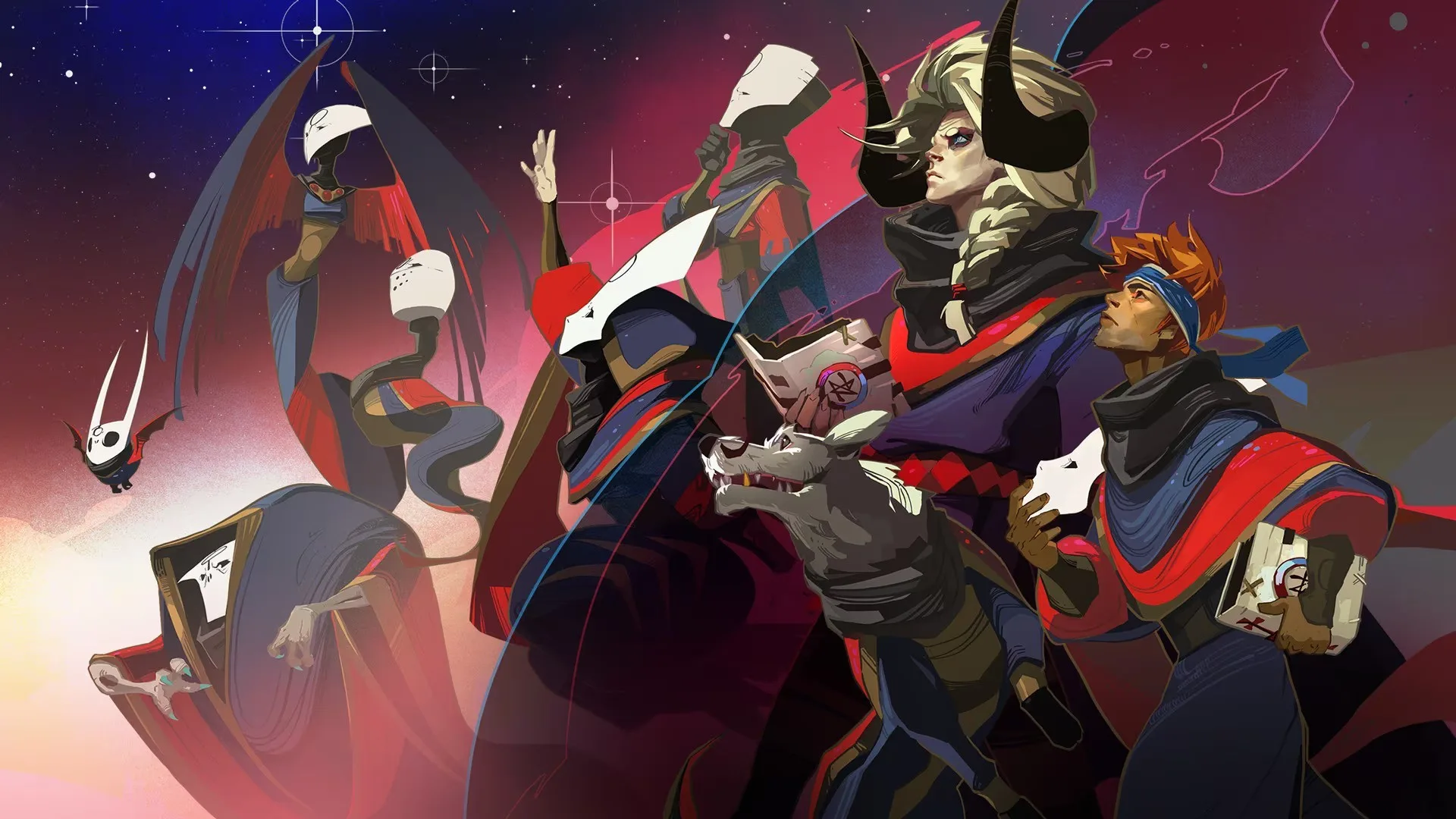
The evolution of Supergiant Games is one of the more impressive stories of modern game development; from 2011’s stunning Bastion to 2014’s less-adored, often underrated Transistor, Supergiant’s continued refinery of their now-signature game play mechanics and narrative tendencies is a short, but remarkable arc. With their latest release, Pyre, Supergiant Games firmly establishes themselves in the upper echelon of game development: Pyre is an ambitious pastiche of genres, from party-based role playing games to arcade sports titles, an incredible distillation of ideas that alternates between being a beautifully crafted visual novel, and a wildly addictive sports game.
Set against the beautiful landscape of The Downside, Pyre is, at its core, a story about a road trip through societal purgatory, experienced through the eyes of the unseen player-character, The Reader. Banished to the gorgeous, neon-soaked landscapes of The Downside, The Reader embarks on a quest with a predictably quirky (and ever-revolving) set of characters, following the stars in the sky to participate in The Rites, an opportunity at redemption sought through a 3-on-3 competition that feels like a mix between NBA Jam and Rocket League, with Transistor’s ability systems thrown on top. Out of context, the story seems a little trite and ridiculous; however, the simple foundation Pyre builds both its story and its gameplay blossoms into an impressive gaming experience pretty quickly.
Early on, Pyre takes on the impressions of a PC visual novel from the early aughts; a collection of linear conversations, set against visually impressive back drops that are nearly drowned out by the sheer amount of information conveyed. However, as Pyre is but a distillation of many genres, Pyre focuses on a few intriguing and engaging elements of visual novels, and ditches the pretension of the rest: branching paths and conversations can have different effects on player abilities and stats in the Rites, and specific player decisions throughout will make decisive, remarkable changes to the narrative at hand. See, at its core, Pyre is a fantasy sports game wrapped in a role-playing game; the novelistic elements of the story are a powerful set of (simplistic) social metaphors are but an entry way into the game’s true gameplay, which are the Rites themselves (also playable in a local versus mode, which means friends can join in on the fun).
The Rites offer sinners the opportunity to re-enter society; with three accused on each team, players try to stuff a celestial orb into a burning pyre in order to win. Sound simple? It’s anything but; those familiar with Supergiant combat systems will feel the similarities in the movement and combat design of Pyre, ratcheted up to a new level thanks to some welcome intricacies and the inherent drama of playing a sports game (complete with booming-RPG-voice narrator, which is so awesome). Using a combination of special offensive/defensive abilities and platforming skills (jumping and throwing, primarily), players move their various characters around – each with their own traits, stats, and unique buffs – trying to score on the pyre, eventually eliminating the opponent when one pyre’s energy goes from 100 to zero.
Unsurprisingly, Supergiant’s technical wizardy is on display every time The Rites come to the forefront of the narrative; each and every match offers players a chance to try out new teammate combinations, with cross-buffs, special abilites, and all sorts of other stat-nerd friendly material fans of NBA 2K and Dragon Age alike will drool over. Throughout the campaign, emotional bonds are formed and broken as players win close matches with specific players, find new teammates worthy of playing time, and The Reader continues to unlock the mysteries of The Downside through the ancient texts unlocked after victories.
Throw on the breathtaking visual and audio layers of Pyre, and it’s clear why Supergiant took so much time to polish up this title before releasing it; save for the occasional, random crash, Pyre looks and plays like a dream at full 4K 60 frames a second on my PS4 Pro. And I’ve certainly put it through its excercises; after nearly a dozen hours with the campaign and about 50 versus matches played with friends and against the AI, I’m still itching to dig further into the strategic minutiae of team building, the same way I would with a traditional sports title or role-playing adventure.
In a year with so many great titles experimenting with the mash-up of genres – Horizon and Zelda‘s mix of survival and open-world action game, for example – one might think the overwhelming amount of unique influences seen in Pyre would make for a disappointing title. However, Pyre is a game that takes a number of loved genres, and strips them down to their very core, building out the complexities between these beloved systems, rather than trying to iterate on the mechanics themselves. All the characters of Pyre move similar to those of Transistor; however, a completely redefined context and game play area feels almost revolutionary, in how it adapts what’s known into something completely new, and mechanically complex. In short, it’s hard to find an element of Pyre that isn’t an impressive achievement for Supergiant Games, a $20 game with more ambition, technical mastery, and pure gamer pleasure at its core than most $60 titles from much-larger studios.