
The list of filmmakers truly pushing the boundaries of film technology are few and far between; in fact, some of the greatest directors of our generations, like Scorcese and Tarantino, have set their focus on a mission of preservation – of film techniques, film stock, classic theaters, and development of new talent behind the camera. Though a director like James Cameron, the Blockbuster Whisperer and wizard of technical advancement, would seem to stand in stark contrast to their mission, Cameron’s attempts to save the theatrical experience itself unites him with his contemporaries in that pursuit. And with his latest – and possibly final – film franchise, Cameron’s thoughts about preservation extend beyond the incredible virtual imagery he introduced to the world in 2009 with Avatar; with this year’s long-anticipated return to Pandora, Cameron’s thoughts continue to dwell on the very fate of humanity itself, to wondrous, devastating result.
Avatar: The Way of Water, the first of many Avatar sequels, is a film adrift in its own industry, releasing in a very different landscape than the original did thirteen years ago. In 2009, Avatar’s incredible world building and embrace of 3D technology presented a film redefining what a blockbuster could be; in 2022, its sequel releases amongst a melange of massively-budgeted superhero films, all built on interconnected universes and cheaply contracted CGI work (see: the dogsh*t visual design of all Marvel content this year). It is also Cameron’s first film since the first Avatar movie – itself a melange of fascinating visual technology, freshman-level script writing, and immensely satisfying worldbuilding – which makes Avatar quite the nine-figure proposition: would anyone remember Jake Sully, and more importantly, would they care?
After three-plus hours of time with the Sully clan and their adventures into the archipelagos of Pandora in The Way of Water, the answer is a resounding – and, for this grizzled critic, surprising – yes. Avatar: The Way of Water is a wildly imperfect film, languid and awkward, self-obsessed and wandering… it is the kind of thoughtful, adventurous massive-budget film we only see a few times a generation, amongst the unending barrage of tie-ins, spinoffs, celebrity cameos, and underwhelming CGI-fests of modern action films. Though its the most CGI-ed of perhaps any movie ever, The Way of Water features long stretches where, through its photorealistic visuals and ambitious narrative design, it doesn’t feel like a fantasy science fiction story at all, in the very best ways possible.
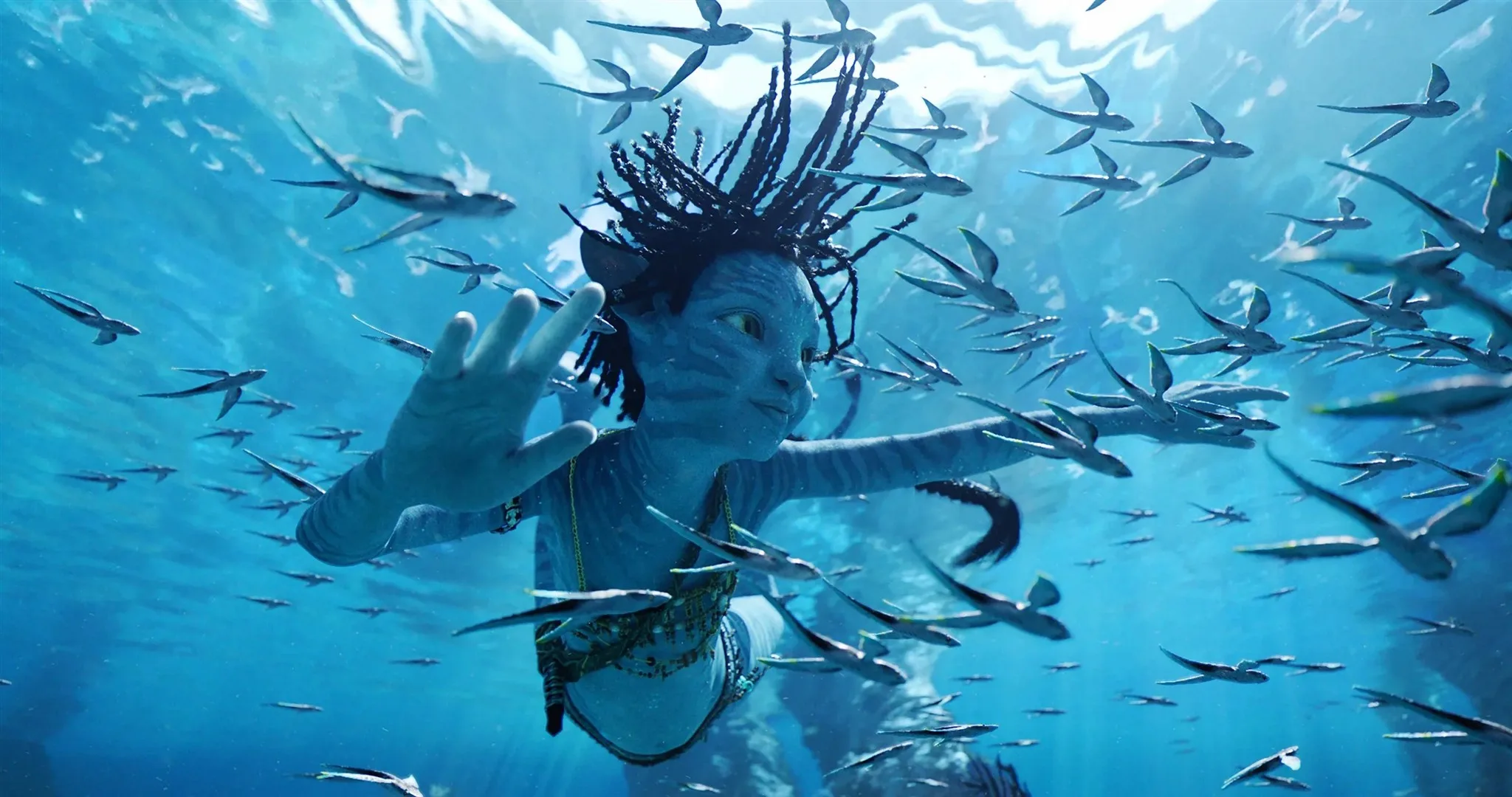
For better or worse, The Way of Water is a story of children: though Sully and Neytiri (Zoe Saldana, unfortunately given a lot less to do here)and their rekindled fight against the RDA is the primary driver of plot, The Way of Water is really about their four children, examining the world of Pandora, and life on it, through the lens of their offspring. It’s really here where the story of aliens and humans fighting with mechs and flying piranhas finds its voice, especially in the film’s fantastically magnanimous second act – once the Sully clan begins to settle in their new coastal home with the Metkayina clan, The Way of Water shifts to tell a story of a new generation connecting with nature, dealing with teenage turmoil, and embracing the mystery of the unknown – and in the process, completely upending expectations for what the film would be.
Now, the two acts bookending the film’s best moments are exactly what you’d expect; the film opens with a supremely awkward, stunted return to its own universe – and as it has to set up the already-in-production future sequels, stumbles through a massive third act, one that does call into question whether Cameron has anything left up his sleeve with action sequences.
But despite the predictability of the film’s larger setpieces and themes of corporate greed and environmentalism (thankfully, nobody says “unobtanium” here), The Way of Water still manages to feel fresh in its delivery, even beyond the high frame rate sequences and obvious advances in environmental simulation technology in the time between the two entries. It does so through the children of Pandora (a few of whom whose parentage are wrapped up in unnecessary mysteries for future films to answer), telling stories about outcasts, discovering identities, falling in love – and in its most important moments, dealing with loss and disappointment, moments where Avatar puts an impressive amount of time, and effort, into developing its youngest, unestablished characters.
Those looking for incredibly deep storytelling or evocative dialogue are of course going to be disappointed; but as a film of ideas and technical ambition, Avatar: The Way of Water is afforded some leeway (there’s also something to be said for adapting familiar storytelling arcs and tropes through generational technology as an entry point, which I’m sure dozens of college theses have been written on). But I would argue Avatar, under the confidence of Cameron’s track record, understands it has some breathing room thematically – and takes advantage of it at times, with handfuls of side plots, story threads and character beats that remain unfinished by the film’s ending (which comes unexpectedly abruptly for a film that comfortably runs over three hours, and takes no time in rushing to get to the point).
And even though it feels like by the end, The Way of Water is running on metaphorical fumes a bit (there’s even a 30-40 second sequence where Cameron nods to all of his films at once that would play like a retirement reel in other circumstances) one can’t help but leave the theater in wonder of what he may still have up his sleeve. No matter how large, loud, or explosive The Way of Water gets, it feels like there’s something being held back, an unfinished thought that is just getting to the point when it suddenly ends, leaving the audience hanging at a particularly low point in the narrative. Not many people can pull that off in 2022 with the pressures of massive budgets and expectations over their head; James Cameron is doing it on the back of a CGI dolphin, with two middle fingers up to the rest of the industry (and with Disney, his own financiers), a master of his craft hopeful for the future of his chosen industry – and in a much larger sense, Earth itself.