There are a lot of evocative moments in Westworld’s magnanimously awful fourth season – so many, in fact, that the trailers for it offered hope of not just a new world for its uncanny robots, but for the creators and audience itself. After miring in two seasons of needless convolution and philosophic propositions left ambiguously unanswered, it felt like Westworld’s fourth (and perhaps final?) season presented it a unique opportunity to redefine its own legacy – so much so, it was included alongside other thought-provoking works of art in my summer preview!
Ah, but what fools we are to the loops we exist on; as Westworld likes to point out so often, we are but fools to our coding, destined as a species to run ourselves on the same biological cycles, over and over until we melt away (either because of global warming, or in a billion years when we inevitably are consumed by a dying star). When a prestige series boasts incredible performances from Tessa Thompson, Evan Rachel Wood, Ed Harris, and a melange of wonderful character actors – well, goddamnit, we are going to give that show so many chances it doesn’t deserve.
Let me put it bluntly; Westworld season four doesn’t deserve it. Set both a few days and 23 years after the events of season three (and particularly “Crisis Theory”, one of the all-time maddening hours of modern television), Westworld’s fourth season begins with a prestige television show full of big ideas it has completely lost the thread on, playing out like a lifeless version of the first twenty minutes of The Matrix Resurrections – except on HBO, those twenty minutes of film translated into four painfully obscure hours of television.
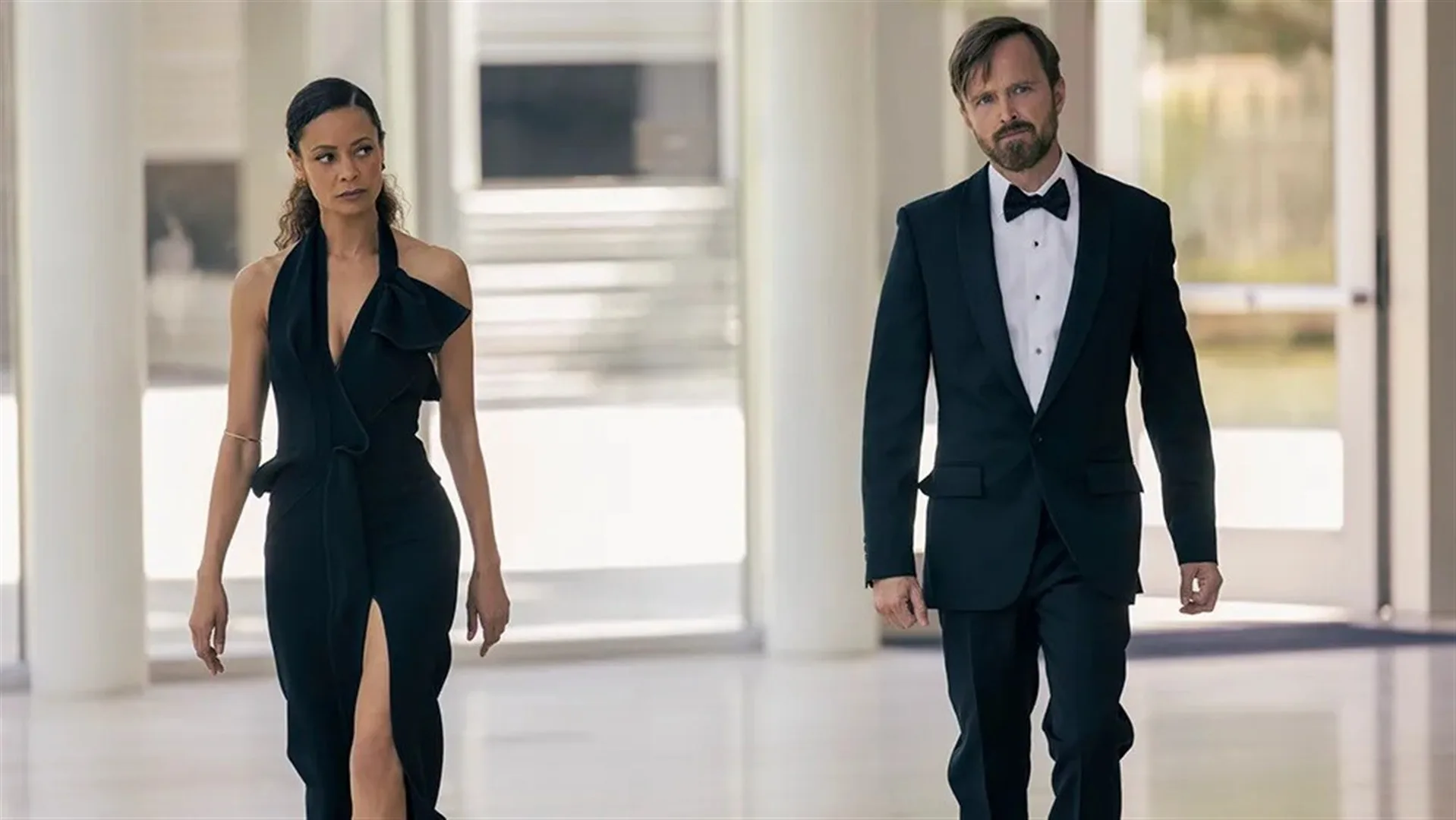
Though its proven its inability to do so multiple times, Westworld’s fourth season insists on trying to spend half of its season unlocking narrative mysteries of its own creation: at best, it feels like intentional confusion, trying to stir the viewer into a breadcrumb-searching frenzy about what happened to Caleb (Aaron Paul trying his absolute hardest to find meaning in this season’s arc), where Christina (Evan Rachel Wood, returning in a new role) is, or what’s going on with William and his various clones.
At the same time, the opening hours of Westworld purport the same large, fascinating science fiction questions that keep idiots like myself watching the show: for all its faults, creators Jonathan Nolan (in what will be remembered as an all-time nepotism hire) and Lisa Joy have a fascination with what comes next for society in a way that is engaging and thought-provoking; if human beings grant consciousness to AI, what does that mean? What does a life force made in our image actually look like?
Unfortunately, through four seasons, the only answer Westworld has is “they’d really like to murder, and the female robots would be attached to kids.” That’s it! For 30+ interminably long episodes of television, Westworld has continuously raised questions about identity and consciousness, that it is almost afraid to answer – after all, if humans and their creations are equally violent, then you can just have a ton of gunfights whenever someone tries to start exploring the tough questions.
Without spoiling the actual plot, of course, that’s exactly what happens in season four: though Jeffrey Wright’s Bernad can scour and crease in brow in thought all he wants, Westworld is less a show of thinking, and more a show of shooting – both in how their characters behave, and how the show greenlights scripts that feel like they’re halfway written.
The lone exception to this miserable season of television, is the season’s sixth episode “Fidelity” – which is a fascinating hour of television, both in theory and practice. It’s great award bait for Aaron Paul, who goes through the various performances of different Caleb clones with a pathos so many characters on Westworld lack (mostly in their writing; can you see a trend here?). But again – ultimately, “Fidelity” is just repeating similar concepts from episodes in the show’s first season (themselves central to the only good mystery this show’s ever done), and once that episode is in the rearview, the season quickly devolves into the blood-and-monologue filled mess that has plagued the end of every season.
Westworld, for all its sleek cinematography, Big Ideas, and award-winning performances (even though nobody has approached Anthony Hopkins’ presence since he departed the series), might be the most unwatchable show on American television right now. At least the latest werewolf drama The CW is pitching at any given time knows exactly what it is; Westworld, with its haughty ambitions and masturbatory sense of self-importance in every single line of dialogue and camera choice, just feels like a show pretending to be something its not, and doing a very bad job of it.