
Card games are enjoying a renaissance right now; on the heels of Blizzard’s success with Hearthstone, collectible card games like Magic: The Gathering and The Pokémon Card Game are thriving in the digital realm. This trend has inevitably lead to a handful of new titles in the genre, both remixing traditional card games like poker and solitaire, or offering new takes on the collectible card games, hybridizing with other traditional genres to create entirely new deck-based experiences.
Both forms have offered some really interesting innovations, like iOS’s Solitarica, which turns solitaire into a magic-fueled dungeon crawler. Or Gwent, which went from being a series of side quests in The Witcher 3 to a full-fledged, competitive card game; just about everyone’s throwing their hat on the proverbial card table, including Image and Form, who’ve delivered one of the best games of the year to date with SteamWorld Quest: Hand of Gilgamech, released in April on Nintendo Switch (where I played) and PC platforms in May.
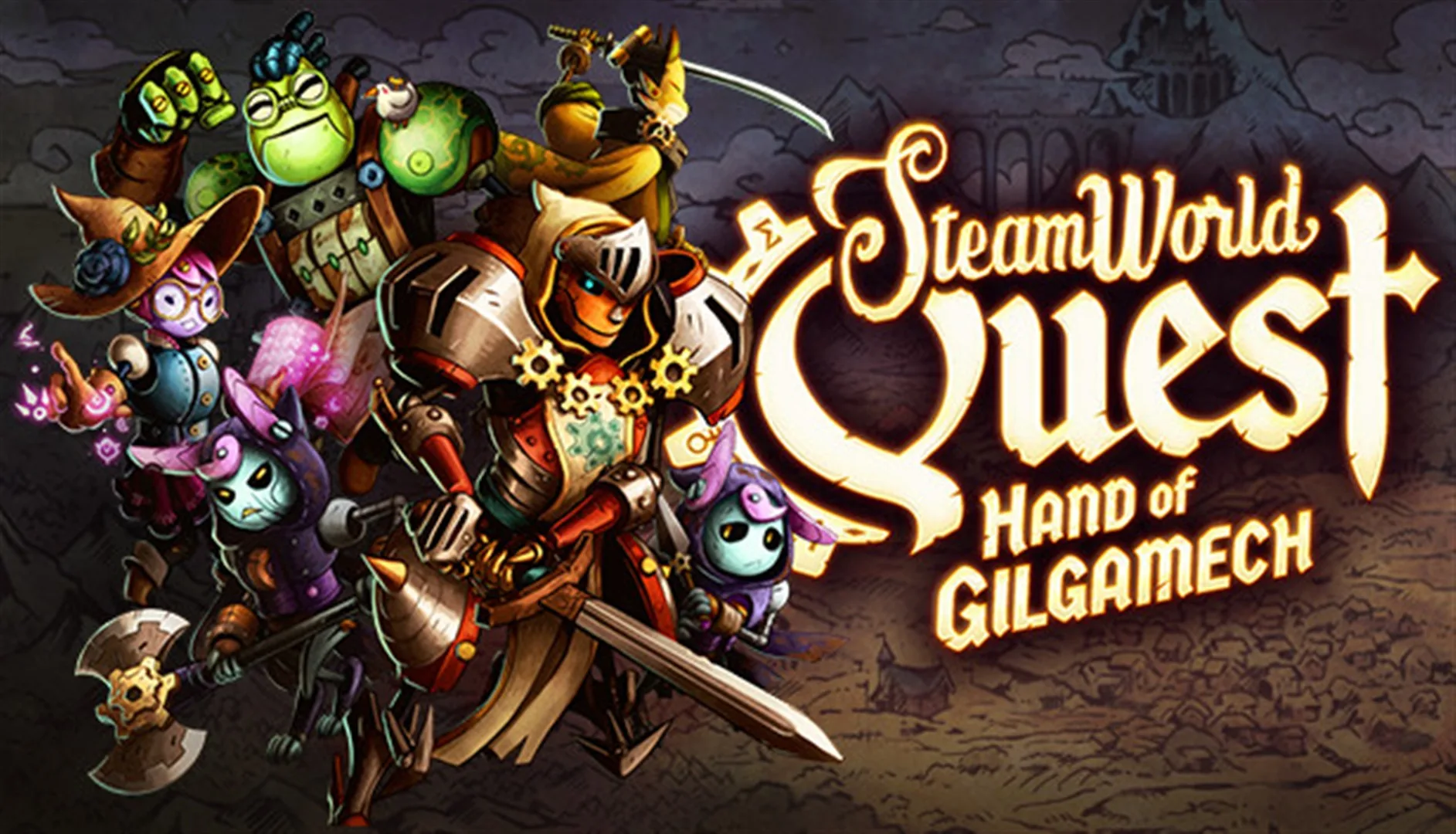
Set in Image and Form’s established SteamWorld universe (think light fantasy with sarcastic mechs), SteamWorld Quest takes the strange, oiled world of magical mechs and rusty cowboy cogs of its previous action and puzzle games, and morphs it into a deck-building role-playing game. Set against the backdrop of a bed time story being told to a young robot, SteamWorld Quest is the latest pinnacle of the rejuvenated card game genre, and perhaps the best non-Nintendo developed game to release on the Nintendo Switch so far in 2019.
SteamWorld Quest is a single-player adventure, where players control a party of three, choosing between five different characters, each with their own unlockable card sets and abilities. Traveling around stages a la Castlevania, a cookie cutter story about an ancient text and an all-powerful evil slowly unveils itself across four acts, each composed of four chapters full of dangerous encounters with a wide variety of different enemies.
The story and world of SteamWorld Quest are rather perfunctory; where this game shines is in the many battles staged across the lengthy campaign; each battle pits one’s vaunted trio against any number of enemies, each with their own individual spells and attacks. Using decks of 24 cards (eight from each characters), players take turns fighting AI (computer) opponents, each of which are carefully designed to offer challenging, tense scenarios.
No matter how much planning one puts into their deck construction, every battle of SteamWorld Quest offers a surprise, each beautifully designed to expose player weakness, and make every fight feel like barely contained chaos. It makes for a much more lasting, controlled experience than multiplayer focused games like Hearthstone or Pokemon TCG; each encounter is a puzzle, rather than a battle, requiring players to understand how the cards synergize, between decks and characters alike.
The story itself is not all that interesting; there’s a magic book, a terrible, mostly unseen evil presence, and a lot of walking around reading lengthy, pointless text boxes. SteamWorld Quest lives and dies with its gameplay; which, thankfully, remains fresh and engaging through each of the game’s 16 different chapters, each full of hidden alternate paths, treasures, and bonuses to find. It finds that sweet spot between chasing the meta in a multiplayer game, or falling down the rabbit hole of strategy card games with dozens upon dozens of card mechanics; the rare game that truly finds the balance between being welcoming for casual gamers, while still maintaining the level of depth and challenge more dedicated players seek.
The only thing SteamWorld Quest lacks is content; if there’s any complaint to be had with the game is the lack of endgame content, save for a brief arena mode, which forces players to survive a series of battles using a single, predetermined set of cards. It all adds up to a roughly 20-hour experience – which is certainly not short, but feels deflating once the final battles of the campaign are completed. Endless mode, boss rush challenges, additional unlockable dungeons… should SteamWorld Quest offer an expansion in the future, there are plenty of exciting directions the game’s core mechiancs could be taken, a wealth of potential the game only begins to unlock when it suddenly ends.
At only $25, though, SteamWorld Quest offers plenty of bang for its buck – especially in the age of $60 games with eight-hour long campaigns. Where SteamWorld Quest may lack in length, it makes up for in strategic depth and affable personality, in what amounts to one of the most ingenious takes on modern card games, and one of the Nintendo Switch’s best releases of the year to date.