
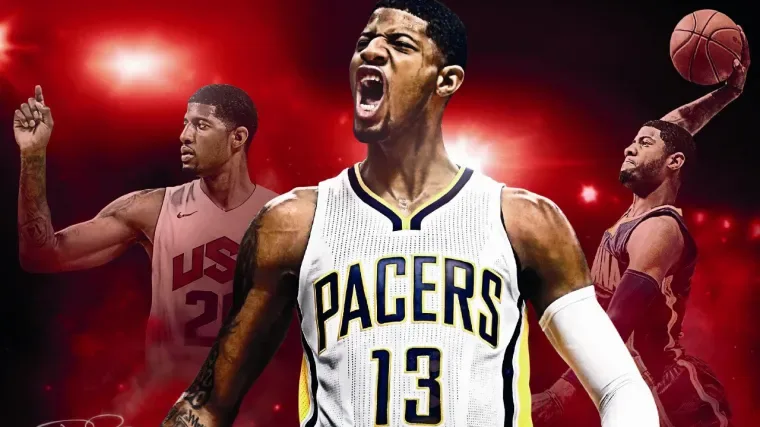
NBA 2K17 is a fantastic sports video game, by most conventional measures of the genre. It pushes the series forward mechanically in a number of important ways, without sacrificing what gave it the distinction as the best, most realistic basketball simulation available (an honor that’s become somewhat more dubious as EA’s NBA Live series flops around like a dead fish in their extensive catalog). The controls are tighter, the animations smoother – and, to tout their most marketed new feature this year – the face-scanning technology looks much-improved over last year. More modes, more creative tools in General Manager mode… every single traditional barometer for progress and success NBA 2K17 meets or exceeds, and yet as a whole, NBA 2K17 feels like a lesser game than previous installments.
Why does NBA 2K17 feel fresh and stale, seemingly simultaneously? With handfuls of new features, one would seemingly have to press real hard to find flaws within what is generally considered a binary evolution of the series. That is, unless one happened to play NBA 2K16, 2K15, or any of the 2K games before it: as tends to happen with sports games, the new, exciting features generate more audience interest than promises to patch and update what was broken, or glitched, in the previous game: take ball-hawking power forwards, who became defensive superstars when 2K13 introduced new AI structures and behaviors for defensive players. For four years of 2K games, thousands of layups have been thrown away by 6’9” players with hands seemingly magnetized to any ball floating or bouncing through the lane or anywhere near the paint, causing some of the most egregiously cheap forced turnovers one could ever see in a sports video game.
Or how about the game’s animation system, which is clearly cracking underneath the strain of 2K17’s demanding code, pushing the game’s ability to complete the arithmetic of its physics to its absolute limit. For years, unblockable dunks and animation exploits (like the infamous Backcourt Violation bug, where players could force opposing PG’s into multiple turnovers by timing defensive animations) have ruined the game’s claim to realism around the basket, something 2K17 tries to rectify with all-new “in between” animations, which simulate player contact at the basket, and lead to more diversified animations around the rim.
In theory, a fantastic idea: but the game’s first attempt at creating the “chaining move” equivalent from fighting games is lackluster at best. Trying to execute two dribble moves in a row has become a chore of timing animations properly, lest a player repetitively bounce the ball of a defender’s thigh anytime their animations end up overlapping each other. Same goes for trying to executve a crossover into a bounce pass down the lane: wacky, ill-fitting animations + previously mentioned defensive balancing? Yeah, that’s going to lead to a lot of ridiculous turnovers.
The “in between” animations begin to expose a larger issue with the 2K series as a whole: that a short development window hinders innovation and creativity, and leads to consumers paying for a product every 12 months that is never actually in a full working state at any point in the year. This is an issue for all games in the Patch ‘Em Up era we live in, but for sports games, this is becoming a major issue: the in between animations, of which there are about a dozen, all of which I’ve seen in two weeks playing the game, are but a band-aid for larger issues with player model interactions and real-time physics, the latter of which NBA 2K as a series won’t touch with a ten-foot pole. With only nine months to develop a game every year, this leaves 2K and developer Visual Concepts in a very tough position: fix the bugs in the game (like the eternally broken, lame All-Star Weekend events in myPlayer mode that haven’t worked properly in three years), or continue to push the envelope in terms of graphics and game play, hoping the game’s back end monetization will carry it through bad buzz and increasing gamer frustration with the game’s continuous set of issues.
Combined with half-assed features like the aforementioned animations, 2K’s ever-increasing reliance on in-game purchases (beyond the $60 sticker price to buy the game) to generate revenue is becoming an issue. At this point, there isn’t a single mode tied heavily into the game’s VC currency, which can be bought in large quantities for real money, or earned in smaller quantities through different game modes. In 2K17, “innovation” mostly boils down to “paying more for everything” – VC is everywhere, from unlocking players in myTeam, to improving a player in myCareer, right down to charging for every single animation players want to customize their digital baller with (in the past, each animations had dozens of free animations, along with others players could purchase with VC). Like Apple with its new policy of removing popular features and calling it “innovation”, 2K’s policy to each new 2K game has become increasingly troubling in what it means for fans of sports games, and just how much it will cost to actually enjoy each new release every October.
Maybe the solution is one suggested by Madden NFL Mobile, a pared down version of the console game, itself suffering from Yearly Release Burnout (or Assassin’s Creed Disease, as many would call it): instead of releasing a new game every single year for full price, offer an update for the new season, and extend the life of the game’s code, engine, and player base: with so much monetization built into the back end, offering players a roster and UI update for $10-30 a year seems reasonable, and then frees up teams to begin working on truly evolutionary sports games, projects that could take the time to resolve issues of the past (like 2K’s net code, some of which is 15 years old) while thinking of new ways to bring these massive digital sports franchises into the future. EA’s struggles with NBA Live may be unique, but their continued failure shows just how easy it is for it all to fall apart – and once it does, how hard it can be to get back on the once-a-year money train Madden, 2K, and FIFA have enjoyed for the past two decades.
I don’t know what the answer is, but the experience of playing 2K17 is an illuminating one. There are certainly moments of pure pleasure where everything clicks into place the way a developer would envision it; but those moments are too often interspersed with head-scratching moments of frustration that repeat year in and year out, to the point where deep-seeded bugs and flaws are just accepted by gamers as “the way things are”, years after they first appear in action. Like the rest of the video game industry, it seems the old habits of sports video games aren’t quite working anymore, especially in a world of increasingly-complex and expensive game development . For proof, look no farther than 2K’s gorgeous, awkward, occasionally life-like, lumbering, thoroughly entertaining and hair-pulling basketball game, a game that captures both the modern NBA game and the frustrations with modern game development, often in the same immaculately-animated breath.