
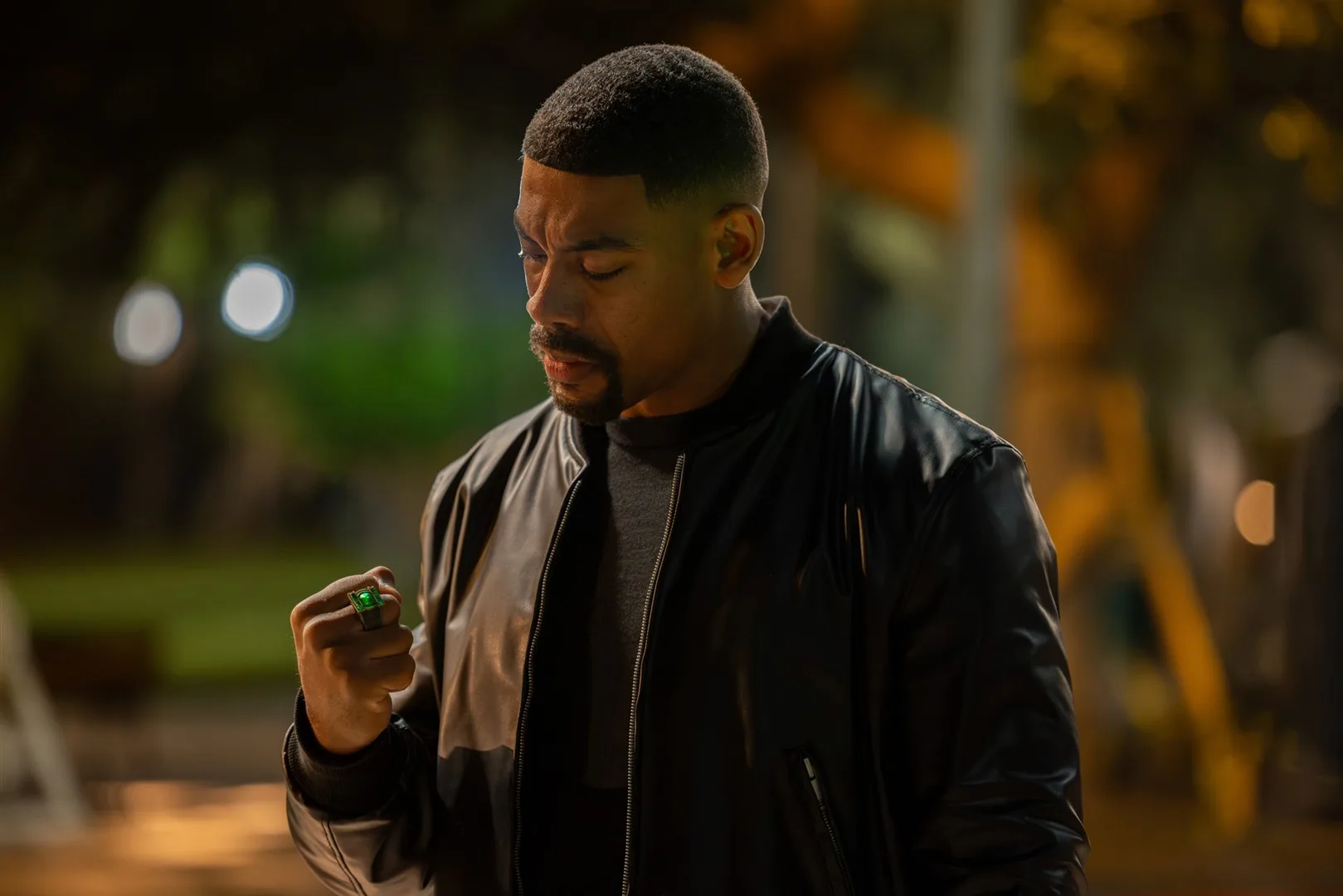
Lanterns‘ first (?) season has been a strange creature, an attempt to blend the tenets of prestige television’s recent heyday with the lumbering, grotesque demands of being “intellectual property”, while also trying to be an origin story for a character in a cinematic universe crossing over television and film, a proper adaptation of its source material – and an interesting, dynamic television show that could stand on its own two feet (albeit with one of said feet standing inside a massive, still-forming multiverse). It’s a lot to try and accomplish in eight episodes; and unfortunately, “Dirt and Stars” tries to carefully weave a thoroughline between all of these things, resolving narrative threads and character arcs just as it opens new ones, in an appropriate, satisfying ending – one that is nonetheless frustrating in the choices it does (and in some places, explicitly doesn’t) make in its final hour.
Most unfortunately, Lanterns opens its finale with a big ass lore dump, in the form of a chained Sinestro being questioned (and later lightly tortured) by John. Without any context, it’s a pretty great scene, Ulrich Thomsen chewing through the few moments of dialogue and presence Sinestro’s offered on-screen. The problem is, most of what Sinestro is talking about, he’s just talking about: as he details what Noah’s been up to for the past decade, Lanterns shows us almost none of it, leaving the audience to fill in the most important emotional gap between what happened and what is to come for Rushville; the arc of Noah following the death of his grandmother, how that formed and changed his relationship with his mother – and most interestingly, what happens when Noah realizes he himself is a Manhunter.
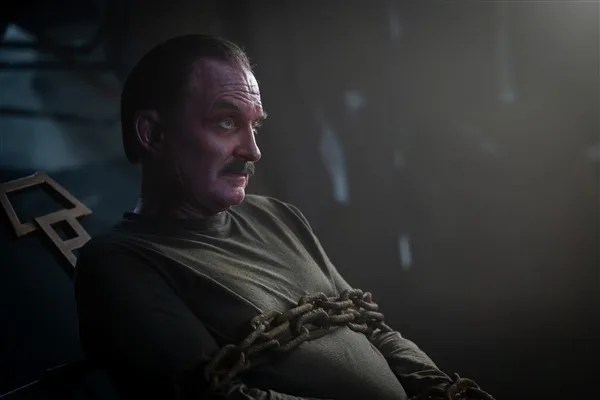
That Noah is a Manhunter is not an entirely unanticipated twist – and given how strongly it ties into the central themes of the series, his entire arc, which is hidden from us until John comes back through the wormhole and Noah kicks the shit out of him, plays out off-screen (imagine what this series could’ve done here with two more episodes!). Everything, from his relationship with Zoe, to however he broke out Sinestro and stashed him on a dying planet poisoned with fear, speaks to Lanterns‘ exploration of nature vs. nurture (which takes its form in “Dirt and Stars” through the concepts of inherited trauma and forces of will, respectively). But so much of that is fed through Sinestro’s lone scene in the finale, where he also explains he’s made a yellow-streaked Lantern for Noah, and clearly plans to use him as a tool to help him kill the rest of the Guardians left from his first failed coup.
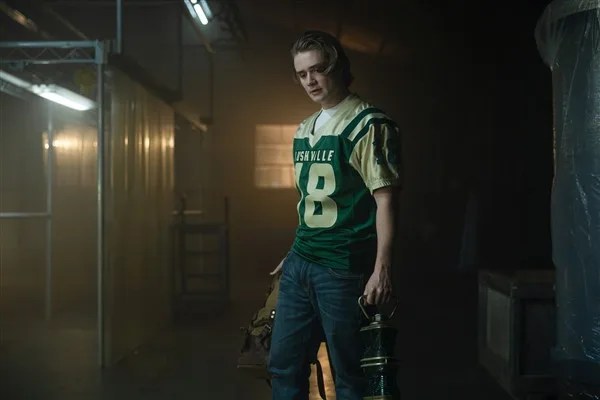
Sinestro’s brief appearance is important in reinforcing the relationship between fear and willpower the series has explored through John, Hal, and Rushville through the entire season; problem is, it also establishes a habit of the season finale to tell us about its important moments and developments, rather than showing us. Part of this was to be expected, of course; anyone hoping that every plot thread, from the presence of Guardians on Earth to the inner workings of the waitress trying to blackmail John, would be resolved has clearly never watched a Lindelof series, where a certain amount of convolution and lack of resolution is a feature of his work, rather than a bug (except when it’s a bug, of course). But for a show that spends most of its time in 2026 simply reflecting and reacting to the actions of a decade earlier, one might hope for a bit more development and depth to characters like Kerry and Noah, especially when most of the finale’s emotional weight falls on their shoulders, rather than those of John and Hal.
With Noah, at least, it feels like Lanterns sticks the landing, despite it being an unnecessarily late reveal; Noah’s scene with John, where he talks about the war he’s waging against his own biological programming, is the second best moment of the finale (John and Hal’s farewell being the obvious highlight), as he asks John to kill him so he doesn’t ever have to worry about falling prey to the schemes and ideas his brain is constantly developing. As John has experienced throughout his life, just because someone told you to be something doesn’t mean you’re going to be exactly that – at the very least, you have to find that out on your own terms, to process the things that you’ve learned and experienced, and allow other people the same grace so you see them as they are, not as you perceive them. This whole season has been about John understanding that about himself; seeing him resolve that by deciding to break the cycle and let Noah live (all while keeping very close tabs on him, giving him a good justification why there should be a second Lantern in Earth’s sector along the way), is a strong thematic moment that only works because of John’s arc through the entire season (and Aaron Pierre’s performance, whose subtle evolutions of character throughout the season have been a treat).
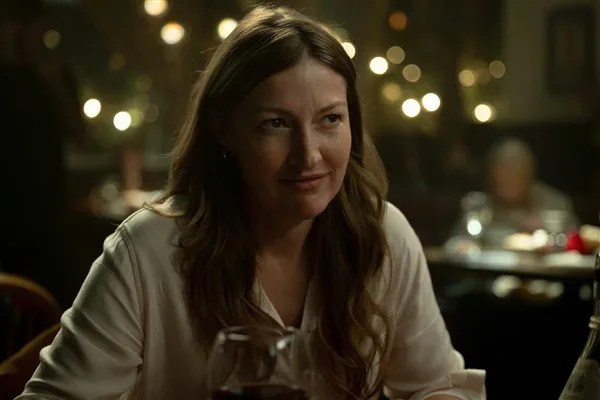
Kerry’s arc, unfortunately, ends up being the least effective, and probably most divisive, part of Lanterns overall, especially when it is revealed that she killed Hal after a very brief disagreement about Noah. While I really like the ambiguity of the moment – did Kerry kill Hal to protect her son because she really, truly wants to protect him, or because Manhunters are just that good at manipulating the families they infect and slowly corrupt? – it is definitely a moment that feels a bit rushed, with a two-minute argument suddenly escalating when Kerry decides she doesn’t want to hear what Hal has to say, and pulling her gun and shooting him without so much as a hesitation. It’s such an out of character moment, it begs for more context the series doesn’t really have time to give; how he dies, while he’s in the middle of saying “Goddamnit, I love you,” feels poetically appropriate, at least. But after Lanterns put Hal through such a ringer, only to bring him home from jail to be shit on and subsequently killed by his over-protective cop girlfriend (which… a cop shooting wildly in a situation that absolutely doesn’t call for it? No way!), the moment gives a certain anti-climactic feel, one that doesn’t help the show’s themes echo louder, instead only pointing out some of the more illogical, underdeveloped choices made around Kerry this season that “Dirt and Stars” is stuck contending with.
For the most part, though, “Dirt and Stars” keeps itself upright when its attention is focused squarely on John, who conjures Guy to pass a message to the Guardians (reminding them to “search their hearts”) before paying off the waitress (goodbye, undeveloped subplot!), and flying out of Rushville to end the series. Before he does so, of course, John pays a visit to the Green Lantern light in Rushville, and has one final moment with Hal-ogram before charging his ring and catalyzing his own, unique oath – one that makes it clear John is embracing both his nature and nurture, in order to inform his own path outside of the Green Lantern Corps, free of its power struggles and conflicts to serve and protect Earth in a different way (as he tells Guy, “You take the stars; have fun. I’ll take the dirt”). In those moments, “Dirt and Stars” is a strong, final statement, one with more than a few parallels to Watchmen‘s series finale – though in this case, Lanterns opts for a much more straightforward, character-forward approach to its plot resolutions and philosophic conclusions.
Where “Dirt and Stars” leaves Lanterns is a more complicated question: as we see in the final moments, John powers his lantern with his own oath, inspired by Hal-ogram’s declaration that willpower is not indifferent and absolute. Should John fail to embrace his fears, he’ll never be anything but a tool of the Guardians and a reflection of others’ values – after all, those in power are known, in realities both real and imagined, to try and restrict others from accessing their own levers of power through the levers of binary thinking. How John represents that, as an “unsanctioned” Lantern who has chosen his own path and vow, using a lantern powered (at least in part) by fear, is an interesting, obvious hook for a potential second season; it’s also a really strong moment that ties back to Noah, informing just why John is willing to leave Hal’s murderer and her existentially dangerous son to live, before heading back home to finally reconcile with the rest of the Stewart family (though anyone hoping we’d see a resolution between him and his family is left with a wordless five-second moment).
All in all, “Dirt and Stars” is a remarkably strong finale thematically – but it falls victim to being too much, too soon, trying to wrap up a bunch of secondary stories in a rush, which leaves some of the most important parts, like Kerry’s rash decision and Noah’s existential conflict (or how John seemingly repairs his family relationships overnight) on the sidelines in order for long, languid scenes of two characters talking lots of plot and character points at each other. But what it shows is incredibly strong, resolving John’s arc of identity in a way that ripples out to the other characters and stories of Lanterns, in a way that gives such life to the concepts of fear and what it can drive humans to – and through John, exploring just how hard it can be to overcome that (and impossible to do so completely on your own). When calibrated with the right moments and characters, “Dirt and Stars” is exactly the beautifully unsatisfying ending I’d hoped for; in other moments (more than I expected in the finale) it only exacerbates some of the show’s glaring pacing issues, and the unfortunately awkward ways it positions itself to fit inside the larger forming DCU.
Other thoughts/observations:
- and that’s a wrap on Lanterns! It’s quite unfortunate the first time we’ll see John Stewart as Green Lantern will not be in Lanterns season two (should it happen), but in next year’s Man of Tomorrow. It’s a bit diminishing, and the finale certainly feels that gravity when Guy appears to talk to John.
- Sinestro is left tied to a chair on this strange planet… does this guy ever have to eat and/or poop?
- Ahhh, high school football on TV shows. Still hits!
- SO MUCH YELLOW in this finale – a hint towards season two, perhaps?
- The moment of Bernadette hugging her son is nice, even though I’m wondering why his brothers are so cool with him completely blowing their business plans out of the water.