
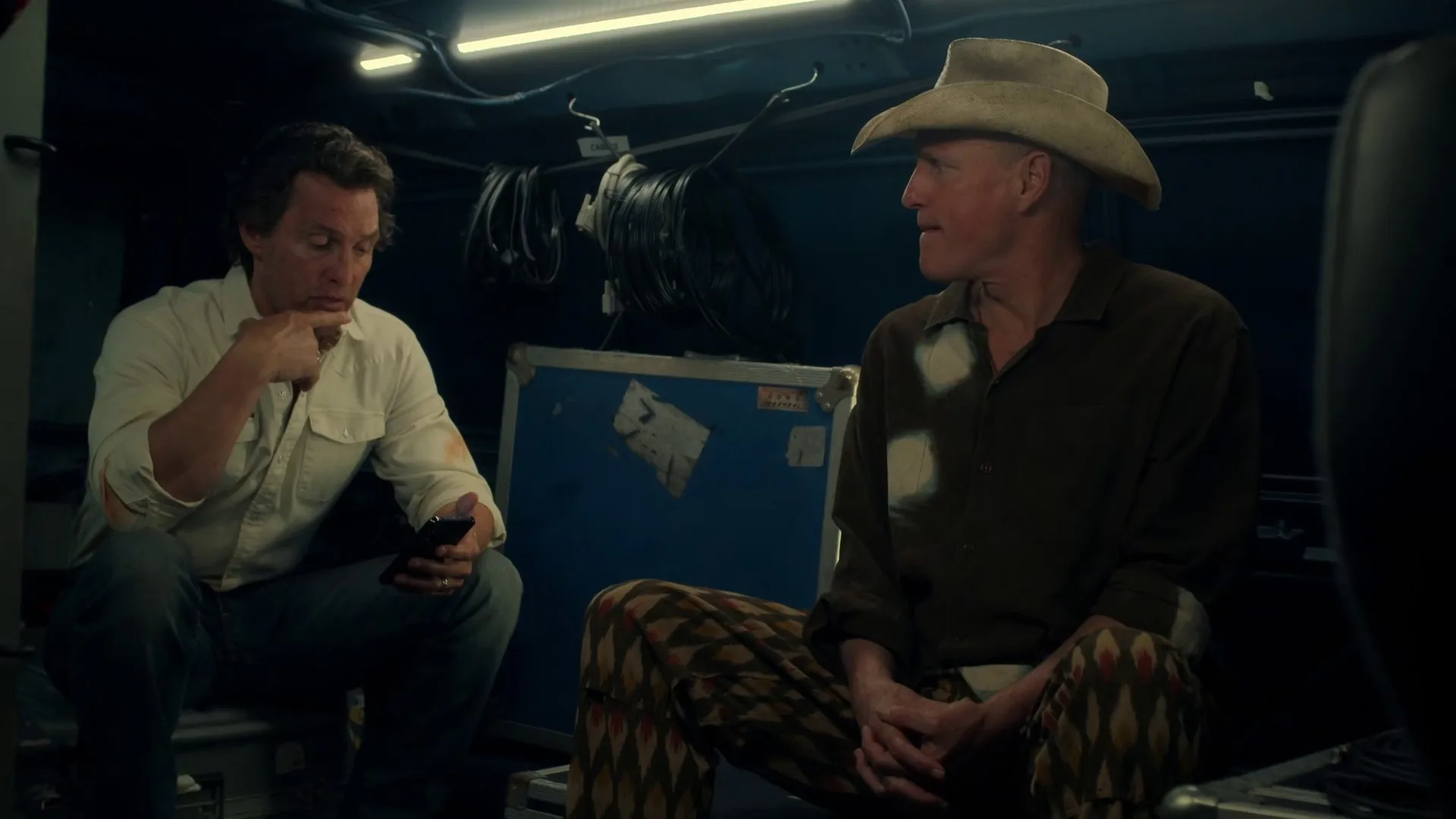
Given Brothers has fourteen listed executive producers, it’s no surprise the first two episodes of Apple TV+’s surrealist dramedy feel like different visions of the series shoved awkwardly together. Knowing the creative circumstances behind the scenes – original showrunner, David West Read, left with two episodes in the season to be replaced with Lee Eisenberg (whose most recent, telling credit is Stick) – it makes even more sense that Brothers feels like three incredibly different series, all of which vary wildly in quality. The result? An unmoored, confusing pair of opening episodes, with an incredibly clear contrast between what works and what doesn’t – and a troubling sign the series is going to lean much heavier on the latter.
The overarching version of Brothers is more straightforward than its meta-premise might seem; Matthew McConaughey and Woody Harrelson play exaggerated versions of themselves, a southern-flavored, dust-covered Odd Couple that trades in the interior and domestic conflicts of a traditional sitcom, and marries them to something a bit weird and more reflective, as the two men go on various journeys of self-discovery and identity (one of which includes them learning they might be brothers, tapping into the real-life gossip that gives the show its title). Of the three versions of the series, this is the one with the most obvious potential, just seeing two buddies with completely different perspectives and approaches to finding truth in life, butting heads and having some good ol’ times along the way; the first episode, “On the Road”, has a few hints of this early on, when the two are reflecting on their lives as fathers and men, and how their lives and perspectives have been shaped by their experiences.

Given the two personalities, Brothers finds some really fun contrasts in the first two episodes, playing McConaughey as the straight man to Harrelson’s goofball persona. There’s clearly a lot of love between the two performers, and offering slightly exaggerated versions of themselves in their early, shared scenes leads to some good hangout comedy, the kind you’d have happily spent $9 on a movie ticket to see on a Friday night – since those movies don’t exist, however, Brothers offers this in fleeting moments of laidback, playful comedy, letting the seasoned banter of two old buddies drive an incredibly light, weightless comedy that may not have a ton to say about life and the world, but has enough personality and panache to fill its time, Woody’s goofiness providing the slapstick foundation to McConaughey’s trademark thoughtful squinting.
However, this is the version of the series we only see for a handful of moments in “On the Road”; “The Hunt”, the second episode, takes the moments in between them and begins to build out more comprehensive narratives for its two leads, independent of each other (assuming they could only get them both on the same set for limited periods of time). The problem is, those two parallel stories bifurcate the show into two completely different, dichotomous forms: on Woody’s side, Brothers is an incredibly silly, yet grounded journey of a goofy man set in his ways coming to question his identity and place in life – but on Matthew’s side, Brothers transforms into a ridiculously weightless vanity project, projecting McConaughey as a philosophic savant-slash-Regular Dude who just so happens to decide to run for Governor, and faces no other personal or professional challenges of any sort (save for Woody’s adult children tagging along on a hunting trip, something that obviously throws the infamously vegan Harrelson in a fit).
The Harrelson version of Brothers is the best one, reducing McConaughey to a gruff, occasional presence who really exists to ground Woody’s wilder adventures of trying to chase down his potential shared lineage with McConaughey. Not only does this story entail more interesting additional performers, but there’s an existential underpinning to the story that is incredibly fun, like Harrelson doing his best The Dude impression as he smokes weed, avoids the coven of women in his home (his wife and daughters; both leads have actors playing fictional versions of their families), and tries to maintain a life of anarchistic pacifism in 2026 Texas. That is not a hard series to sell anyone on – and Harrelson’s perfect for it, his willingness as a performer giving brevity to the comedic and introspective touches alike, especially when contemplating the life he’s built for his daughters or trying to inform the world of his incredibly unique, though consistent, perspective.

With McConaughey, however, Brothers morphs into something very different, something that takes the very obvious dramatic and performative potential, and wastes it with incredibly superficial, navel-gazing stories that feel a bit like a performer/producer/writer’s hand being a little involved in the proceedings. The plots themselves aren’t inherently an issue – he spends the first episode writing a eulogy for his father (during a crazy night of adventures planned by Harrelson), and a second episode weighing his options for running for Texas governor – but how the series navigates these stories is odd, inconsistent, and ultimately, incredibly ineffective.
Now, if Brothers wanted to lean into the more obvious meta-comedy potential of having an actor (who has considered running for political office) running for governor, there is some real potential there, if a more selfless performance was being given; the same goes for the other, more introspective half of the show, which ties in McConaughey’s intense self-reflection and creative process and contrasts that with Harrelson’s, a series that could turn the show into True Detective meets Men of a Certain Age; that sounds like a goddamn fine show to me, but Brothers is so unwilling to challenge the pristine, manicured image of The McConaughey, it can’t let go of that image to do something less vain (at one point, he basically gives half of a Lincoln commercial script as a speech to his son, while acknowledging it’s from a commercial… there’s so much untapped potential in the scene because it’s so self-aware, I wanted to scream).
What it makes Brothers feel like is a buddy meta-comedy that Harrelson is all-in on, willing to play an incredibly exaggerated version of himself to provide comedy and pathos to a series that struggles to convince the audience it should exist; through him, there’s huge potential for this series to unlock in its first season. But the camera always turns back to McConaughey when it wants to get serious or reflective, and the result there is a much shallower, safer series, one that feels dangerously close to someone cosplaying themselves for the simple sake of watching it and professing just how cool and awesome and deep they are (want to know how many copies of Greenlights were sold? This show will absolutely tell you!). Being pulled in all of these incredibly different, dissonant directions only makes the contrast between what works and what very much doesn’t incredibly clear in the first two episodes, rendering Brothers as a series with a fundamental identity crisis it has no interest in recognizing, or resolving.
Other thoughts/observations:
- There’s a scene where McConaughey hits a deer at full speed, the result only being a tiny scratch on the pristine SUV. A fitting metaphor for his plot in the first two episodes, if any.
- Holland Taylor plays Matthew’s pot-smoking mother with tons of stories to tell; her scenes with Woody are easily the highlight of the first two episodes.