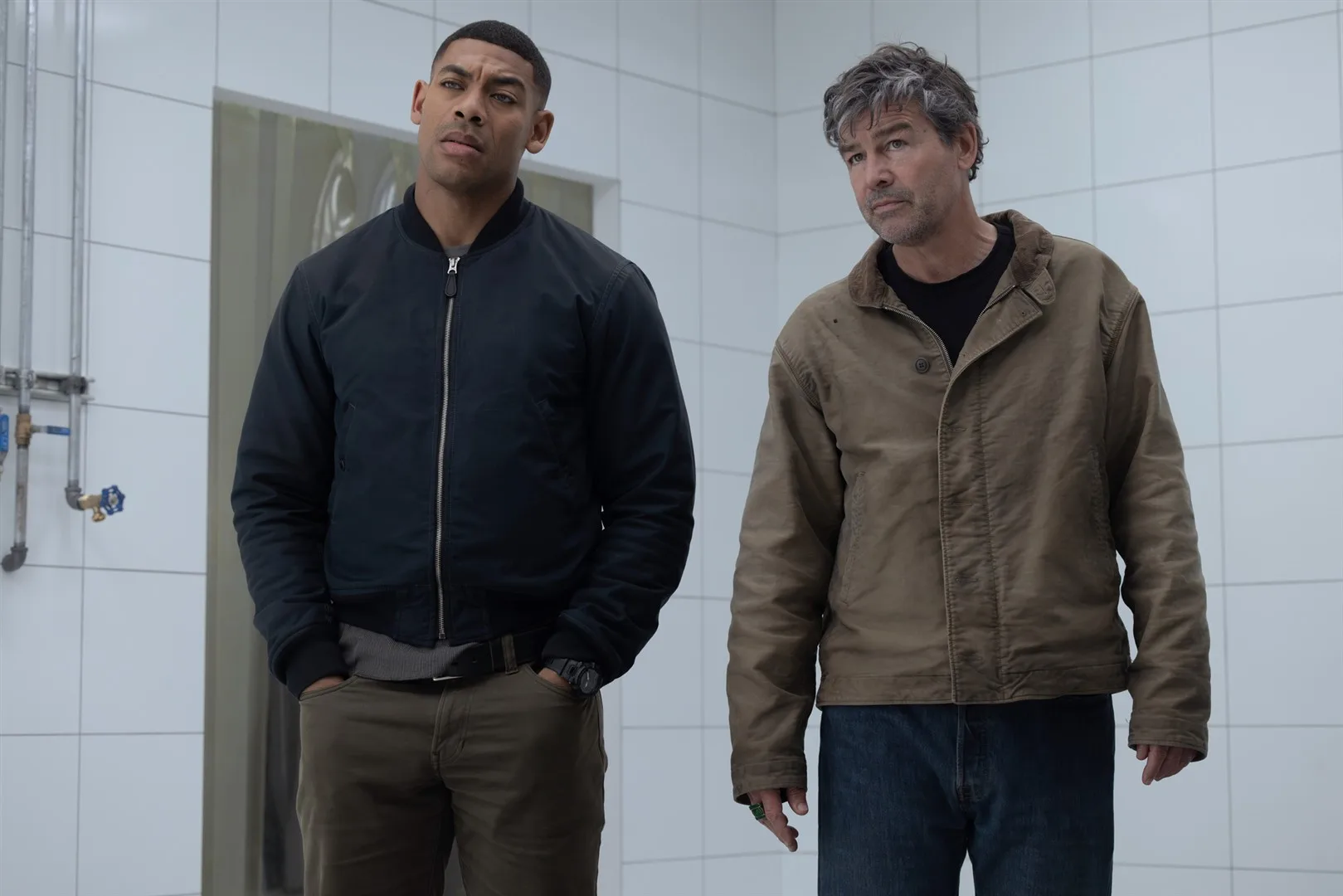
The truth is in the heart in “The Weenie”, a fascinating episode of Lanterns that puts aside some of the overwrought flashbacks of “OutKast” – and more importantly, streamlines some of its dense worldbuilding and sprawling, intergalactic cast of characters into a much more engaging, layered mystery, letting its characters lead the way rather than its worldbuilding or occasional flash of spectacle. A marriage of Lanterns‘ grounded character work and Green Lantern’s insanely vast, complex space mythos, “The Weenie” is a meticulously crafted hour of subjective moments and subtle choices, all of which make for the most propulsive, focused hour of the series yet – and by the end, instills an unsettling, inescapable sense of uncertainty that allows for an impressive breadth of interpretation.
Although the episode mostly centers itself on a single story thread – Hal and John uncovering the identity of the Manhunter in Rushville – there’s a lot more to the concept of “The Weenie”, explained best when John introduces the concept to his reluctant mentor. ‘Weenie’ was a concept coined by Walt Disney for the buildings in Disneyland, derived from Walt watching his dog follow him around whenever he held a treat in his hand. By pointing customers towards large, identifiable visual markers, Disney could define their journey through Disneyland, pushing them unknowingly along a path of his own design. That concept, which John explains as a hypothetical to explain where the Manhunter might be hiding, is the foundation of every interaction in “The Weenie”, making for an insanely layered, thematically rich hour which calls into question the motivations and decisions just about every character makes, as it winds its trail through the mysteries behind Hal Jordan’s ascension to Green Lantern, and how that event would inevitably lead to his death.
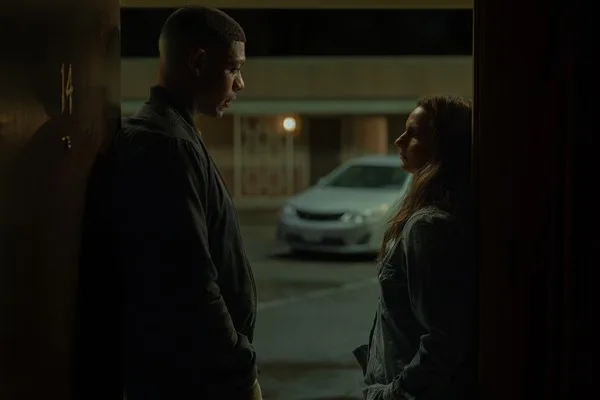
I also like that “The Weenie” embraces a bit of Lindelof weirdness, marrying the cosmic oddities of the Green Lantern world with Lindelof’s penchant for cinematic curiosities, layering the weirdness as it builds out the decades-spanning mystery of Abin Sur’s crash, Sinestro’s coup, and how two easily manipulated humans ended up in the middle of the whole mess. Though this is an episode soaked in the same beige-laden palette I’ve complained about in previous reviews, the narrative texture and depth shown in “The Weenie” is pretty wild. In this episode alone, we get William Macon stripping naked and asking John to paint him The Titanic-style (which he calmly does, in my favorite single moment of the whole hour), space lasers, cows appearing through portals (and then being dissected with said space lasers), guns that shoot dark, Lantern-ring inhibiting mist … and of course, the reveal of Zoe as the manhunter manipulating everything in Rushville, a truth that both unites and divides Hal and John over the course of the episode’s second half.
All throughout, however, “The Weenie” keeps poking at a central idea; in a world full of corruption, misguided self-righteousness, and fear, how does one trust anything, including themselves? John Stewart’s character continues to be the driving force of this central idea, a person whose entire life has been defined by a singular, driving truth of his supposed destiny; what happens when this idea is stripped away? In its best moments, Lanterns examines this idea in the context of the danger of it driving us away from ourselves, towards places of insecurity, anxiety – and of course, fear, a force so strong and corruptible it can twist someone into a completely unrecognizable version of themselves, if allowed to fester and take over. It’s what leads to isolationist mindsets, societal slides into authoritarianism (the most obvious, neat parallel to our own world), and desperation; which may explain why the Macons, who at this point appear to have made a deal with the Manhunter to weaponize fear, are at every lever of power in town (or it is just a town full of Manhunters?).
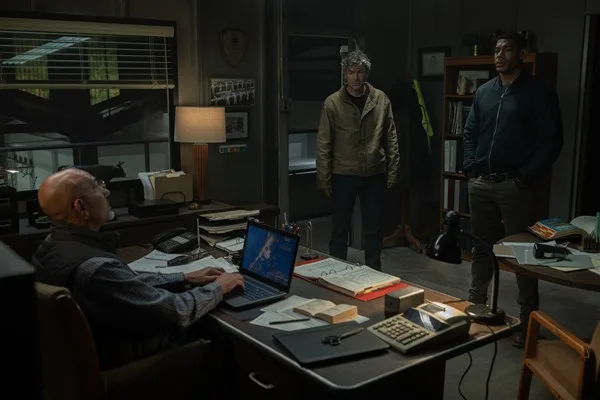
And what does fear affect the most? Trust; trust in self, in others, in institutions… to borrow a phrase from Hal and Sinestro when describing the physical attributes that betray a Manhunter, fear literally crystallizes the heart into something innately inhuman. Grounded in that idea, “The Weenie” is able to build out a rather terrific hour that less represents superhero IP and more an intense grand mystery; that vision is much clearer in this episode than the show’s first three, where the narrative density often overshadowed the thematic ideas it wanted to explore; while the scope of this hour, in reality, is larger than the first three hours combined, how it streamlines that story and its concepts is much more effective and resonant – exactly what one would hope to see as the season hits its halfway point.
While I still worry there’s a bit too much going on for Lanterns to keep itself grounded and focused consistently across its last four episodes (is all this 2016 story the real weenie of Lanterns?), the impressive construction of “The Weenie” around its central themes is an incredibly encouraging sign – and with next week’s preview suggesting a violent acceleration of events in Rushville (assuming this is the Manhunter deadline coming to fruition) it will be a perfect opportunity for Lanterns to expose a bit further both the scope and ambition of its grander story, and to reinforce the underlying character exploration keeping it all (somewhat) grounded. One thing is definitely clear: after a bit of a stumble with “OutKast”, Lanterns is firmly back on track as it heads into the second half of its run.
Other thoughts/observations:
- Sheriff Kane’s presence in Rushville, and how her and the rest of the Macon family interact, is incredibly strange and inconsistent. I’m not quite on board with the notions towards a romantic subplot with her and isolationist Hal feeling like an extra plot point Lanterns doesn’t really need to work.
- Also, Sheriff Kane is from Gotham? Interesting…
- Falling victim to the manipulations of the Guardians (who are being… oddly hands off with the transition they want from Hal to John) and Zoe’s allure; boy, John’s facade of discipline keeps slipping and slipping.
- John: “The ring’s always been mine; that asshole is just keeping it warm.”
- Hal trusting his instincts while a space laser gently rests over the house of John’s family is an interesting moment, especially for someone who talks about losing his family tragically (and noting that John losing someone is another step in the hero’s journey that Hal deep down feels he has skipped along his path of the supposed Chosen One).
- Really hope we get Hal jumping out of at least one more vehicle this season.
- A bit of mythology condensation here for those looking for a little context: The Manhunters were the original Green Lantern Corps, in their own way. Constructed by the Guardians, the Manhunters are androids who went a bit fundamentalist and started wiping out worlds, before the Guardians killed nearly all of them. Realizing their failures in creating things without emotions, the Guardians created the Green Lantern Corps, so things were driven by logic and emotion rather than data. Seems like a relevant note in today’s world, no?
- John not being able to fully maintain a construct when he gets confused or challenged; feels like an important note!
- While I’ve harped on this show’s undersaturated color palette, the ONE element that really works is how it uses green and yellow in concert with each other. As with many colors, there is a subjective line where yellow tips into green and vice versa; the use of really lightly-accented hues (suggesting a mix of yellow and green) behind Hal in the bar, or while observing the drill construct as its pushes forward. Great stuff.