
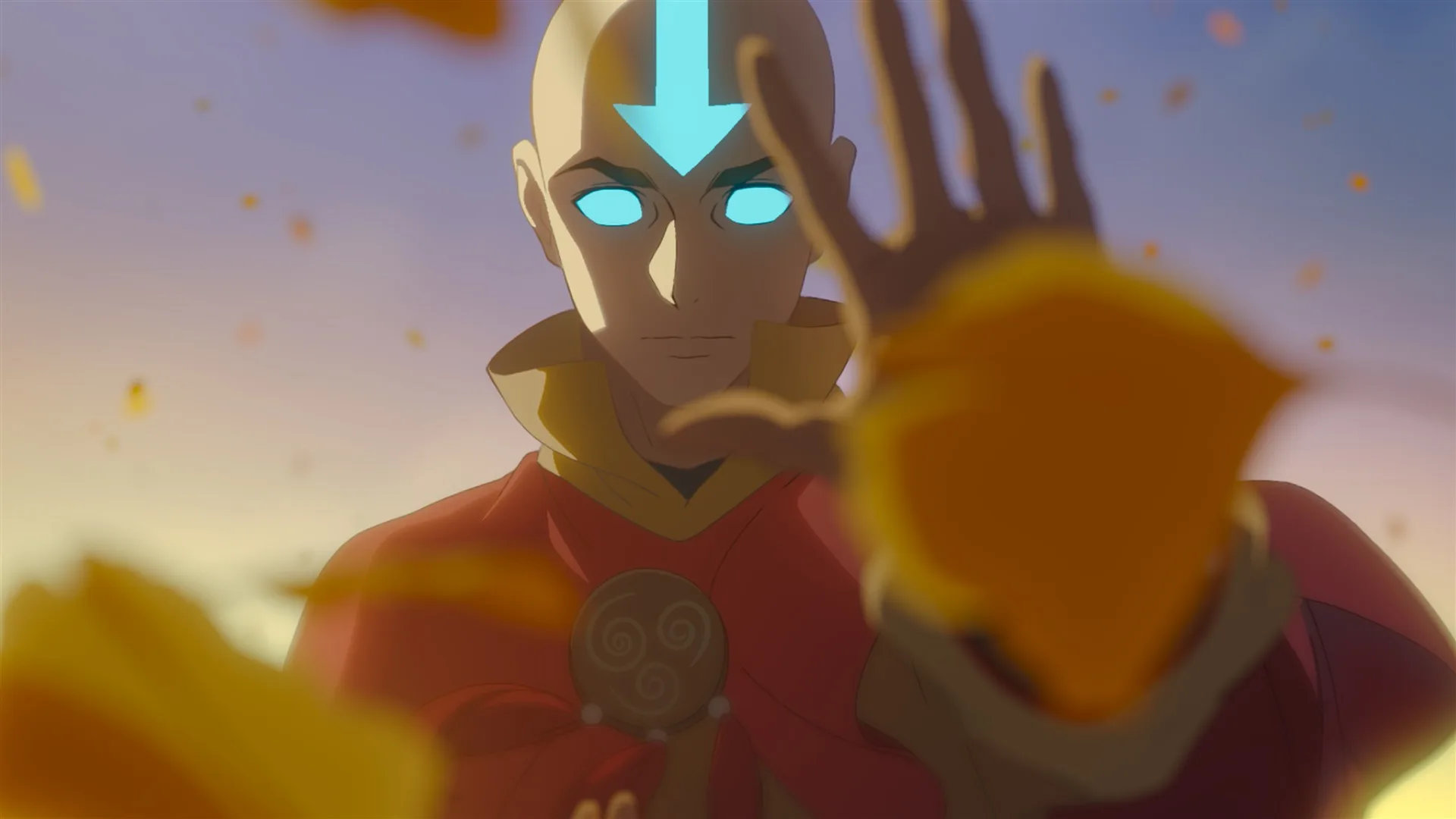
There must be balance in the universe – how else could one explain how openly and consistently Nickelodeon has bungled the Avatar: The Last Airbender franchise over its 20 year existence? After all, only a franchise of such quality storytelling and rich worldbuilding could experience the indifference with which this property is treated by its handlers since the end of the original series in 2008, be it the disastrous, near franchise-killing 2010 live-action film, the increasingly hostile treatment of the ambitious, complex sequel series The Legend of Korra, the underwhelming Netflix adaptation – or now Avatar Aang: The Last Airbender, an Avatar film denied a true cinematic release, despite being the spiritual springboard for the newly-formed Avatar Studios and its expansion of the brand (beginning with this fall’s Avatar: Seven Havens series, which will follow Pavi, Korra’s Avatar successor).
Despite all that, Avatar fandom has persisted for the past two decades, and for good reason: it remains some of the best worldbuilding and storytelling in Western animation, the rare example of a universe that doesn’t lose its intrigue or profundity with each corresponding expansion. Some unassumingly solid graphic novels over the years certainly haven’t hurt, allowing for the exploration of the decades of space between Avatar Aang and Avatar Korra, a period of technological and societal expansion that remains an incredibly rich, utilized piece of mythology. One may have their qualms with The Legend of Korra‘s storytelling across its four seasons (I don’t), but there’s a fascinating amount of potential in Korra‘s premise that Avatar Aang: The Last Airbender appears perfectly positioned to catalyze on – unfortunately, while it does represent a blending of Avatar: The Last Airbender‘s practical stories and The Legend of Korra‘s more spiritual endeavors, the result is a bit mushy, a gorgeous 90-minute film that undoubtedly contains the spirit and heart of the world from which it sprang, but lacks the propulsion and dimensionality of its predecessors.

Avatar Aang: The Last Airbender is certainly not a bad film; fans of the original who enter with measured expectations are certainly not going to walk away dissatisfied with the setting and tone of the story, which follows a mid-20s Aang as he tries to rebuild the Air Nation in the face of conflicts internal and external alike – in the form of the Air Nation’s mysterious past, and the presence of a radical fringe group of non-benders called “the Denied” racing against Team Avatar to discover a powerful ancient relic. If one were to purely look on the surface, Avatar Aang seems a natural progression for the franchise, a mash-up of familiar elements – violent fringe groups and a long-haired bender from the Old Times with a mysterious past form the main plots of the film, both of which have been multiple arcs in both Aang and Korra’s original series of adventures – delivered with a new cinematic flair, something more akin to “Sozin’s Comet” or any of Legend of Korra‘s set pieces, albeit with the typical slow-mo sequences and dynamic camera work standard in modern Western anime presentations.
The result is an undeniably beautiful, exciting, and frustratingly hollow story: after some truly heartwarming reintroductions to Team Avatar (that first shot of Katara as she bends water in front of the moon… my goodness), Avatar Aang: The Last Airbender quickly begins to introduce a bunch of interesting ideas, in the form of the young Republic City, the Avatar gang aging into adulthood and becoming leaders of their communities – and for Aang, rediscovering the complicated legacy of the Air Nation’s quest to remain a pacifist society. All of these threads are precisely what Avatar fans would expect; ideological concepts soaked in the rich, textured history of Avatar‘s world, as the franchise begins to explore the space between a feudalist world of The Last Airbender and the one in the heart of its Industrial Revolution throughout The Legend of Korra.

And for awhile, it’s good to just hang out with the gang; the first act of Avatar Aang: The Last Airbender is a heated blanket of nostalgia, palpable moments of reintroduction that only reinforce the bonds these stories and characters have maintained with their audience over the past twenty years, despite the (waves arms at every non-Korra Avatar project) actively working against it. So when Avatar Aang begins to push into its original narrative in the second act, it is genuinely exciting in the kind of way one might really enjoy as a shared experience on a large screen with a group of like-minded people (but I digress).
Unfortunately, as Avatar Aang: The Last Airbender begins to dig into its true story – the story of Avatar Sonam and her loyal liege, Tagah – the familiar rhythms and constant callbacks begin to work against themselves a bit. Despite the beautiful animation and cinematography, and the near-limitless potential to tell stories about how Team Avatar began to grow up alongside the world around them, Avatar Aang: The Last Airbender keeps itself too familiar and streamlined as its story begins to develop, opting for long action sequences and unnecessary asides into the Spirit Realm (the great gift and curse of late-era Avatar storytelling), all in service of a story that ultimately treats its characters as static entities, never evolving its nostalgic look at Aang, Korra, Toph, and Sokka (the latter of which is barely in this film, despite ostensibly being in nearly every scene), even when its ambitious narrative premise absolutely demands it.
By the time Avatar Aang: The Last Airbender is doing its obligatory cabbage vendor bit in the middle of the third act, the film shifts from a pleasant, if somewhat walled-off experience into something just a little bit slighter and less satisfying – which makes it all the more disappointing, an absolutely serviceable film that suggests a lot of interesting texture and pathos in its evolving world, but ultimately does nothing but play the hits for the last forty five minutes of its running time. The result? A lot of great, dynamic action scenes, littered in between with egregiously-undercooked breadcrumbs of character for its main ensemble. Aang and Katara are, predictably, still a couple in this film – don’t you think the maturing of their relationship might make for some interesting stories, especially as Katara sits on the Republic City council, and her brother trains and leads the next generation of soldiers for the one unified city in the world? Instead, this just points and says “they’re still a couple”, without a second thought.
Strangely, no Avatar character is immune from this idea; even Aang, whose journey to understand the ancient past of the Air Nation ends up being nothing but a flashy lap around the world (both physically and emotionally).

It seems the problem here is obvious; Avatar Aang: The Last Airbender has too many ideas it does nothing with, getting bogged down in dynamic imagery and allusive worldbuilding, at the cost of having coherent characterization, or anything that isn’t flat and deliverable within a few lines of dialogue. “But it’s kid’s TV!” you might exclaim: and that’s the fucking point, is that Avatar Aang: The Last Airbender feels like a synopsis of a much deeper story, one that might’ve been better served in a more familiar, episodic setting. While I appreciate how this film absolutely operates as a proof of concept what a high-budget Avatar animated series or film could look like, it feels like a television season unsatisfyingly condensed and reshaped into a film for a streaming network (all of whom have a similarly bastardized approach to rebooting iconic series; thankfully, Avatar keeps its goofy personality squarely in place, which helps it avoid the dregs of network’s attempts to nakedly appeal to a millennial audience.
Had Avatar Aang: The Last Airbender been an eight, or even six, episode mini-series, stories like Toph’s existential boredom, Uncle Iroh’s unexplained absence, and Katara’s journey as a healer could be incredibly palpable reintroductions to iconic characters – they certainly have the look and sound of the characters down, but they are mostly presented as being displayed behind glass throughout this film, never doing anything but exactly what fans of the series would expect them to do. And it’s there where Avatar Aang is the most disappointing: by all measures, The Last Airbender is a solid, if slightly uninspired film, if nothing a proof of concept that Tim Hedrick (who wrote the film), Michael Dante DiMartino, Bryan Konietzko, and the like that they are still tapped into this universe, still fully capable of capturing the tone and essence of these characters, their interactions, and their changing relationship with the world around them. However, there’s no shaking the feeling that Avatar Aang: The Last Airbender is a bit too safe, a bit too clean, and a bit too uninspired to be a truly memorable addition to the Avatar legend, despite being just good enough to get me really excited for the world’s true return this fall with Avatar: Seven Havens.